 SUNSET:


How to See Saturn at Its Best
The rings were tilted 15° on February 7, 2012, when Robert English in Kentucky took this fine image using a 20-inch Newtonian reflector. Saturn is entering the early evening sky this spring just as Jupiter begins its exit in the west. Here's a quick guide to spotting the ringed planet…
Sky at a Glance, May 2 - 10
Friday, May 2 How soon after sunset can you see the first stars and planets coming out? The brightest this spring is Jupiter. Look for it high in the west, almost two fist-widths at arm's length above or upper left of the Moon this evening. Next brightest is Sirius, sinking…
Sky at a Glance, April 25 - May 3
Some daily sky events for April 26 — May 3, 2014
Sky at a Glance, April 18-26
Friday, April 18 Jupiter shines right under the big Arch of Spring this year. The Arch spans much of the western sky. Pollux and Castor form its top (as seen from mid-northern latitudes). To their lower left is Procyon, one end of the Arch. Farther to their lower right is…

April's Total Eclipse of the Moon
North Americans haven't seen a total eclipse of the Moon since 2011. But this long dry spell breaks late on the night of April 14–15 as the Moon makes a leisurely pass through Earth's deepest shadow.
Sky at a Glance, April 11-19
It's opposition week for Mars! And Jupiter, not to be left out, pairs up with the first-quarter Moon.

Sky at a Glance | March 28th, 2014
Mars is nearing opposition, so are Ceres and Vesta, and the gigantic Winter Hexagon is falling over westward as spring takes hold.
Sky at a Glance | March 21st, 2014
The Moon is waning away into the morning sky, leaving the evening dark for deep-sky observing. And can you catch the double shadow transit on Jupiter?

"Proof of Inflationary Universe" to be Announced
Rumors are flying that the long-sought "smoking gun" for inflation has been found in polarization patterns in the cosmic microwave background. If so, it would confirm the inflation theory for how and why the Big Bang happened.
Sky at a Glance | March 14th, 2014
The week's big event is the asteroid Erigone occulting Regulus, with a campaign to watch for a satellite of the asteroid too. Meanwhile, the waning gibbous Moon will pass Mars and Spica high at dawn.
Asteroid to Black Out Bright Star Regulus
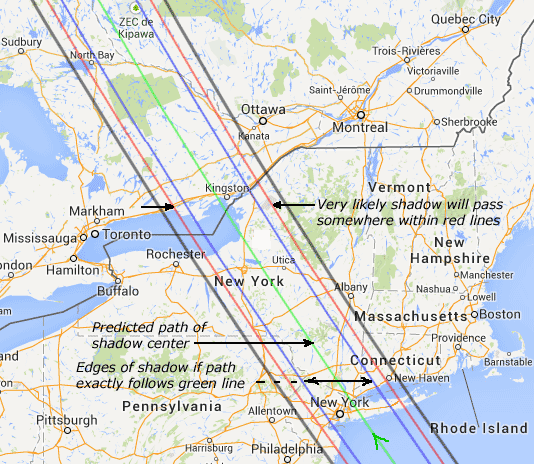
Bright Regulus will dramatically snap out of view behind a faint asteroid for several seconds very late Wednesday night for well-placed viewers — if the sky clears!!

Asteroid to Black Out a Bright Star
Bright Regulus will disappear behind a faint asteroid for several seconds very late next Wednesday night for skywatchers in the New York City region and points north.
Sky at a Glance | March 7th, 2014
As the Moon waxes past first quarter it walks above Orion and below Jupiter. And the Big Dipper has more pointers than you may know.
Sky at a Glance | February 28th, 2014
The waxing crescent Moon returns to the evening sky, and Sirius points the way to Canopus.
Sky at a Glance | February 21st, 2014
Capella and Rigel march in step across the meridian after dusk, and the waning Moon passes more planets at dawn.

Supernova in M82 Passes Its Peak
Supernova 2014J, in the galaxy M82 in Ursa Major, peaked at magnitude 10.5 in early February and is now down to 11.2. Spot it with your telescope above the Big Dipper.
Sky at a Glance | February 14th, 2014
Jupiter shines high in evening, Mars and Saturn follow up late, and Venus blazes at its brightest as the Morning Star at dawn.
Sky at a Glance | January 31st, 2014
The waxing crescent Moon passes Mercury low in evening twilight, and Jupiter blazes high through much of the night.
Sky at a Glance | January 24th, 2014
Mercury after sunset, and Venus before sunrise, have both climbed up into excellent view. After nightfall, Jupiter continues to dominate the moonless evening sky.
Sky at a Glance | January 17th, 2014
The waning Moon is rising later each night, opening an evening window of darkness for observing winter's deep-sky wonders. Then, turn your scope to dazzling Jupiter climbing high.
