 SUNSET:

This Week's Sky at a Glance, Sept. 26 – Oct. 4
Mars shines above Antares in the southwest at dusk this week.
This Week's Sky at a Glance, September 19–27
Arcturus is the bright star fairly high due west at nightfall. It's an orange giant 37 light-years away. Off to its right in the northwest is the Big Dipper, most of whose stars are about 80 light-years away.
This Week's Sky at a Glance, September 12–20
Follow the lineup of Saturn, Mars, and Antares as it changes day by day.
This Week's Sky at a Glance, September 5 – 13
Friday, September 5 Saturn, Mars, Delta (δ) Scorpii, and Antares form an equally-spaced ragged line in the southwest at dusk, as shown at right. Delta Scorpii used to be a bit dimmer than Beta above it. Then in July 2000 it doubled in brightness. It has remained bright, with slow…
This Week's Sky at a Glance, August 22 – 30
Friday, August 22 Altair is the brightest star shining halfway up the southeastern sky after nightfall. Look to its left, by a little more than a fist at arm's length, for the dim but distinctive constellation Delphinus, the Dolphin. He's leaping leftward, just below the Milky Way. In Saturday's dawn,…
This Week's Sky at a Glance, August 15 – 23
Jupiter and Venus join together in the dawn sky, while Vega bejewels the zenith and the Milky Way's center reaches its highest in the south.
This Week's Sky at a Glance, August 8 – 16;
Friday, August 8 Already you may see an occasional Perseid meteor if you keep an eye on the night sky. The shower's peak night is predicted for next Tuesday (August 12–13), but moonlight will compromise the view all week. Look northeast as the stars come out for W-shaped Cassiopeia. It's…

Perseids vs. Moonlight: Which Will Prevail?
This month's usually dependable Perseid meteor shower competes with a nearly full Moon. If you can find a dark viewing location, you might see a bright meteor every few minutes.
This Week's Sky at a Glance, August 1 – 9
Friday, August 1 At dusk this evening, the Moon forms the lower-right end of a very long, curving line of celestial objects. Counting to the Moon's upper left, these are Spica, Mars, and Saturn, as shown here. Today is Lammas Day or Lughnasadh, one of the four traditional "cross-quarter" days…

Equipment: Guides & Recommendations
Power and Aperture in Binoculars
They come in a wide range of apertures. But for astronomy, large aperture is only part of the story. High magnification is just as important when binoculars are used on a night sky that's not absolutely dark.
This Week's Sky at a Glance, July 25 – August 2
Friday, July 25 Mars and Spica shine in the southwest at nightfall. Mars keeps pulling farther away from Spica; they're now 6° apart. Saturn glows pale yellow to their upper left. Arcturus sparkles high to their upper right. Saturday, July 26 New Moon (exact at 6:42 p.m. EDT). Summer is…
This Week's Sky at a Glance, July 18 - 26
Mars at dusk is still slightly less than 3° (two finger widths at arm's length) from Spica in the southwestern sky at the beginning of the week. But they're widening and sinking lower day by day.
This Week's Sky at a Glance, July 11 – 19
Friday, July 11 Mars and Spica form a striking pair in the southwestern sky at dusk! They're now just under 2° apart. On Sunday evening they'll be at their minimum separation, 1.3°. Watch them change day by day. Full Moon tonight and Saturday night (exactly full at 7:25 a.m. Saturday…
This Week's Sky at a Glance, June 27 - July 5
Friday, June 27 This is the time of year when, at the end of dusk, the dim Little Dipper floats straight upward from Polaris (the end of its handle) — like a helium balloon on a string, escaped from some summer evening party. Look due north. (Through light pollution, all…
This Week's Sky at a Glance, June 20 - 28
A calendar of daily sky sights, from Sky & Telescope magazine.
This Week's Sky at a Glance, June 13 - 21
Friday, June 13 Vega is the brightest star shining in the east after dusk. It's currently the top star of the big Summer Triangle. The brightest star to Vega's lower left is Deneb. Look farther to Vega's lower right for Altair. The Summer Triangle will climb higher in early evening…
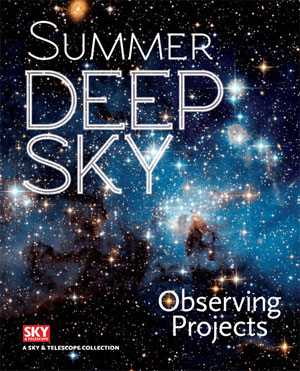
New E-Book: Summer Deep-Sky Observing
Look a little deeper into the summer sky with our new e-book, Summer Deep-Sky Observing. We'll have you happily busy at your telescope all season long!
Sky at a Glance, May 23 - 31
Friday, May 23 Meteor Update Saturday morning: Well that was a dud! Meteor watchers all over North America who went out in the early morning hours for the new predicted Camelopardalid shower saw few if any. People indeed reported observing a handful of meteors from the new radiant, but just…
Sky at a Glance, May 9 - 17
Friday, May 9 The waxing gibbous Moon in the evening sky forms a curving line with Mars to its left, and Spica to the lower left of Mars. Saturday, May 10 Bright Mars shines left of the Moon. Although they look rather close together, Mars is 260 times farther away…

Eta Aquariid Meteors in 2014
Seen each year in early May, the Eta Aquariid meteors are spawned by none other than Halley's Comet. This shower is best seen before dawn's first light.
