 SUNSET:

 3
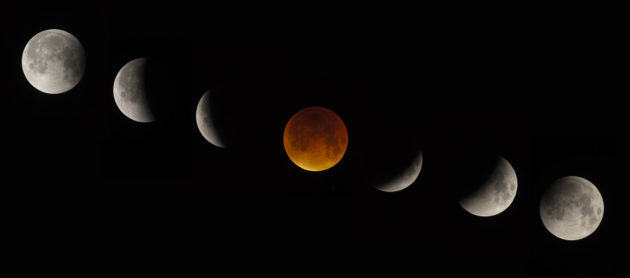
3Although no total solar eclipses occur this year, skywatchers can look forward to two total lunar eclipses — including one that will be visible across North America.
Sean Walker
Up to seven eclipses of the Sun and Moon can take place in one year, though the last time that happened was 1982, and the fewest possible is four. This year, as in 2024, we’ll once again settle for the minimum of four — but the mix will be different!
In 2023 and again in 2024, we witnessed one total and one annular (ring) solar eclipse, both very exciting events! However, this year will be a letdown, solar-wise, as we’ll have to settle for two partial coverups. On the other hand, over the next 12 months we’ll be treated to two total lunar eclipses — the first of these since 2022, some 2½ years ago. You can go directly down to the circumstances of this year’s events if you wish, or continue here to explore some eclipse basics.
Why Do Eclipses Happen?
Jay Anderson
A solar eclipse, such as the one seen coast to coast across the U.S. in 2017 and the follow-up event last year, occurs only at new Moon, when the lunar disk passes directly between us and the Sun and consequently the Moon’s shadow falls somewhere on Earth’s surface.
Conversely, a lunar eclipse takes place during full Moon, when our satellite passes through Earth’s shadow.
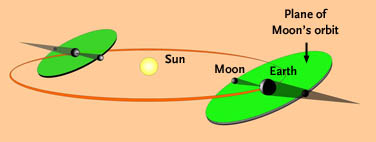
These alignments don’t happen at every new and full Moon because the lunar orbit is tipped about 5° to Earth’s orbital plane — only occasionally do the Sun, Earth, and Moon line up exactly enough for an eclipse to occur. (The technical name for that, by the way, is syzygy.) And, as the diagram above implies, those alignments occur roughly a half year apart. So since the last eclipse of 2024 occurred in early October, the first one in 2025 doesn’t take place until mid-March.
Lunar Eclipses
Three types of lunar eclipse are possible — total, partial, and penumbral — depending on how deeply the full Moon plunges into or near the umbra, our planet’s dark, central shadow.
Johnny Horne
If the Moon goes all the way in, we see a total lunar eclipse that’s preceded and followed by partial phases. That was the case during the widely viewed event in September 2015, which marked the conclusion of a series of four consecutive total lunar eclipses! Such eclipse tetrads are not common — the last one occurred during 2003–04, but the next won’t begin until 2032.
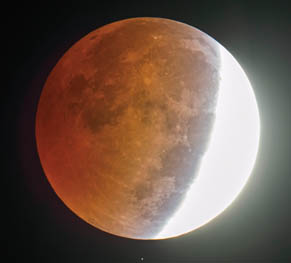
If the Moon ventures just partly into the umbra, as pictured here, only partial phases occur — you’ll see some of the Moon in nearly full sunlight, and some of it steeped in the deep, red-tinged umbral shadow.
And if its disk passes just outside the umbra, the Moon still encounters the weak penumbral shadow cast by Earth. A sharp-eyed observer will notice that one side of the full Moon’s disk looks a little dusky. All four of 2020’s lunar eclipses were of the penumbral variety.
Fortunately, every lunar eclipse is observable anywhere on Earth where the Moon is above the horizon. (But there’s still an element of luck involved — after all, the sky has to be clear!)
Solar Eclipses
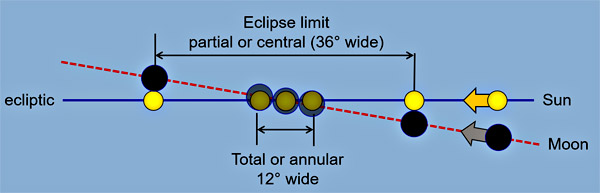
Annular and total solar eclipses require the Moon to cross directly in front of the Sun as seen from Earth — and, as the graphic below shows, such “central” solar eclipses can only occur within a two-week-long interval when the Moon crosses the ecliptic during one of its two nodal crossings each year. However, the geometric window for partial solar eclipses is wider, roughly five weeks long.
Jay Anderson
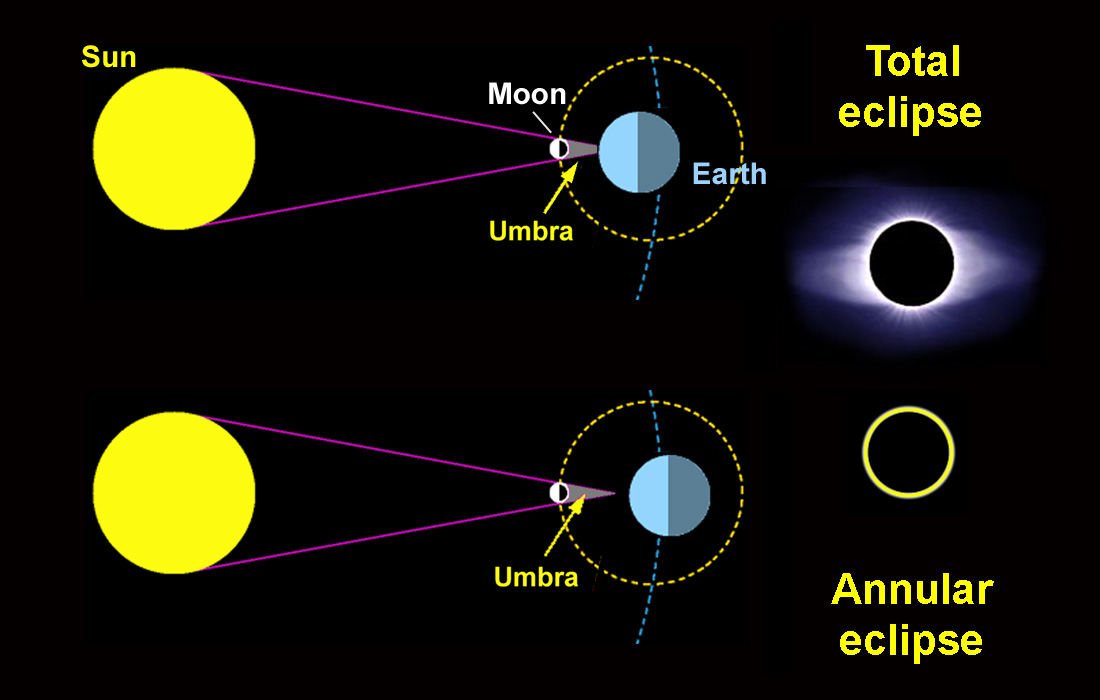
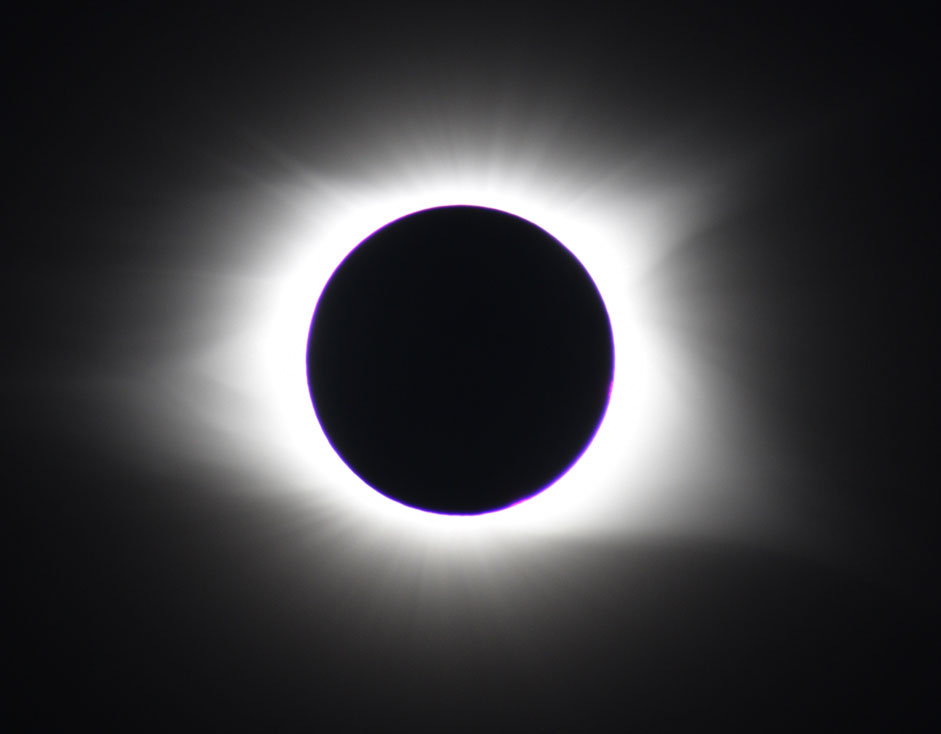
If the Moon completely hides the Sun, the eclipse is considered total. With its brilliant disk completely covered, the Sun’s ghostly white outer atmosphere, called the corona, is momentarily revealed for durations from seconds to several minutes.
Occasionally the Moon passes directly in front of the Sun but doesn’t completely cover it. When that occurs, it’s usually because the Moon is farther from Earth than its average distance. (The Moon’s orbit isn’t perfectly circular; its eccentricity is about 5%.) This geometric circumstance is known as an annular eclipse, so-called because you can see a ring, or annulus, of sunlight surrounding the lunar disk. Annular eclipses of the Sun occur about as often as the total ones do.
Sky & Telescope
Unlike total lunar eclipses, which can be viewed from roughly half of Earth’s surface, total and annular solar eclipses tightly restrict where you can see them because the Moon casts a much smaller umbral shadow than Earth does — and you need to be within that shadow to view the event. A completely eclipsed Sun can be viewed only from a narrow track or path on Earth’s surface that’s typically just 100 miles (160 km) wide. Outside of that path, about half of the daylit hemisphere of Earth is able to watch a partial solar eclipse as the Moon obscures a portion of the Sun.
Sky & Telescope / J. Kelly Beatty
Getting to the path of a total or annular eclipse often involves long-distance travel. In November 2013, for example, planeloads of eclipse-chasers thronged to a remote corner of northern Kenya to watch just 11 seconds of totality. On December 4, 2021, a small armada of 15 cruise ships converged on the eclipse path in a remote stretch of the Southern Ocean hundreds of miles northeast of the Antarctic Peninsula. Yet only one of those ships succeeded in dodging the early morning clouds and glimpsing totality. What dedication!
Every location on Earth experiences a total solar eclipse every 375 years on average, with the Northern Hemisphere enjoying a slight statistical advantage right now. (To explore the worldwide distribution of total solar eclipses more closely, check out Sky & Telescope’s beautiful eclipse globe.)
The Four Eclipses of 2025
Below are brief descriptions of the four eclipses that take place in 2024. You’ll find more details in Sky & Telescope magazine or on this website as the date of each draws near. Times are given in Universal Time (UT) except as noted. Adjust these to get those for your time zone: for example, PST = UT – 8, and EST = UT – 5. (But be sure to allow for daylight or “summer” time, when PDT = UT – 7, EDT = UT – 4, and so on.)
| Date | Type | Maximum | Visibility |
| March 14 | Total lunar eclipse | 6:59 UT | North and South America, Europe, Africa |
| March 29 | Partial solar eclipse | 10:47 UT | NE North America, Greenland, Europe |
| September 7 | Total lunar eclipse | 18:12 UT | Europe, Africa, Asia, Australia, New Zealand |
| September 21 | Partial solar eclipse | 19:43 UT | Antarctica, New Zealand |
March 14: Total Lunar Eclipse
The year’s first eclipse is a winner! Not only is this the first total lunar eclipse visible anywhere since 2022, it’ll be timed perfectly for North (and South) America! Weather permitting, everyone in the contiguous U.S., Mexico, and Canada will be able to watch the event, from the first umbral nibble at 5:09 UT (which is late evening on the 13th for those on the West Coast) to the last touch of the umbra at 8:48 UT. This map tells the story:

Leah Tiscione / Sky & Telescope
During this event, the Moon crosses the ecliptic near the descending node in its orbit, which puts it near the Leo-Virgo border. You’ll note in the plot below that it’s not passing directly across the umbra but rather through the northern half. So keep an eye out for the limb closest to the edge of the umbra. It should look a little brighter than the rest of the disk during totality, and this bright edge will roll from the (celestial) northwest limb to the eastern limb.

Leah Tiscione / Sky & Telescope
(Remember: Sky & Telescope creates these lunar-eclipse paths with celestial north at the top. So, for example, that direction is skewed toward the left in your sky near moonrise and toward right near moonset.)
All told, the partial phases will last more than 3½ hours, but you can start watching for slight shading once the disk is about halfway through the penumbra. Totality lasts 66 minutes. If you’ve ever dreamed of shooting a time-lapse sequence of a total lunar eclipse, here’s your chance!
Also, the Moon makes a passage through Earth’s umbra that’s well offset from its center. So will this be an especially dark eclipse? Probably not — and even at mid-eclipse you can expect some brightening along the Moon’s northern limb.
How dark is dark? Lunar-eclipse observers use a five-step estimate called the Danjon scale for such estimates. You can also perform a bit of “citizen science” by using a telescope to study the progression of the umbra’s abrupt edge across the lunar disk and to record the times when it covers or uncovers particular craters. This article explains both the Danjon scale and crater timings.
March 29: Partial Solar Eclipse
Two weeks after March 14th’s lunar eclipse, after the Moon has swung around to the opposite side of its orbit and becomes new, it crosses mostly in front of the Sun to create a deep partial solar eclipse. This will be timed well for Europe and the northwest corner of Africa, for which it’s primarily a morning event. Eclipse expert Fred Espenak has provided local circumstances for hundreds of cities as well as an interactive map that provides them for any location.

Leah Tiscione / Sky & Telescope
However, geographically these locations are well removed from the point of greatest eclipse; even from the northwestern tip of Scotland, the Moon will cover no more than half of the solar disk. To witness the maximum, you’ll need to trek to a remote area of Québec on the northeastern shore of Hudson Bay, from which, at sunrise, you’ll see 93% of the Sun’s disk covered as it rises.
Although the globe above shows that North America is largely left out for this event, a closer look reveals that sunrise from the Maine coast and the Canadian Maritimes could be very exciting.
The farther north you go, the deep the eclipse and the more likely you’ll see two brilliant “horns” poking over the horizon as the Sun comes into view. Just remember that late March in this region is still cold and inclined to be snowy.
September 7: Total Lunar Eclipse
The year’s second lunar coverup strongly favors the Eastern Hemisphere — it’s going to be unobservable from the Americas. On September 7th the Moon is near the ascending node of its orbit, in Aquarius. The path carries the lunar disk through the lower half of the umbra, with totality lasting 82 minutes centered on 18:12 UT. The partial phases begin at 16:27UT and end at 19:57 UT.

Leah Tiscione / Sky & Telescope
This timing makes the eclipse an evening event for Europe and Africa, but a sight observable after midnight and before dawn on September 8th for most of Asia and Australia.
September 21: Partial Solar Eclipse
In al my years of eclipse-chasing, I’ve often wondered where a solar eclipse would need to occur to have the fewest possible witnesses. September 21st’s event would rank high on that list. As the globe here shows, the area of visibility is almost entirely over the South Pacific and Southern Oceans. It’ll be visible from a good chunk of Antarctica — but too early in the summer season to have many cruise ships in the area. “Greatest eclipse” (80% obscuration) takes place 19:42 UT, and to see that you’ll need to be bobbing in the Southern Ocean, off the coast of Antarctica, at 61° south, 153° east.

Leah Tiscione / Sky & Telescope
The big winner for this event is New Zealand. From Auckland, the Sun rises (on September 22nd) with the eclipse under way en route to a peak obscuration of 60%. From Stewart Island at the country’s southern end, up to 73% of the solar disk will be covered.
Looking Ahead to 2026
Next year the recent minimalist eclipse trend continues, with just four in the offing once again. But those four offer plenty to satisfy even the pickiest of eclipse-chasers. There’ll be an annular solar eclipse on February 17th (observable only from and near Antarctica), a total lunar eclipse March 3rd (a good one for the U.S.), a total solar eclipse on August 12th (head to Spain!), and a not-quite-total lunar eclipse early on August 28th that will be widely seen in the U.S. on the previous evening.
| Sky & Telescope offers great opportunities to view the solar eclipses in 2025 and beyond. Our trek to Greenland for March’s deep partial solar eclipse is sold out, but there’s still availability for the total solar eclipses in 2026 and 2027. Click here to check out all S&T’s upcoming tours! |
About J. Kelly Beatty
J. Kelly Beatty, S&T Senior Editor, joined the staff of Sky Publishing in 1974 and specializes in planetary science and space exploration. Learn more about him here.


Comments
AB
January 10, 2025 at 12:02 am
The "interactive map" link for the March 29 eclipse does not work. It comes up with 2 L's in "html", so it works if one deletes that from the error page -- but not everyone will notice that.
You must be logged in to post a comment.
AB
January 10, 2025 at 12:04 am
Oops, and then when you delete the extra 'L' it goes to a page for the April 8/24 eclipse.
You must be logged in to post a comment.
Monica Young
January 10, 2025 at 1:06 pm
Thank you for letting us know - this link has now been fixed and now directs the reader directly to the map for the March 29th partial eclipse.
You must be logged in to post a comment.
You must be logged in to post a comment.