 SUNSET:

Sky at a Glance | August 28th, 2009
Jupiter shows off during the evening this week, all four of its big moons briefly hide, and two planets at dawn have separate encounters with star clusters.

Sky at a Glance | August 21st, 2009
Jupiter, just past opposition, shows its Red Spot, a double shadow transit, and, briefly, just one moon. Mars pairs up with a star cluster. And Vega crosses the zenith, signaling that Milky-Way-rich Sagittarius stands highest due south.
Sky at a Glance | August 14th, 2009
Saturn and Mercury pass each other very low in the sunset. Jupiter is at opposition. And the Moon meets up with Venus at dawn.
Sky at a Glance | July 31st, 2009
Mercury meets Regulus. Saturn loses its rings. Vega crosses the zenith. And Jupiter is coming into good view earlier every night.
Sky at a Glance | July 24th, 2009
Saturn's rings are disappearing most interestingly, just as Saturn itself slides down into the sunset. Jupiter with its new impact scar is up in fine telescopic view by midnight.
Sky at a Glance | July 17th, 2009
One day after the anniversary of the Apollo 11 landing on the Moon, the Moon eclipses the Sun for parts of the Far East.
Sky at a Glance | July 10th, 2009
On this Apollo 11 week, the waning Moon passes Jupiter and Neptune, then Mars and Venus, in the early morning hours.
Sky at a Glance | July 3rd, 2009
Earth is farthest from the Sun, the Moon is full, and the Venus-and-Mars pair is widening at dawn.
Sky at a Glance | June 26th, 2009
The waxing Moon passes Regulus and Saturn, then Spica and Antares this week. And the Little Dipper is in its toy-balloon position.
Sky at a Glance | June 19th, 2009
Saturn's rings are darkening, Venus is brightening, Jupiter is turning turbulent. . . and what is Delta Scorpii up to?
Sky at a Glance | June 12th, 2009
Catch Saturn at dusk. Cruise Canes Venatici after dark. And follow the busy activities at dawn on Midsummer Morning.
Sky at a Glance | June 5th, 2009
Capella sinks in the west, the Summer Triangle climbs in the east, the full Moon occults Antares, and late in the week, the eerie waning gibbous Moon shines with Jupiter.
Sky at a Glance | May 29th, 2009
The Moon again poses with Regulus and then Saturn. Saturn's rings continue to dim. And Jupiter and Venus are both rising higher in the sky before dawn.
Sky at a Glance | May 15th, 2009
You know it's getting close to summer; Arcturus and Vega are well up at dusk. Catch Saturn right after dusk before it starts getting low — and in a telescope, see how dim its rings have become!
Sky at a Glance | May 8th, 2009
As wintry Betelgeuse disappears in to the sunset in May, summery Antares comes up in the southeast in late evening.
Sky at a Glance | May 1st, 2009
Mercury stays with the Pleiades in the western twilight. The Moon passes Regulus and Saturn during evening this week, and Venus and Jupiter shine at dawn.
Sky at a Glance | April 24th, 2009
Mercury meets up with the Pleiades in the western twilight, and the Moon joins the party on Sunday the 26th. The two brightest planets, Venus and Jupiter, shine low in the dawn.
Sky at a Glance | April 10th, 2009
Saturn shines high in the evening, but more planetary action happens at dawn. The waning Moon passes Jupiter before sunrise and then, a few days later, occults Venus for parts of North America.
Sky at a Glance | April 10th, 2009
Saturn displays its rings for evening telescope users. Low in the dawn, Venus points the way to challenging little Mars. And there's an outbreak on Jupiter.
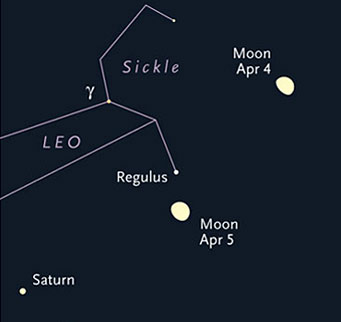
Sky at a Glance | April 3rd, 2009
The Moon and Saturn pose in the evening sky. At dawn the crescent Venus is visible very low, while Jupiter shines higher in easier view.
