 SUNSET:

 0
0Much of the sage advice of the past has become obsolete following recent changes in the equipment marketplace.

Alan Dyer
The advantages of binoculars over telescopes are many — especially for night-sky novices. Not only are binoculars affordable, but they’re also easy to use thanks to the wide fields of view they offer and their right-side-up image orientation. Everyone starting out in astronomy should have a good pair of binoculars.
If you’re a veteran observer, you’re already aware of these advantages, but you might be using the same well-worn pair you’ve owned for decades. Every aspect of binocular performance — field of view, eye relief, optical coatings, and build quality — has improved in recent years. It just might be time to consider an upgrade!
Here’s my up-to-date guide to buying the best binoculars for astronomy.
Aperture and Power
Even otherwise commendable review websites often assume that the best stargazing binoculars must have at least 70-mm (2.8 inches) lenses and high magnification. Not so! While big, high-powered binoculars do have their place, they lack many of the advantages I just listed. My advice is to avoid the temptation of magnifications greater than 12×. Simply put, more power doesn’t always equal a better view.
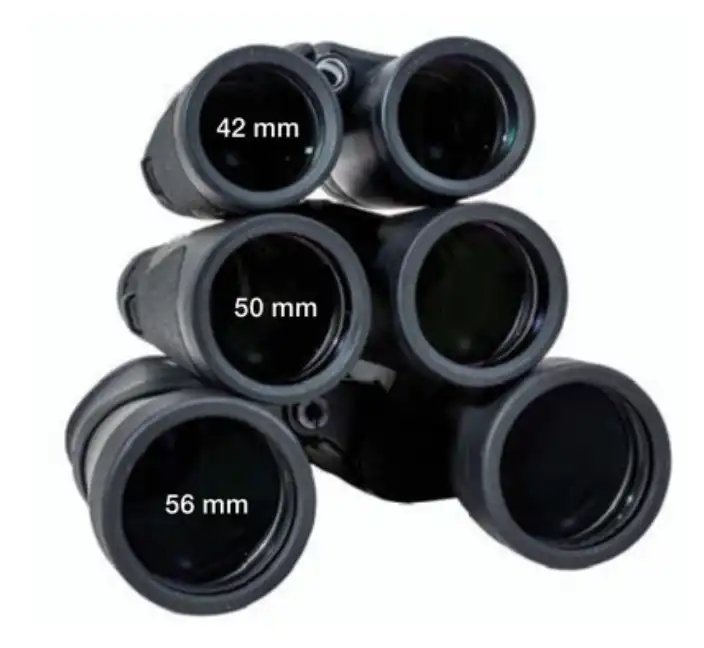
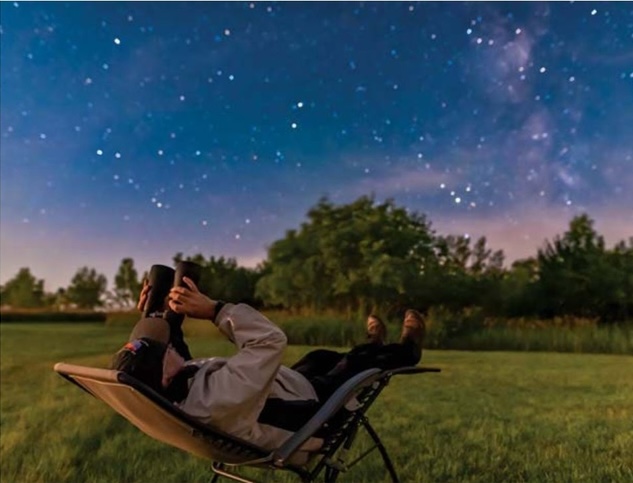
Out of all the combinations of power and aperture on offer, binoculars with lenses 42 mm to 50 mm in diameter and magnifications from 7× to 10× yield the best combination of light-gathering and resolution without sacrificing the wide fields of view and hand-held convenience that make binoculars such a joy to use. These are the models I reach for most often for a night of stargazing.
While 42-mm binoculars are ideal for all-purpose use, when shopping for binoculars primarily for astronomy, consider a 50-mm model. The extra aperture will gather about 40% more light, allowing you to see objects nearly 1⁄2 magnitude fainter.
Alan Dyer
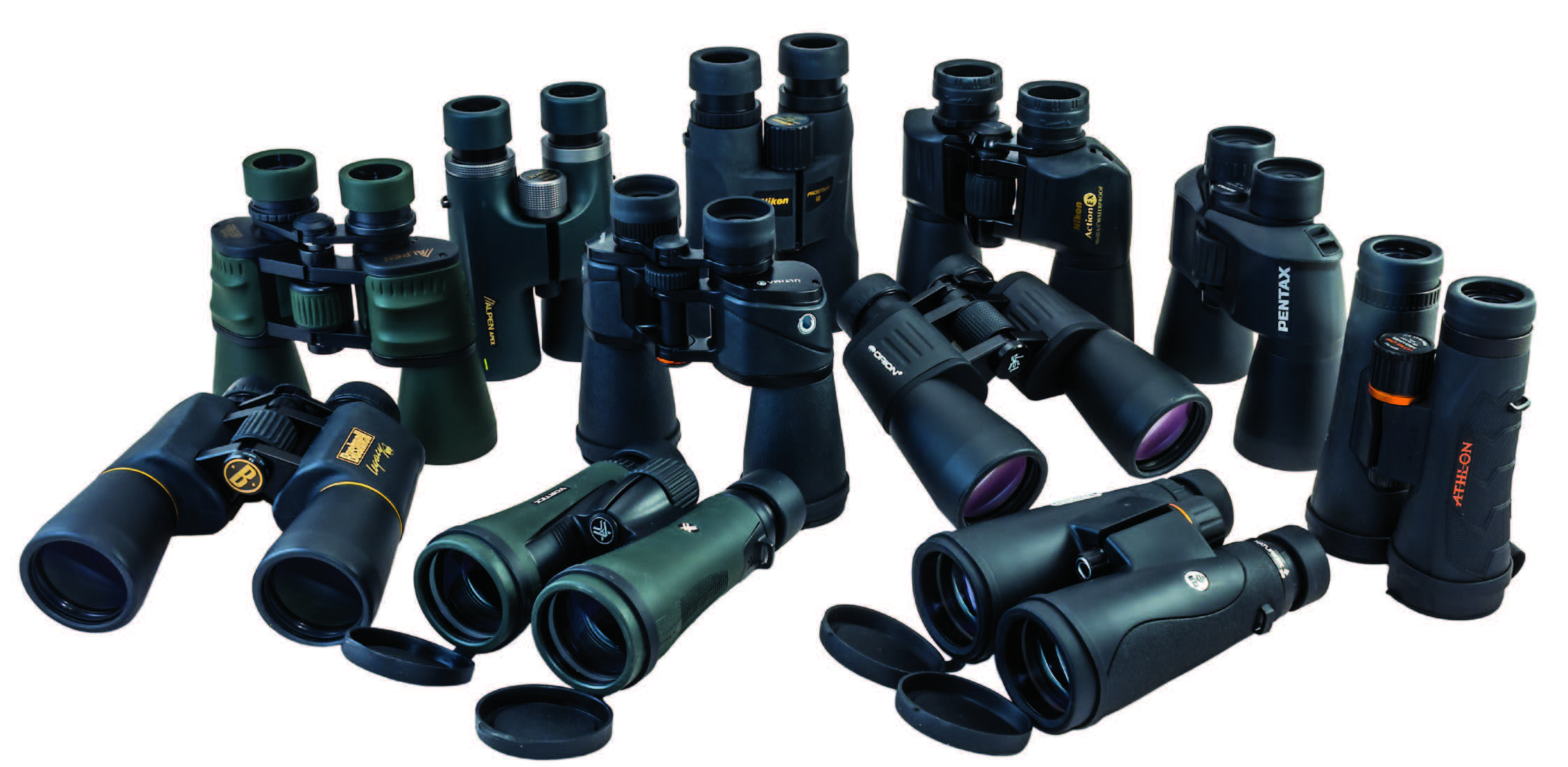
Most 50-mm binoculars tip the scales at 800 to 1,000 grams (28 to 35 ounces), which makes them about 100 to 300 grams heavier than 42-mm binoculars. However, unlike daytime users such as birders, we astronomers don’t carry our binoculars around for hours at a time, so a bit more weight is a tolerable trade-off for brighter images. Even so, any model weighing much more than 1,000 grams can be difficult to hold up to the sky for more than a quick glance. In general, binoculars with 50-mm lenses provide a good balance of aperture versus weight. And that’s why I’ll focus my attention on 50-mm binoculars in this survey.
So what about magnification? Among binocular astronomy enthusiasts, the hot debate used to be between choosing 7×50s or 10×50s. The 10× camp argued that the higher magnification resolved detail better, while the 7× camp countered that the extra magnification made 10× binoculars harder to hold steady.
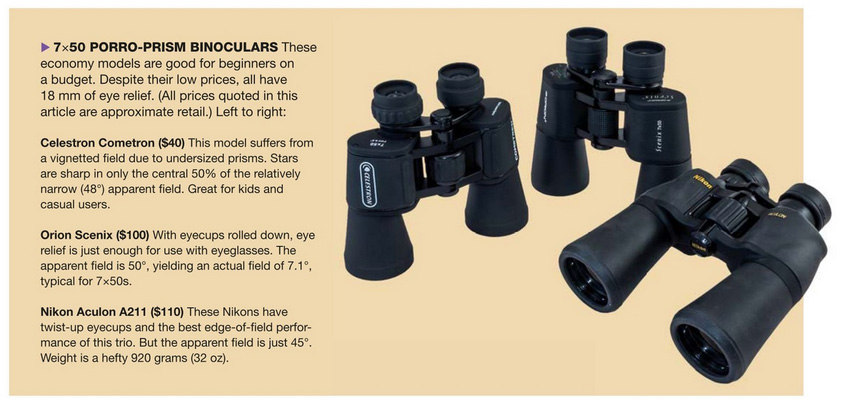
Today the debate is effectively over. Buy the 10×50s. The reason is simple — there just aren’t many 7×50s being made anymore. With the exception of heavy and costly binoculars for marine use (from companies such as Fujinon and Steiner), the few 7×50s left are budget models ($100 and less) with narrow fields of view and performance that’s inferior to most 10×50s.
If you have shaky hands and prefer lower magnification, consider 8×42 roof-prism binoculars of the best quality you can afford. (I’ll say more about the two main prism types later.) I’ve tested several models and can recommend Celestron’s Nature DX ED ($170), the Vortex Crossfire HD ($190), Zeiss Terra ED ($450), and the Hawke Frontier ED X ($550).
Alan Dyer
Exit Pupils and Eye Relief
For a long time, observers were advised that for the brightest images, the light cone exiting the each eyepiece — called the exit pupil — should have the same diameter as the dark-adapted pupils of your eyes, which is around 7 mm for younger people.
To calculate the exit pupil, simply divide the aperture of the main lenses by the magnification. For example, 7×50 binos have 7.1-mm (50 ÷ 7) exit pupils, thus the long-standing preference by mariners and stargazers for 7×50s.
The trouble with this advice is that, after age 30, the pupils of our eyes typically lose a millimeter every 20 years or so. For us older observers, our pupils effectively stop down the binocular’s aperture. So, while 7×50s might, in theory, provide brighter images, in practice 10×50s with 5-mm exit pupils will offer images just as bright for older eyes. Once again, 10×50s prove the better choice.
Observers who must wear eyeglasses to correct for astigmatism, or who simply prefer to keep their glasses on while viewing, will benefit from binoculars with long eye relief. This is the distance from the top of the eyepiece to where you position your eyes. For eyeglass wearers, you typically want at least 15 mm or more eye relief.
Not long ago we had to pay a premium for so-called “high-eyepoint” models. Fortunately, that’s not the case today. Of the more than a dozen binoculars I tested for this survey, almost all had excellent eye relief. Even if you don’t wear glasses, long eye relief makes binoculars more comfortable to look through.
Alan Dyer
Prism Considerations
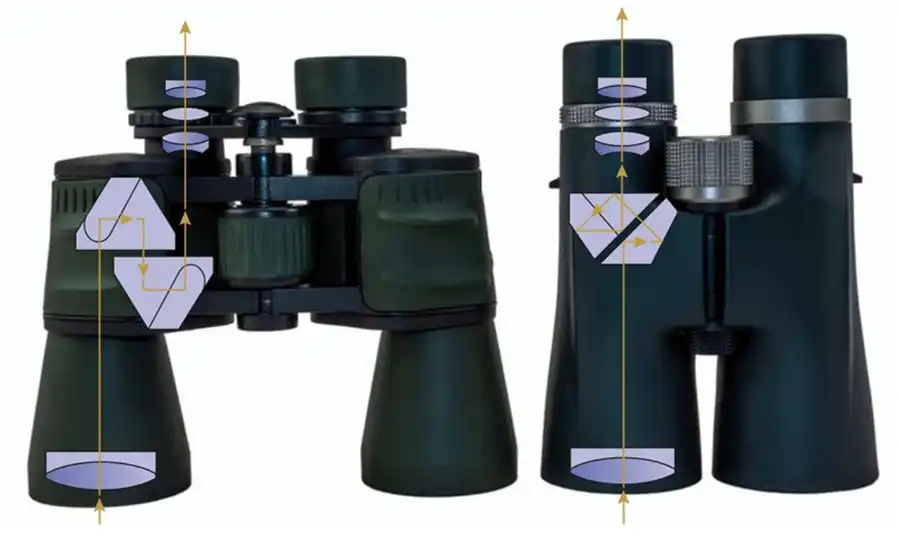
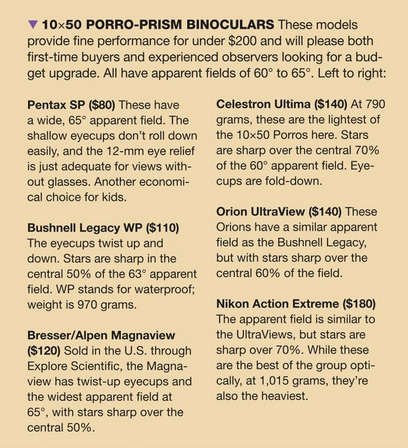
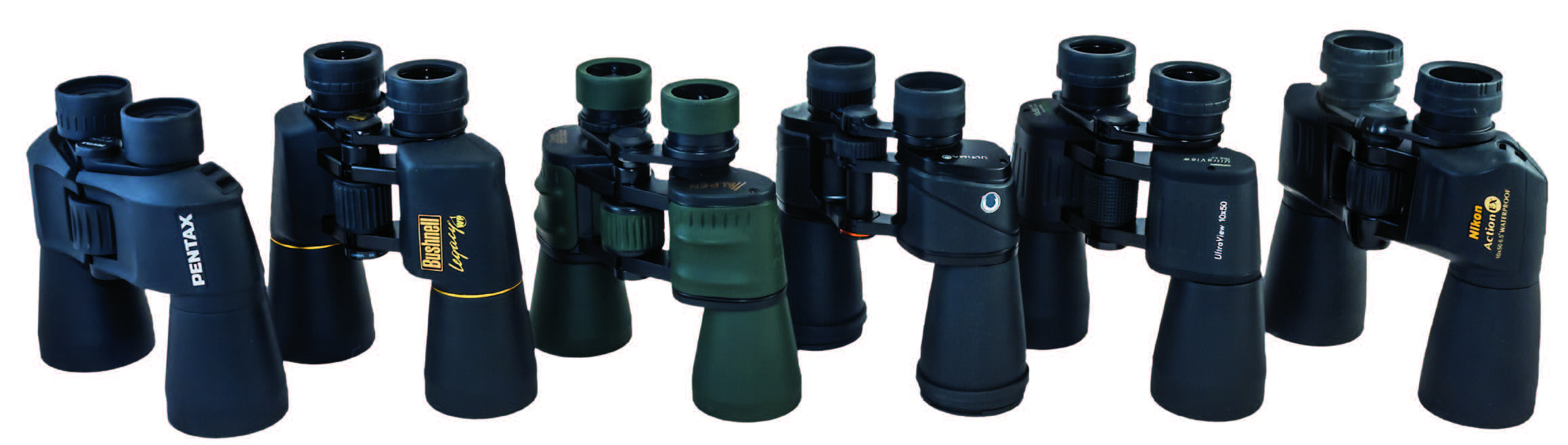
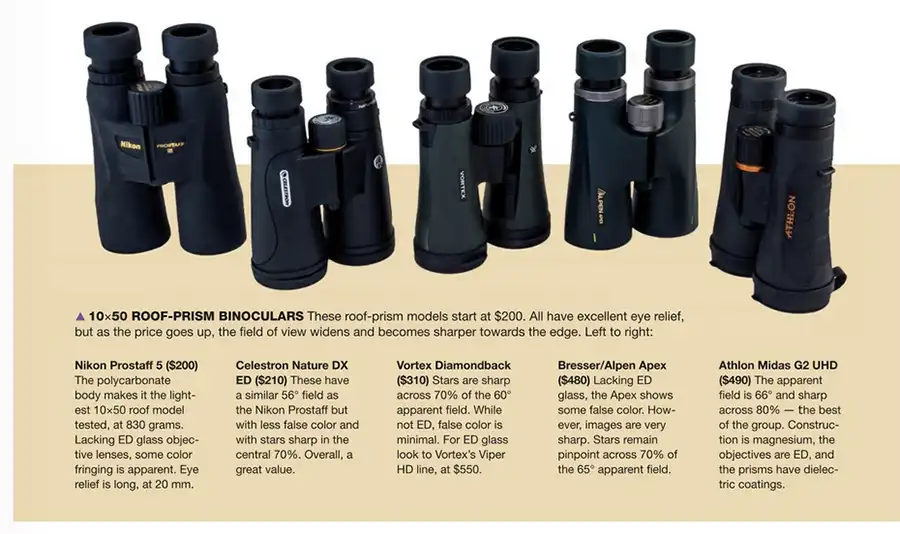
With the exception of a few pricey marine binoculars, models with Porro prisms are now restricted to entry-level instruments selling for under $200. Roof-prism binoculars start at $200 and go up from there. Because of their compact size, this design is now the most popular among demanding birders and hunters. For this reason, roof-prism binoculars generally get the better optics. In the best models I tested, stars snapped to perfect pinpoints, without the spikiness often present in low-cost Porros.
However, roof-prisms have a couple of potential strikes against them compared with Porro prisms. The majority of roof-prism binoculars use the Schmidt-Pechan design of prisms, which have one reflective surface that introduces some minor light loss. However, better models have dielectric coatings on the reflective surfaces to minimize this dimming. Roof-prisms are also subject to a reduction in image contrast arising from the light beams shifting out of phase as they pass through the prism assembly. For this reason, all but the lowest-cost roof prism binoculars now have phase-correcting coatings.
In side-by-side tests, I’ve seen no noticeable difference in brightness and limiting magnitude between a 50-mm Porro-prism model and a well-coated 50-mm roof. However, if it’s maximum image brightness and quality you’re after, seek out binoculars with Abbe-Koenig roof prisms. They’re larger, heavier, and more costly to make than Schmidt-Pechan prisms but provide the greatest light transmission. The design is reserved only for the most premium binoculars, selling for $1,000 and up.
Field of View and Coatings
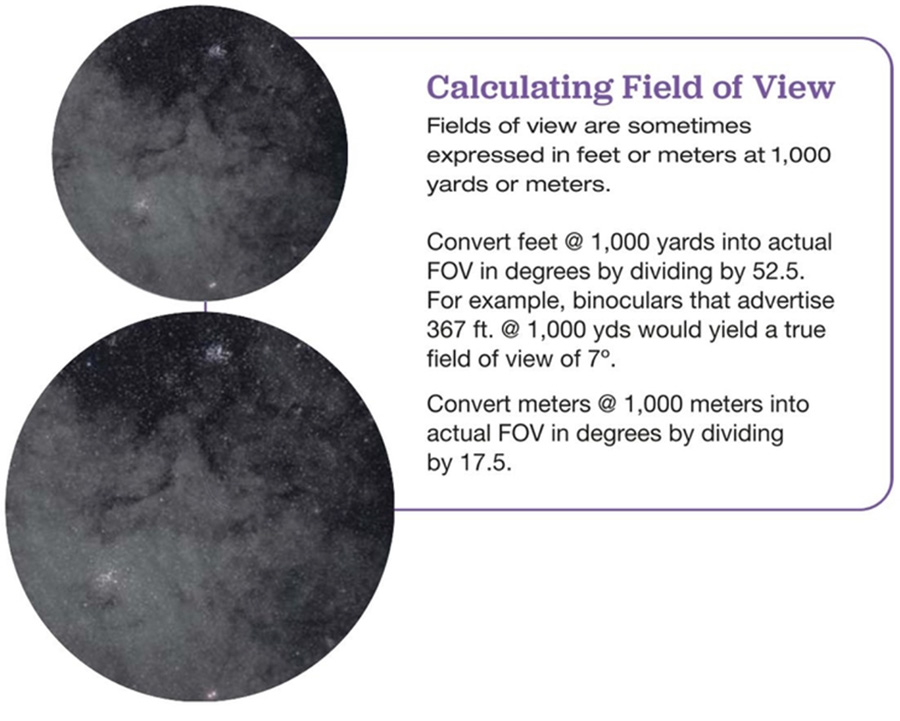
Just as with telescope eyepieces, the diameter of the circle of light seen through binoculars is called the apparent field of view and is measured in degrees (°). The wider the apparent field, the more impressive and panoramic the view. Most 10×50s now have eyepieces with apparent fields of 60° to 65°. In picking models to test, I selected only those with advertised apparent fields of at least 60°. By comparison, binoculars with 45° to 50° fields (typical of 7×50s) provide a less appealing, tunnel-like viewing experience.
Almost all binoculars feature anti-reflection multi-coatings on most (if not all) air-to-glass lens surfaces. Only the lowest-cost models have lesser coatings, usually distinguished by bright reflections off the front lenses. However, the best binoculars have more costly coatings with even more layers to minimize light loss and to reduce glare and ghost images from bright objects, such as the Moon and Venus.
Higher-priced binoculars also feature additional coatings on external lens surfaces to repel water, oil, and dust, and to protect against scratches. As with refracting telescopes, better binoculars are also equipped with objective lenses made using extra-low dispersion (ED) optical glass to reduce color fringing around bright targets.
Mechanical Features
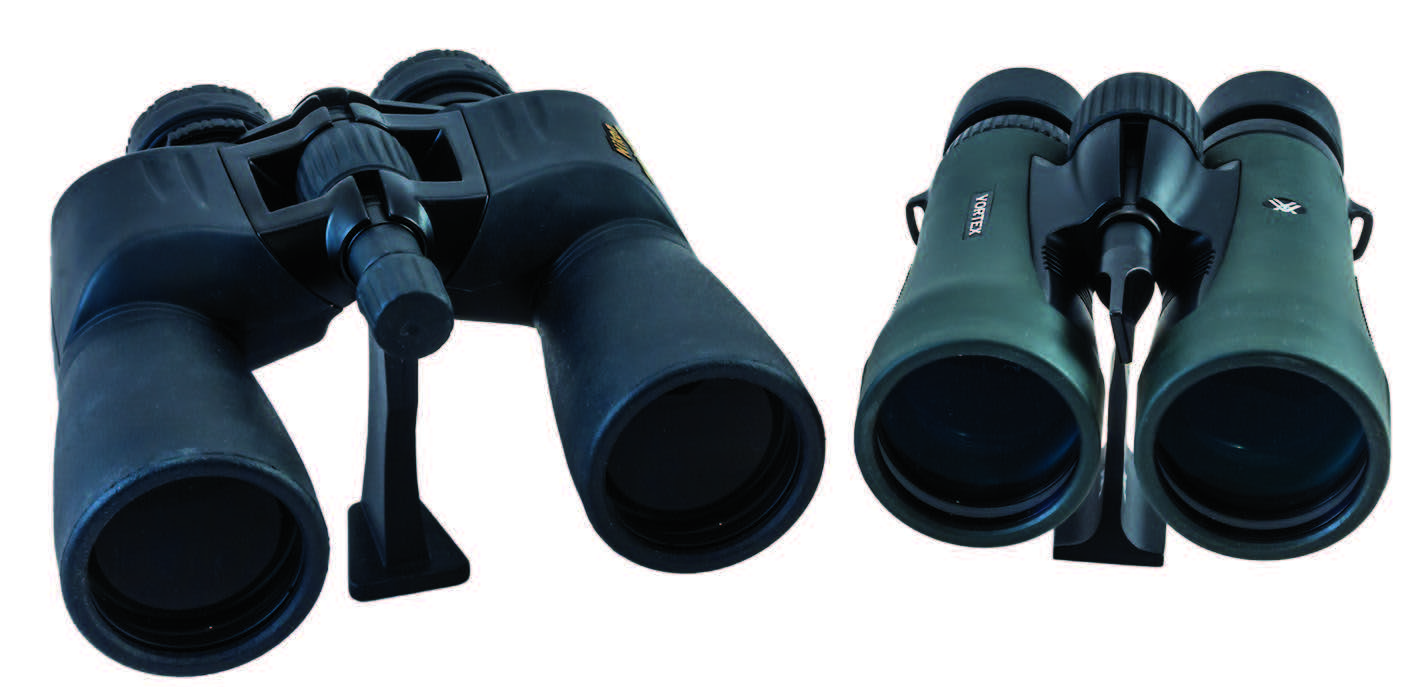
Low-cost, Porro-prism binoculars have prisms that are merely glued in place and can be prone to misalignment if handled carelessly. A more rugged arrangement is to hold the prisms in metal cages, which is typical of most roof-prism models.
The bodies of both binocular types are made from either polycarbonate, aluminum, or (in the best) magnesium for light weight and rigidity. But models in every price range are now covered in non-slip textured armor, often incorporating finger and thumb rests. Many binoculars are also weather-sealed and filled with dry nitrogen or argon, to keep out moisture and dust.
All roof-prism binoculars have precision internal focusing. By comparison, Porro-prism models typically use an external mechanism to focus by moving the eyepieces back and forth. This can impart a “rocking” motion, causing one eyepiece to go out of focus compared with the other. In better binoculars of any type, the grease on the focuser won’t freeze up on winter nights.
While all binoculars now have soft rubber eyecups for comfortable viewing, in lower-cost instruments these just roll up and down — an adjustment that eyeglass wearers can find fiddly — and they often degrade and crack over time. Eyecups that twist up and down are easier to set to the best height for comfortable viewing.
Image-Stabilized Binoculars
Back in the mid-1990s, Canon introduced electronic image-stabilization technology — a common feature in modern digital camera lenses — to binoculars. Their “IS” series quickly became popular with amateur astronomers. Press a button and the shifting prisms magically dampen out vibrations, allowing sharper views without giving up the convenience of hand-held viewing.
Some observers favor Canon’s 10×42 L WP ($1,500) as the best for astronomy, but at 1,030 grams they’re hefty for their size. The benefit of image stabilization really shows itself with the 15×50 and 18×50 models ($1,300 to $1,500), which offer magnifications impractical for hand-held use with conventional binoculars. The optics of these high-power units are razor sharp, and the apparent fields span an impressive 66° to 68°. However, at 1,180 grams, both 50-mm models are moderately heavy to hold. While image-stabilized binoculars do work well, I still find myself grabbing lightweight 10×50s as my binoculars of choice.
Country of Origin
Sport optics companies based in the United States, such as Athlon (in Kansas), Leupold (Oregon), and Vortex (Wisconsin), outsource manufacturing overseas, usually to China and some to the Philippines or Thailand. Binoculars from Tract Optics (Pennsylvania) and premium models from Leupold and Vortex are made in Japan. Only Wyoming-based Maven assembles its high-end models in the U.S., in California, using Japanese components.
The major European optics companies, Leica, Steiner, Swarovski, and Zeiss, take pride in manufacturing most of their binoculars in-house (including glass production) in Portugal, Austria, or Germany. Companies based in Japan, such as Canon, Kowa, and Nikon, make only their top-of-the-line binoculars in-house. While it is still possible to buy domestically produced instruments or opt for European craftsmanship, the price for doing so is high. That said, binoculars made in Asia are superb, with cost being a very good indicator of overall quality.
While all binoculars come with a factory warranty, the best will have 10- to 30-year warranties. American companies Leupold, Maven, Tract, and Vortex are unique in offering unconditional lifetime warranties. You break them, they’ll replace them.
Price Versus Performance
Good-quality Porro-prism binoculars can be purchased for about $100 to $200. A jump up to a $400 to $500 roof-prism model gets you noticeably better performance with optics and mechanics far superior to those well-worn binoculars you bought 20 or 30 years ago.
Of course, you can pay several times more, but the improvements become increasingly more subtle. At the top of the range are Swarovski’s 42mm NL Pure binoculars and Nikon’s 7×50 and 10×50 WX, all with immersive 76° eyepieces and Abbe-Koenig prisms. For $4,000 to $6,000! However, for $150 to $500 you can purchase a superb pair of binoculars that will serve you well for many years to come.
Alan Dyer
This article originally appeared in the August 2021 issue of Sky & Telescope.
About Alan Dyer
Alan Dyer is coauthor with Terence Dickinson of the new fourth edition of The Backyard Astronomer’s Guide, described at BackyardAstronomy.com.



Comments
You must be logged in to post a comment.