 SUNSET:

 0
0When nightscape photos fall short of expectations, chances are the problem is the lens.
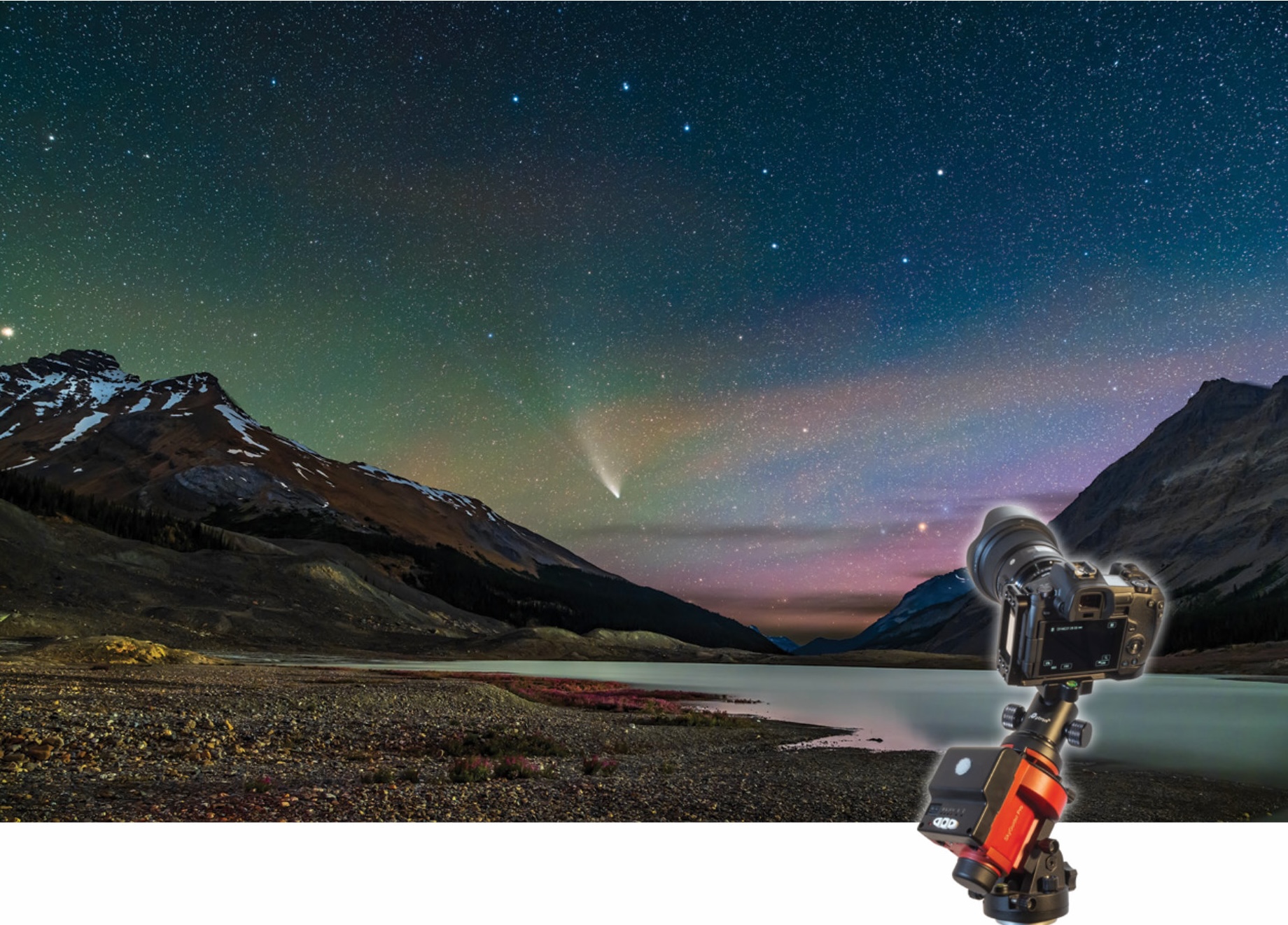
After a solid tripod, a good-quality, fast lens is the best investment an aspiring astrophotographer can make. It need not be an expensive purchase. But it does require research, as the lens market has become rather complex in the past few years, to say the least.
With a focus on choosing wide-angle lenses for nightscapes, here’s my guide to buying the best lens, whether it be for your old faithful digital single lens reflex (DSLR) or for one of the newer digital single lens mirrorless (DSLM) cameras.
Aperture Is Key
While daylight photography is bright and forgiving, at night we need speed. The photographically faster the better. This “speed” refers to the focal ratio, or “f-ratio” of the lens, which is its focal length divided by the maximum diameter of the internal iris of the lens (not to be confused with the size of its front element).
Twilight scenes, conjunctions, eclipses, noctilucent clouds, star trails, and even bright, moonlit nightscapes are captured well with f/4 to f/5.6 lenses. However, the subjects astrophotographers most want to capture — the Milky Way, meteor showers, and aurorae — demand a lens with a maximum aperture of f/2.8 or faster.
They are called “fast” lenses because they let in more light during a given exposure than lenses with larger f-ratios, allowing shorter, faster shutter speeds. Those are important for preventing star trails, freezing the motion of an active aurora display, or recording a fleeting meteor. (Photographing meteors is particularly at the mercy of your lens speed.) Attempting those subjects using typical kit zooms with f/5.6 focal ratios usually yields dark, disappointing results or excessively trailed and noisy images. And no meteors!
Aberrant Behavior
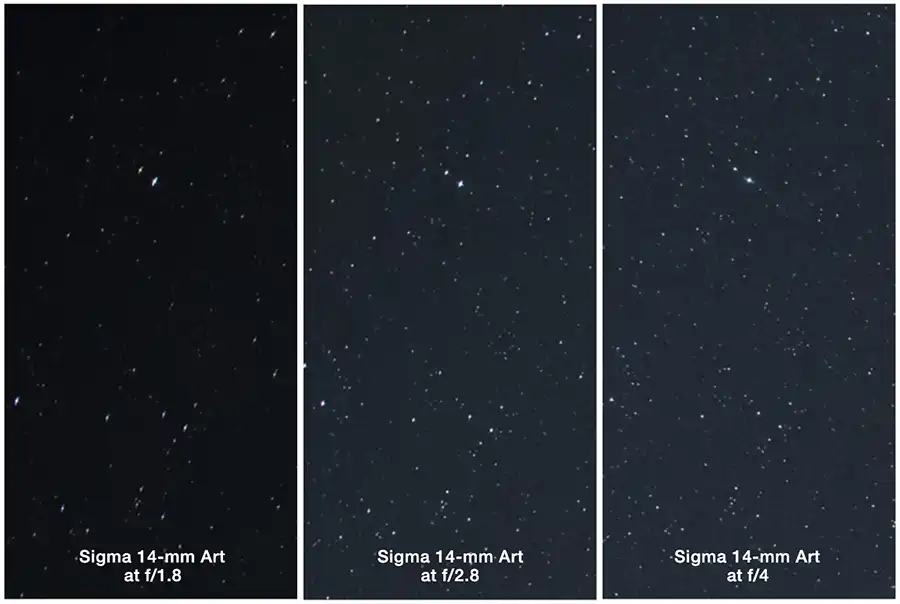
Of course, there are downsides to photographic speed. The first is cost. Fast lenses are more expensive, though selecting a no-frills, manual-focus lens somewhat eases the price pain. The second downside is aberrations. Stars, which offer the most demanding test of a lens, can look bloated and distorted in a fast lens used “wide open” at its maximum aperture.
Spherical aberration enlarges star images across the frame, turning them into soft blobs. Coma turns stars at the corners into comets; tangential astigmatism turns stars into radial streaks, while sagittal astigmatism distorts stars into concentric arcs. Longitudinal chromatic aberration adds blue or magenta glows around stars everywhere in the field, while lateral chromatic aberration spreads stars into tiny rainbows at the corners. As a general rule, the faster — and cheaper — the lens the worse the aberrations, with most lenses showing a mix of imperfections.
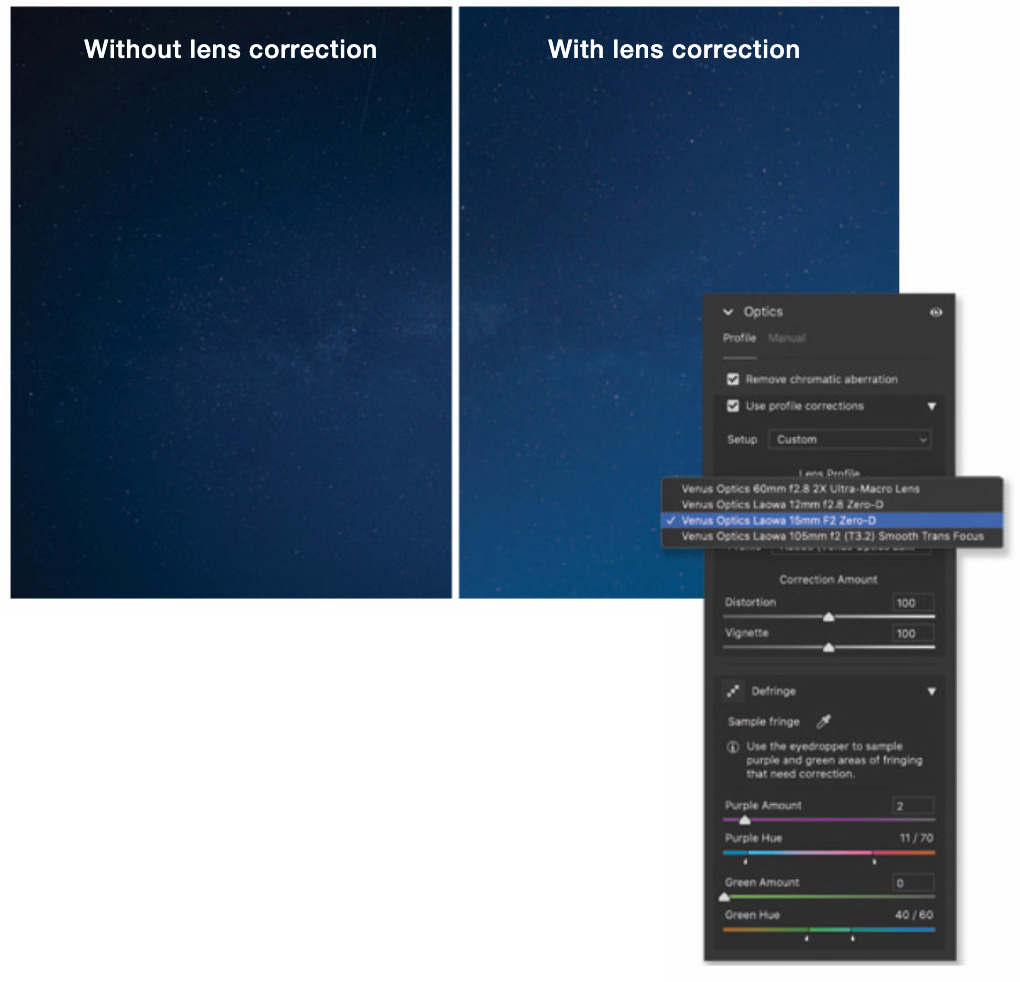
An ill effect even the best lenses can exhibit is vignetting. The corners look dark, sometimes by as much as two to three f stops dimmer compared to the center. Like chromatic aberrations (but not spherical, coma, or astigmatism), vignetting can be corrected in raw-image processing.
Alan Dyer
However, if the corners of an image are too dark out of camera, then boosting their brightness in post-production often reveals ugly noise, magenta tints, and banding artifacts. Vignetting is generally worse the faster and wider the lens.
Manual vs. Auto Focus
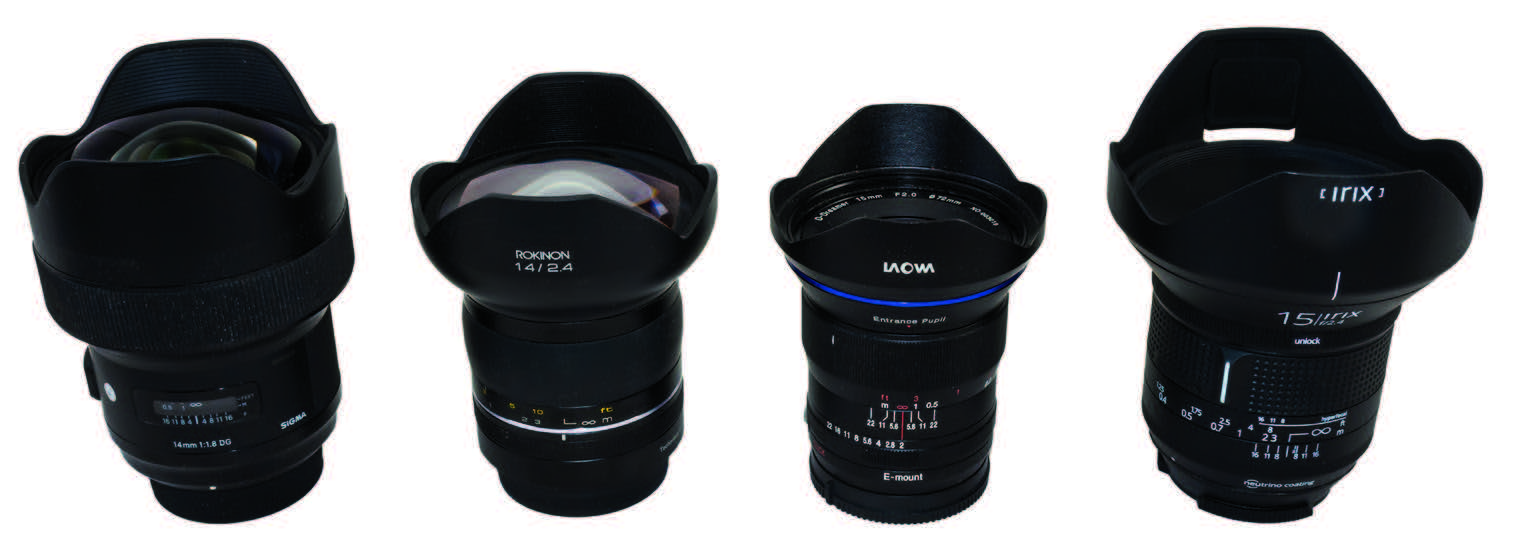
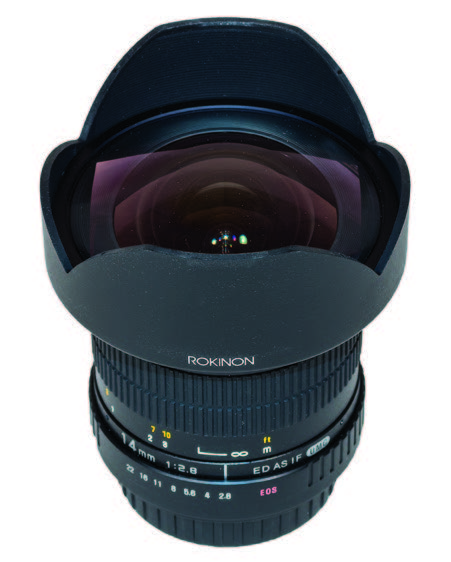
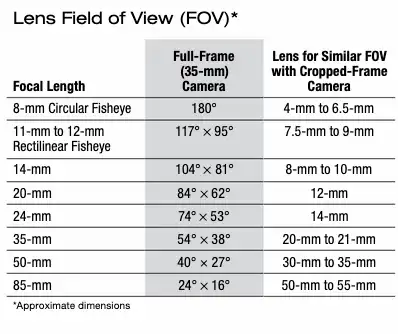
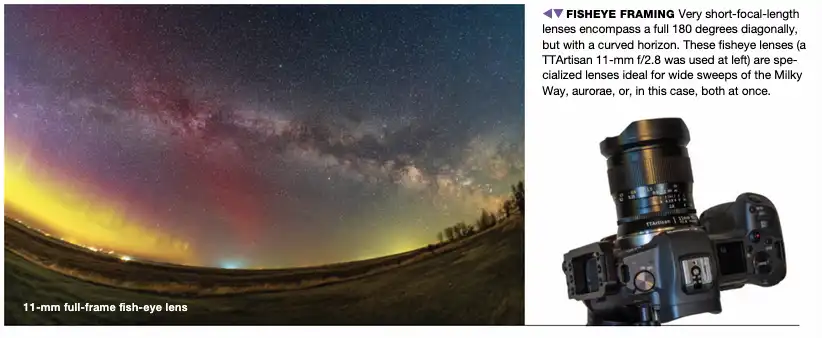
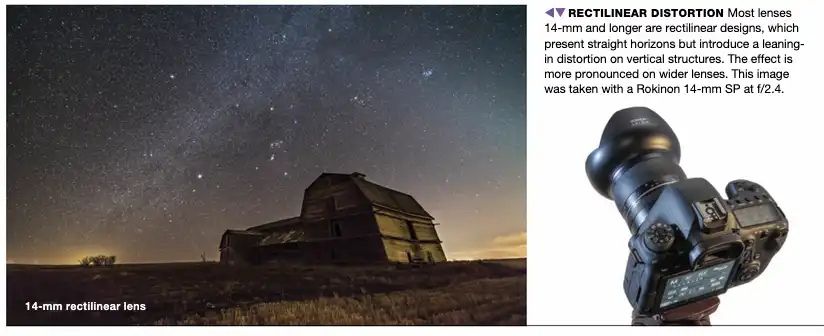
For nightscapes, lenses with 14-mm, 20-mm, or 24-mm focal lengths are the most useful, certainly on full-frame cameras. When shopping for one you’ll encounter a bewildering selection of lenses within that range of focal lengths. For example, you can find 14-mm f/2.8 lenses, a favored size, selling for as little as $250 to as much as $2,000.
The most affordable lenses, often costing less than $600, will be fully manual models. You have to focus and set the aperture by hand. That’s just fine. While the newest cameras are capable of autofocusing on stars and dimly lit landscapes, at night the best method is to manually focus on a star at high magnification using the Live View feature in your camera to
zoom in on a star.
Alan Dyer
The lowest-cost manual lenses offer no electrical communication with the camera. The camera doesn’t know what lens is attached nor its aperture. That’s a slight inconvenience when documenting what gear and settings you used. More advanced manual lenses (sometimes called “chipped” models) have electronics to communicate with the camera, so it automatically records the information in the image file metadata. This information about the lens model and aperture setting makes it much easier to correct distortions and vignetting during post-processing. Programs including Adobe Lightroom can automatically read this information and apply corrections to a large series of images — particularly handy when processing hundreds of frames to assemble into a time-lapse video.
Fully automatic lenses will autofocus when switched to AF mode and also permit the camera to automatically set the aperture. If you expect to use the lens for normal daytime photos, then autofocus and autoexposure become important features.
Alan Dyer
Alan Dyer
While all autofocus lenses also include the ability to manually focus, it’s now often performed via what’s called “focus by wire.” Turning the focus ring doesn’t directly move the lens elements but instead sends a signal to the lens’s internal motors, which perform the adjustments. Many such lenses lack a focus scale, which we’ve relied upon in the past to preset focus to infinity. Precise focusing is possible but has to be done for each shoot, which is the best practice anyway.
While low-cost manual lenses can be great values, I advise purchasing from a dealer who allows for easy returns for exchanges or refunds. Lenses can suffer from de-centered elements, creating asymmetric and exaggerated aberrations that often cannot be identified until you shoot the night sky. And it can be days or even weeks before the weather cooperates to test out the lens.
Cropped vs. Full Frame
Once you narrow your choice of lens, the next step is to check if it will work with your camera. It has to fit your brand of camera, but it also has to fit your type of camera within that brand.
For example, Canon has four different types of lenses: EF (for all its DSLRs), EF-S (for just its cropped-sensor DSLRs), EF-M (for its M series of mirrorless, cropped-sensor cameras), and RF (for its R-series of mirrorless, full-frame cameras). Got that?
Nikon has its decades-old F-mount from the film SLR days and carried over to its DSLRs, as well as the new Z-mount lenses for its mirrorless cameras. Sony offers E-mount lenses, Leica and Panasonic require L-mount lenses, Fujifilm uses its X-mount and medium-format G-mount, while the Pentax standard is called the K-mount. Yes, we have standards. Lots of them!
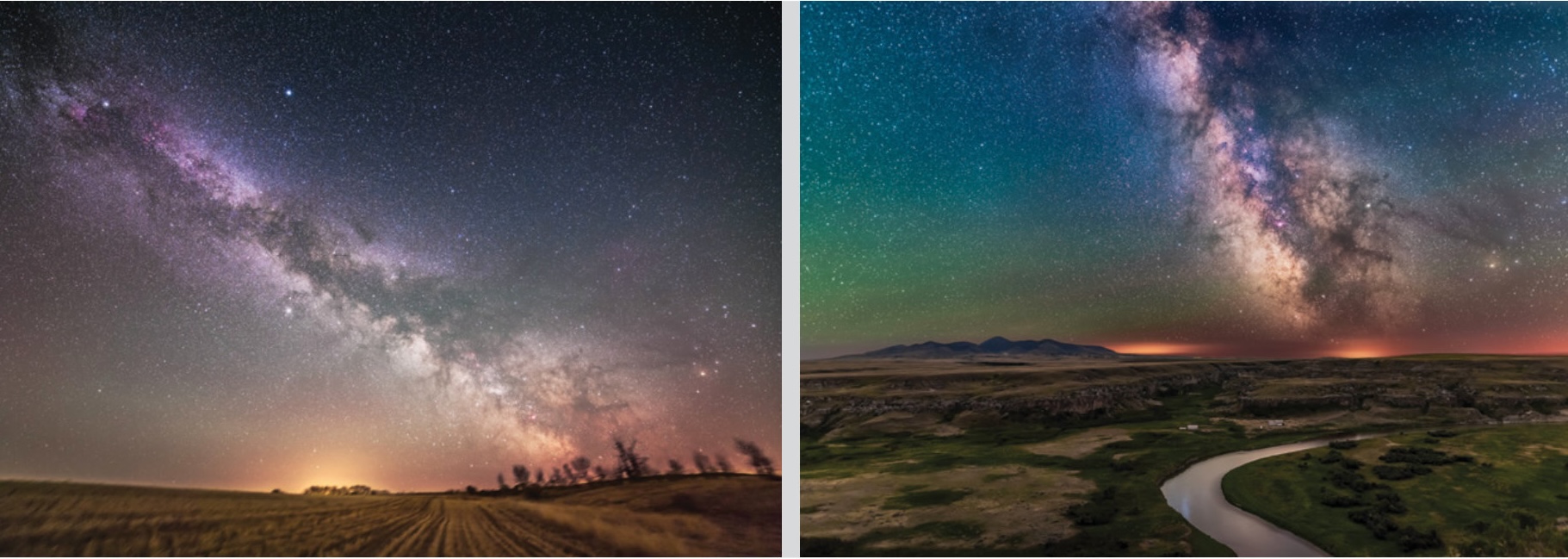

The other spec to check is if the lens will work with your camera sensor. That appealing fast lens might be only for cropped-frame cameras. Sometimes you have to dig into the specs to see if that’s the case. It might say it’s for DX or APS-C, terms camera manufacturers use for their cropped-frame sensors. Even if it can physically connect to your brand of lens mount, such a lens won’t project an image circle large enough to fill a full-frame sensor. The vignetting will be extreme, and no amount of post-processing will fix it!
If yours is a cropped-frame camera, then a cropped-frame lens will be just fine. Nevertheless, be mindful of two considerations. First, the smaller sensors of cropped-frame cameras provide a narrower field of view with any given lens or focal length. It takes a 12-mm lens to provide the same actual field of view as a 20-mm lens does on a full-frame camera. For example, Samyang (aka Rokinon in North America) has a fast 12-mm f/2 in several versions, but it’s only for cropped-sensor cameras.
Second, keep in mind that if you invest in a lot of lenses that work only on your cropped-frame camera, they’ll be obsolete if you later upgrade to a full-frame camera. Industry pundits expect Canon and Nikon will introduce few, if any, new DSLRs in coming years. As with Sony, which discontinued its DSLRs in 2021, all new cameras will be mirrorless, with most of those being full-frame. Only Pentax bravely remains as the manufacturer of just DSLRs, both cropped and full-frame.
DSLR vs. DSLM
DSLRs have vast catalogs of lenses available for them. The lens selection for the new generation of DSLMs is limited but growing, both from the original manufacturers and from third parties. Established lens manufacturers such as Sigma, Tamron, and Tokina now must compete with names such as Samyang/Rokinon and Laowa, and most recently by previously unknown brands such as Irix, Meike, 7artisans, TTArtisan, Viltrox, and Yongnuo, to name a few.
Many of these startups specialize in lenses just for mirrorless cameras, with Leica/Panasonic’s L and Sony’s E-mounts the most widely supported. Canon and Nikon have so far been reluctant to open up their R and Z systems to third-party lens manufacturers
For example, as of late 2021, Samyang’s new 24-mm f/1.8 AF, with a unique infinity-focus light and marketed to astro-photographers, is available only for Sony’s E-mount. The same is true of Tokina’s 20-mm f/2 from its FiRIN series.
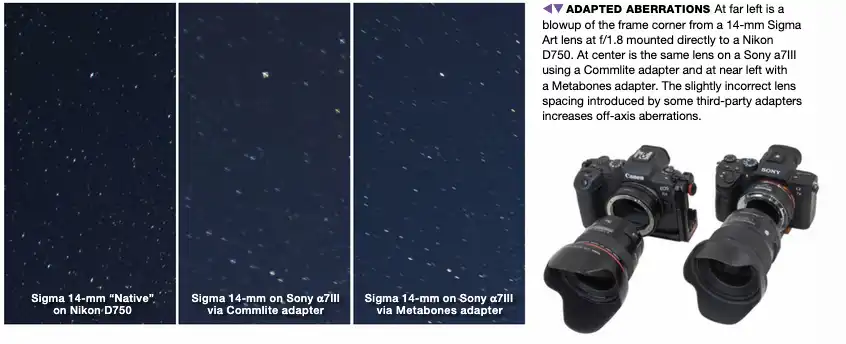
Lenses for DSLMs will fit only on those mirrorless cameras. However, lenses made for DSLRs can be adapted to work with DSLMs. Some lens adapters, such as those Canon and Nikon sell, offer full electrical connectivity, which permit older autofocus lenses to fully operate on the respective company’s new mirrorless cameras.
Third-party adapters from brands such as Metabones expand the flexibility to allow DSLR lenses of one brand to fit on a mirrorless camera from another brand, though usually with some loss of functionality.
The lowest-cost lens adapters are mechanical only. They are best used only with fully manual lenses that have an aperture ring, because with no data communication between lens and camera, the camera cannot control the lens aperture.
Zoom vs. Prime
Another important question to consider when shopping for nightscape lenses is why buy several lenses when a single quality zoom can cover the range? Zooms simplify your lens kit for travel and, once onsite, make it easy to compose the scene.
Canon, Nikon, and Sony all have f/2.8 wide-angle zooms covering the 12-to-24-mm or 16-to-35-mm range. The 15-35-mm Canon RF (reviewed in the April 2020 issue), Nikon’s Z 14-24-mm S, and Sony’s FE 12-24-mm G-Master are enjoying rave reviews from nightscape photographers, with those new mirrorless lenses offering significantly better image quality over the older DSLR versions, though at premium prices. The improvement is sufficient to overturn the old wisdom that zooms have inferior optical quality to fixed-focal-length, prime lenses.
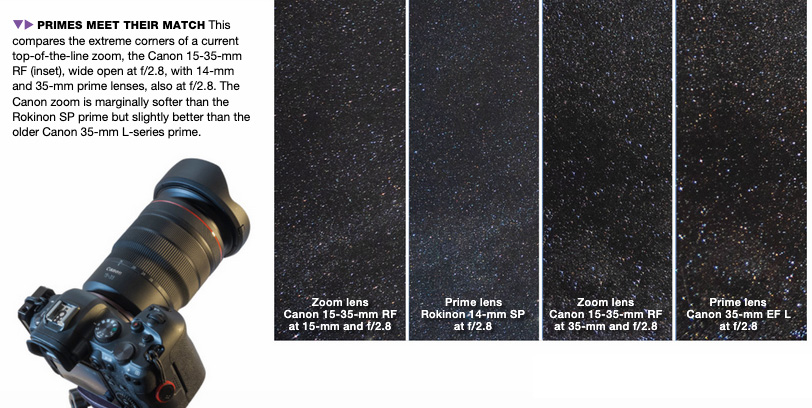
For a traditional DSLR zoom, Sigma has its 14-24-mm f/2.8 DG Art, Tokina its 16-28-mm f/2.8 Opera, while Tamron’s SP 15-30-mm f/2.8 has long been a favorite of night-scapers. For use on cropped-frame cameras, Tokina’s 11-20-mm f/2.8 CF is another popular choice.
So why buy a prime? The advantage over an f/2.8 zoom is that the faster f/2 to f/1.4 apertures of most primes brighten the live view image by two to four times, making it much easier to focus and frame a scene. The faster the lens — we’re even seeing some f/0.95 lenses now — the lower the ISO can be, reducing noise, which for older, noisier cameras might be a fair tradeoff against any added aberrations. For time-lapse photography, the shorter shutter speeds made possible by a fast lens let you capture more frames during a shoot, for a slower, more graceful movie in the final render.
With video-centric DSLM cameras, fast apertures also make real-time movies at night possible. The Sigma 20-mm f/1.4 Art and the Venus Optics Laowa 15-mm f/2 have been my “prime” choices for 4K movies of aurorae.
As with zooms, older DSLR prime lenses, such as the well-respected Sigma Art series, are being outclassed by smaller and lighter mirrorless primes, like Nikon’s 20-mm f/1.8 S and 24-mm f/1.8 S, and Sony’s 14-mm f/1.8 and 24-mm f/1.4 G-Masters.
The camera world is in rapid transition, as are lenses, making selecting the best lens a challenge. However, the latest lenses offer much better performance, a trait we can appreciate when shooting under the stars.
This article originally appeared in the January 2022 issue of Sky & Telescope.
About Alan Dyer
Alan Dyer is coauthor with Terence Dickinson of the new fourth edition of The Backyard Astronomer’s Guide, described at BackyardAstronomy.com.





Comments
You must be logged in to post a comment.