 SUNSET:

 1
1Meet Draco, the Dragon, a constellation that lurks between the Dippers and circles ’round the northern sky.
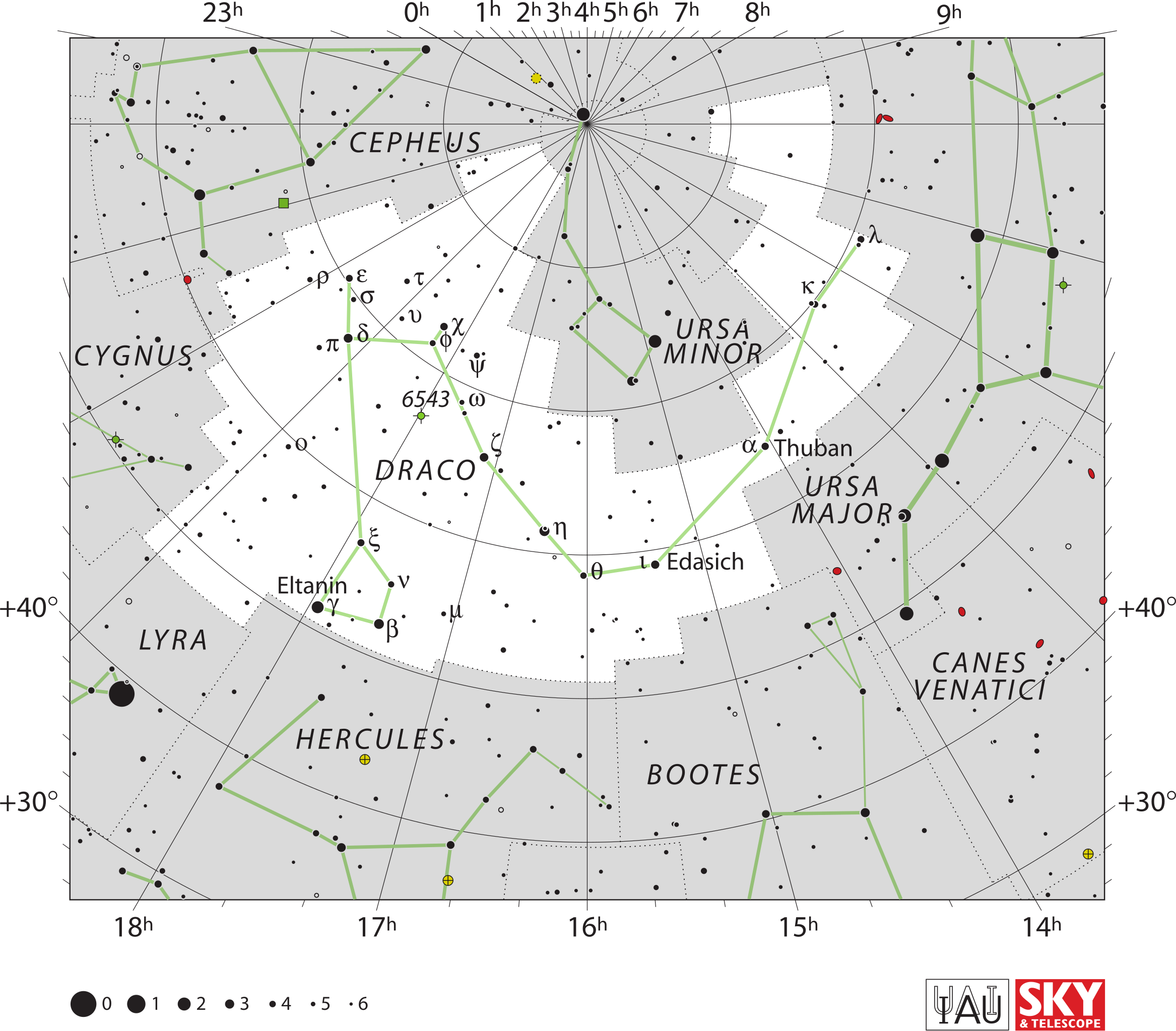
IAU / S&T (Roger Sinnott & Rick Fienberg)
A Winding Wyvern
It’s an old story: Someone takes up astronomy, wants to learn about constellations and other patterns in the sky, and immediately seeks out the recognizable Big Dipper asterism and the nearby Little Dipper. At astronomy club events, we admire the double Dippers in the sky much more than those at the refreshment table. But between the two Dippers begins a sprawling constellation that has always been there but is often ignored. How many countless times have you looked at the Big and Little Dippers, never paying heed to the faint dragon nearby?
If you’ve never explored Draco, the Dragon, perhaps you should reconsider, because there are some good reasons to check it out.
The Stars of Draco
In such a large constellation there are plenty of stars, but we’ll take a close look at some of the brightest. It’s worth noting that each of the stars here is a binary system; we’ll quickly look at the primary star of each example:
- Gamma (γ) Draconis – Eltanin, as Gamma Draconis is also known, is the constellation’s brightest star at magnitude 2.2. It’s a K-type giant, cooler than the Sun with an obvious orange tint. It’s not a supergiant like Betelgeuse or Antares, but with a radius 50 times that of the Sun it’s no trivial star.
- Beta (β) Draconis – Sitting west of Eltanin is 2.8-magnitude Rastaban, and together these two brighter members of the constellation form the Dragon’s eyes. Rastaban is a G2 yellow giant star. The bright nearby star Vega, in Lyra, serves a waypoint to get you fairly close to both Eltanin and Rastaban.
- Eta (η) Draconis – Northwest of the Dragon’s eyes and midway along the Dragon’s body is a star of similar brightness to Rastaban known as Athebyne. It shines at magnitude 2.7. This yellow giant has cooled and expanded with age, but it’s only about 10 times the Sun’s radius and contains about 2.5 Suns’ worth of mass. Athebyne is located just about in the center of Draco, and you can “hop” over to it from Kochab in Ursa Minor.
- Alpha (α) Draconis – In some regards, 3.7-magnitude Thuban might just be the most fascinating of all. Sitting directly between the Big and Little Dippers, it's a fairly ordinary main-sequence star of type A, similar to Altair or Vega. As the fourth-brightest star, it seems hardly worthy of Johann Bayer's "alpha" designation, which usually designates the brightest star of a constellation. However, Bayer marked it as a second-magnitude star, so it must once have been brighter than it is now. It also figured more prominently in the skies of much earlier times: The slow drift of Earth’s spin axis means that about 5,000 years ago, Thuban rather than Polaris was Earth’s North Star.
Get to know the sky's brightest stars with our Meet the Stars series.
Mythology
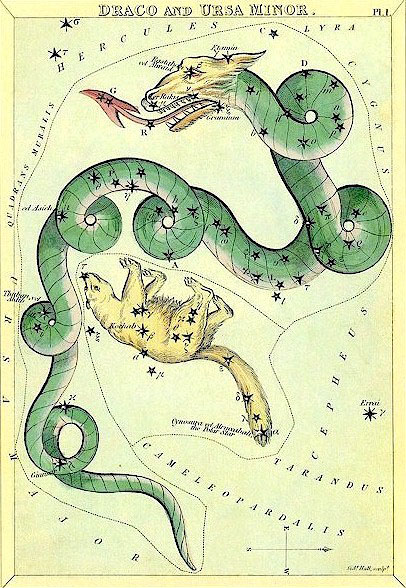
Urania's MIrror
Athena, one of the Olympians of Greek myth is well known for her association with the city of Athens, as well as her roles in the Trojan War and as mentor to Odysseus. What you may not know is that she is also responsible for Draco, the Dragon. In one tale, Athena battled a dragon and “snatched its twisted form and threw it to the stars, and fixed it at the very pole of heaven. And so to this day it appears with twisted body, as if recently transported to the stars," as Hyginus wrote in his Astronomica 2. This story explains Draco’s location near the north celestial pole. Elsewhere in Greek myth, you’ll find Draco guarding golden apples from Hercules or a golden fleece from Jason.
Long before Greek mythology gave us our current name for this constellation, there were the ancient Egyptians. They had no dragons in their stories, but they did have crocodiles in the Nile, along with hippos. The two merged in Egyptian mythology, becoming a hybrid named Taweret. They used the stars of the modern-day Draco to represent this creature.
For the Sioux nation of the North American plains, stars from Draco combined with some of Ursa Minor to form the Thunderbird, a protective mythological creature that could make thunder with its wings and lightning with its eyes.
In early Arabian astronomy (circa 500 AD), local creatures figured in the interpretation of the constellation we now call Draco. The stars detailed a story about a camel train and some troublesome hyenas or wolves. In later Arabic-Islamic terminology, the stars came to denote a dragon or serpent instead.
How to See Draco
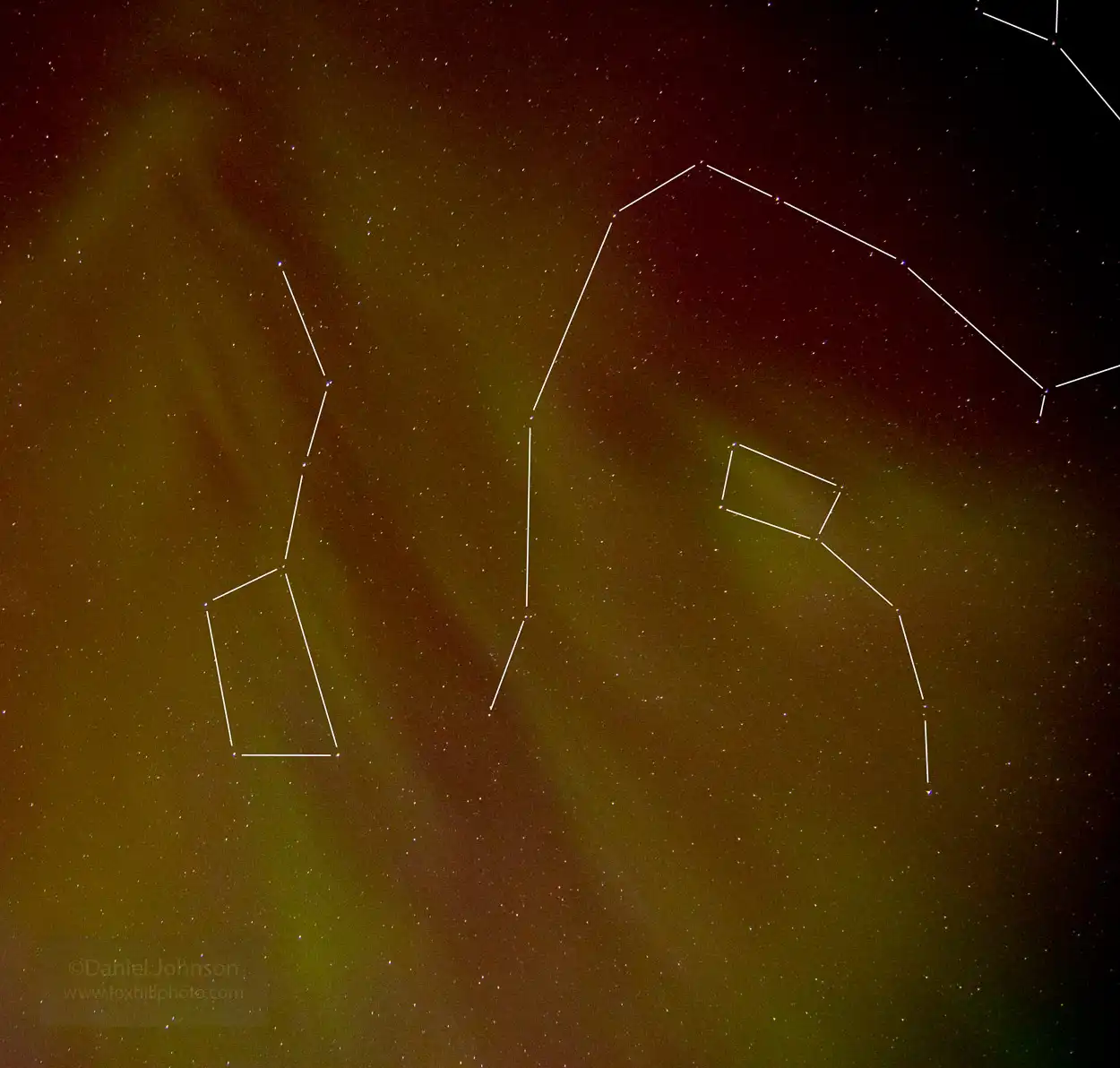
Daniel Johnson
For a good swath of the Northern Hemisphere, Draco is a circumpolar constellation, meaning it’s always visible in the night sky throughout the year, looping around Polaris (the North Star). Seasonal changes will alter where Draco is in its loop and at what times, but you’ll always see it.
If you start to go farther south — say Florida or Egypt — portions of Draco may slip below the horizon at certain times of the year. But the celestial Dragon is huge and some of it will remain visible. Only until you travel deep in the Southern Hemisphere will you lose sight of Draco entirely.
Because of Draco’s size and lack of bright waypoints, it can be a tricky constellation to trace. The darker your sky the better.
The easiest way to find Draco is probably to look for the Big Dipper first, then use that to locate the Little Dipper. Draco’s tail and lower body winds between the two. Once you’ve identified the tail — and maybe Thuban — you can use a star map such as the one above to trace out the rest of the Dragon’s image. The ancients clearly knew the dragon between the dippers — shouldn’t you, too?
Daniel Johnson is a Wisconsin-based freelance writer and professional photographer and the coauthor of more than a dozen books. He’s a longtime amateur astronomer and fortunate enough to live in a rural region with excellent seeing conditions. You can view some of Dan’s photography (he does a lot of animals!) at www.foxhillphoto.com.
About Daniel Johnson
Daniel Johnson is a Wisconsin-based freelance writer and professional photographer and the co-author of over a dozen books. He’s a longtime amateur astronomer and fortunate enough to live in a rural region with excellent seeing conditions. You can view some of Dan’s photography at www.foxhillphoto.com.


Comments
Andrew James
October 18, 2024 at 4:20 am
The greatest thing about Draco is the numeral innumerable double stars that occupy it's boundaries. There are many colourful examples here that are worth checking out. I.e. Here https://skyandtelescope.org/sky-and-telescope-magazine/draco-double-stars/ Mu Draconis is brilliant in 20cm.
You must be logged in to post a comment.
You must be logged in to post a comment.