 SUNSET:

 2
2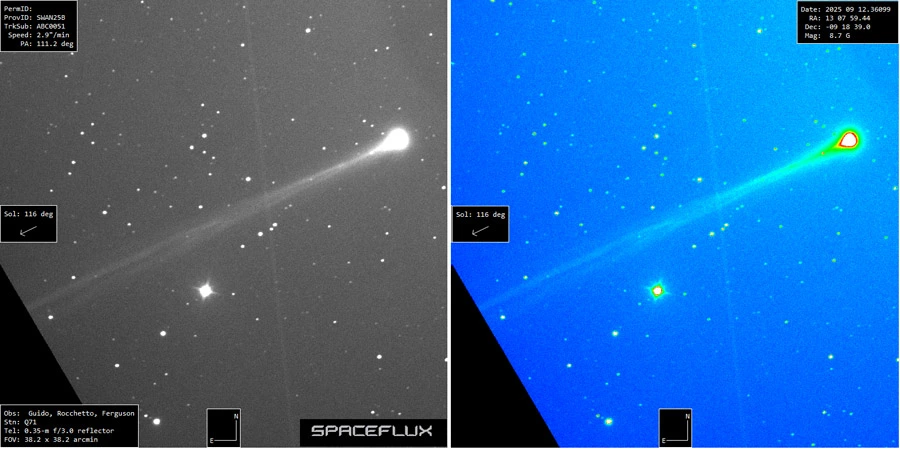
E. Guido, M. Rocchetto, J. Ferguson, Spaceflux
Congratulations to amateur astronomer Vladimir Bezugly of Ukraine! He discovered a bright new comet on September 11th around 1:45 UT in publicly posted images from the Solar Wind Anisotropies (SWAN) instrument on the orbiting Solar and Heliospheric Observatory (SOHO). This took a keen eye as the comet was barely visible just outside SWAN's solar occulting disk. It turns out that SWAN25B — its temporarily name — has hovered in virtually the same position for more than a month because its velocity and direction have nearly matched that of the Sun, maintaining a constant tight elongation. On September 15th it received the permanent designation C/2025 R2 (SWAN).
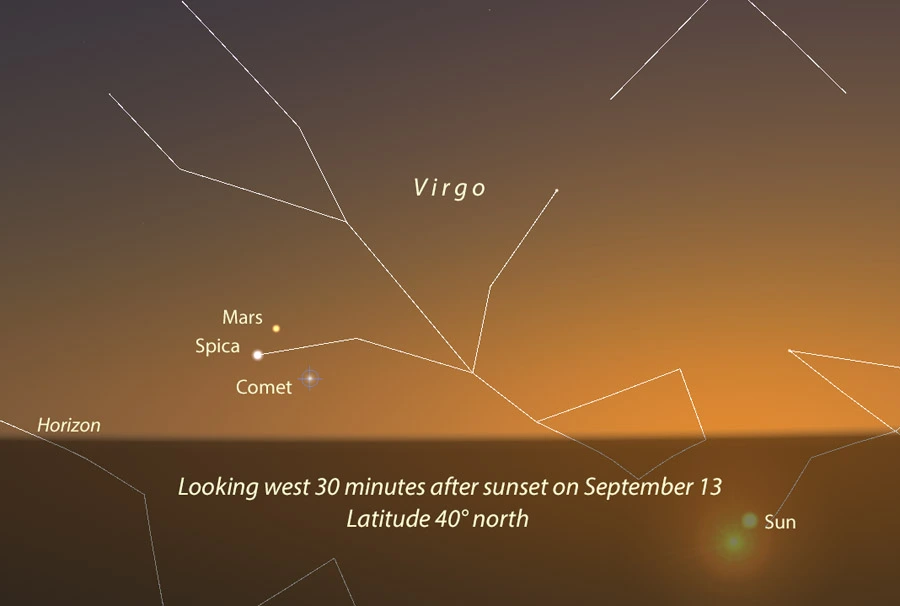
Stellarium
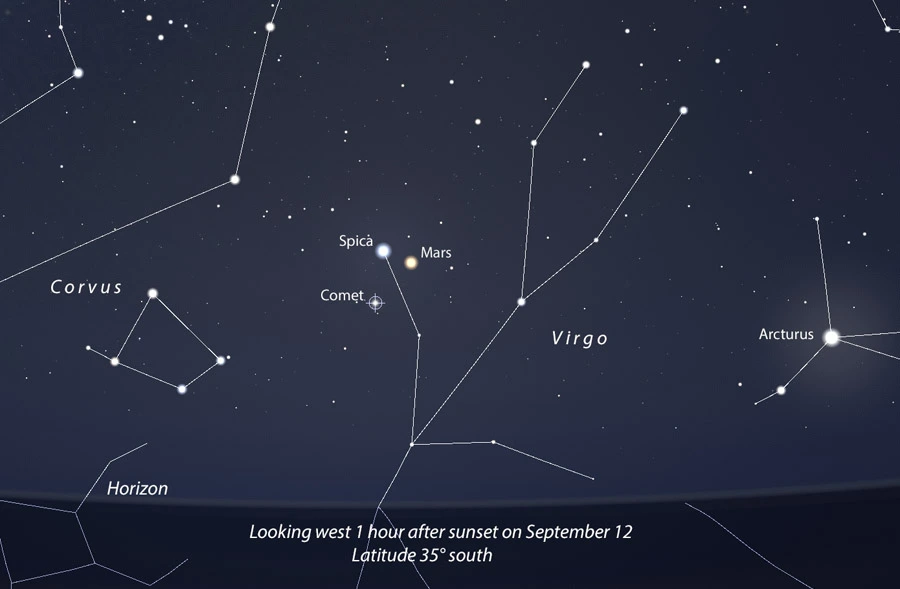
From the Southern Hemisphere the comet still hovers near the Sun but it's higher up in a darker sky. This is the view Friday night, September 12th. Stellarium
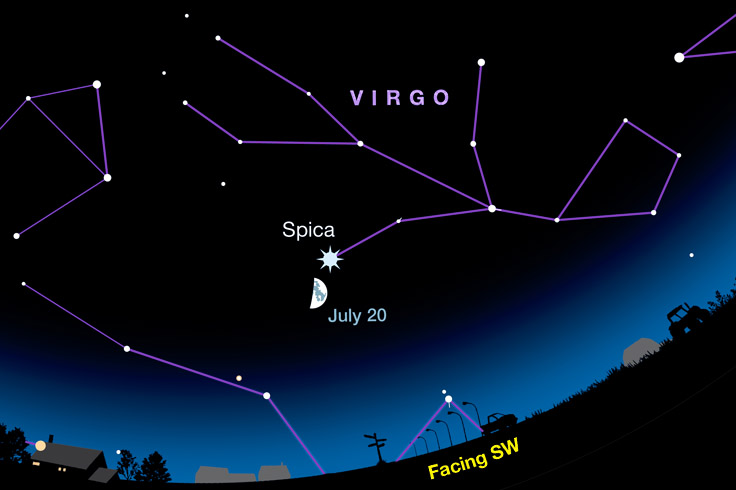
The object was quickly confirmed by Michael Mattiazzo of Australia, who spotted it in 15 x 70 binoculars on September 12.4 UT and estimated its magnitude at 7.3 with a tail in excess of 2°. Comet SWAN is currently located just a few degrees from Mars and Spica very low in the western sky after sunset and moving southeast. For Northern Hemisphere observers it's extremely low or lost in the solar glare for the time being. Those in the Southern Hemisphere have much better prospects, with the comet visible low in the west an hour or more after sunset.
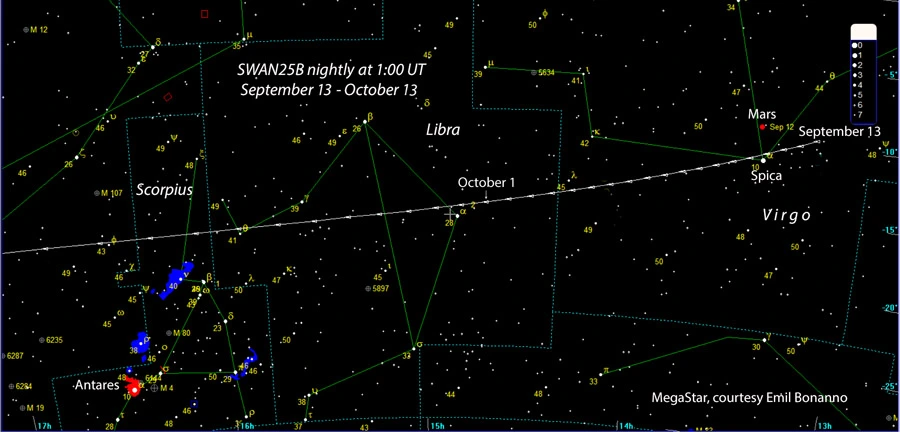
MegaStar, courtesy of Emil Bonanno
Viewing prospects for northerners will gradually improve from late September into October as the object slowly gains altitude and increasing elongation from the Sun — assuming the comet's current brightness isn't the result of a temporary outburst. Although its orbit is still preliminary, it appears it will pass 0.25 a.u. from Earth in October, according to comet observer Sam Deen. He also suggests the possibility that Earth will cross the newcomer's debris stream around October 4-6, with a possibility for a meteor shower.
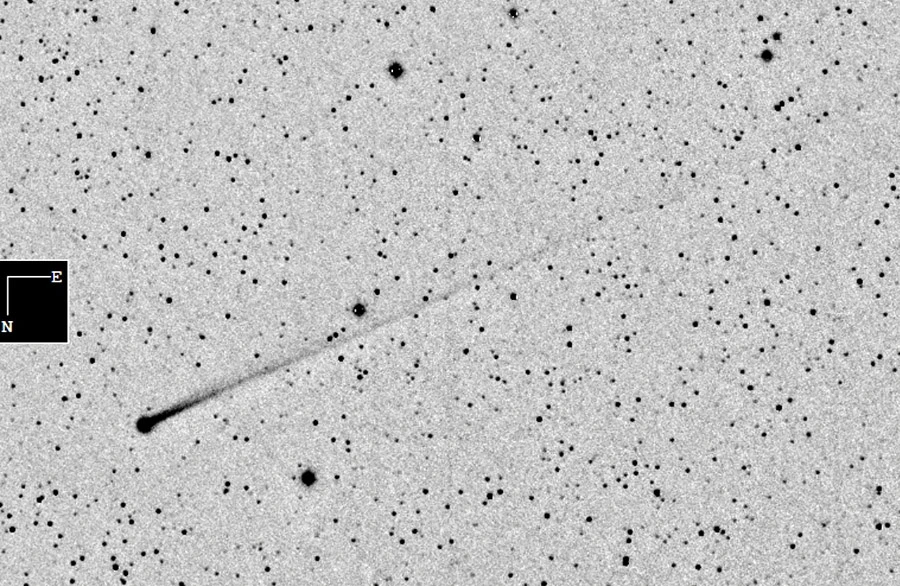
Martin Mašek
What's curious about this comet is that it wasn't discovered earlier. Granted, it was swamped by solar glare from Northern Hemisphere locations, but it's been in the evening sky for some time for Southern Hemisphere observers. One possibility is that C/2025 R2 only recently underwent a bright outburst that caused its magnitude to skyrocket. There's possible evidence for this. Based on the most recent images from September 13th, the coma has a peculiar, vaguely triangular shape (see images below) — sometimes called a "hammerhead" — which may indicate that the nucleus is undergoing fragmentation.
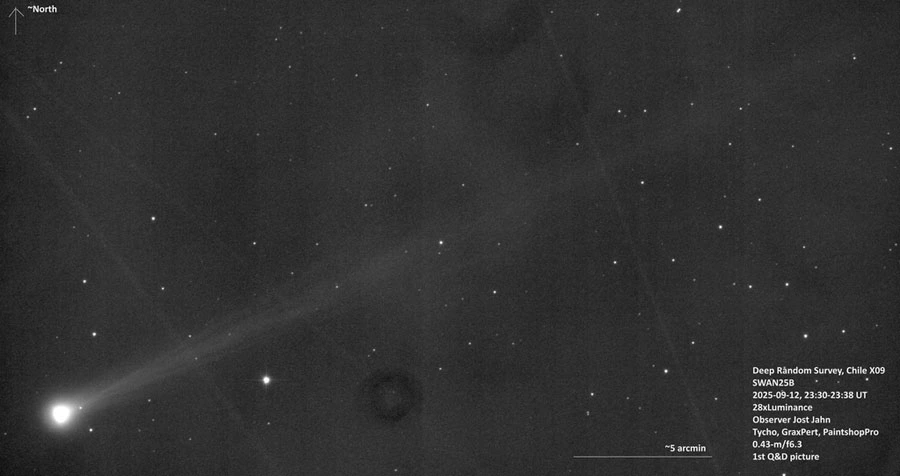
Jost Jahn / Deep Random Survey
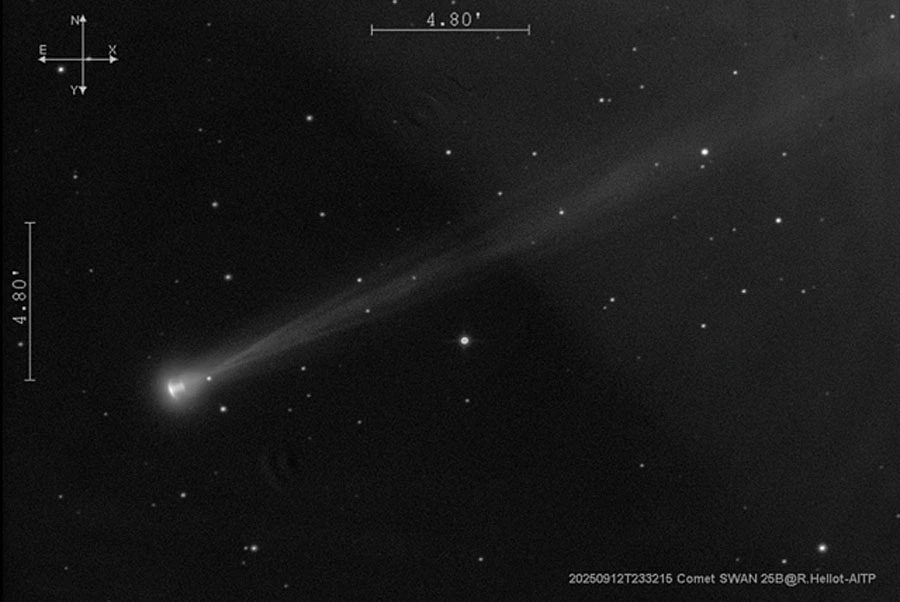
Roger Hellot
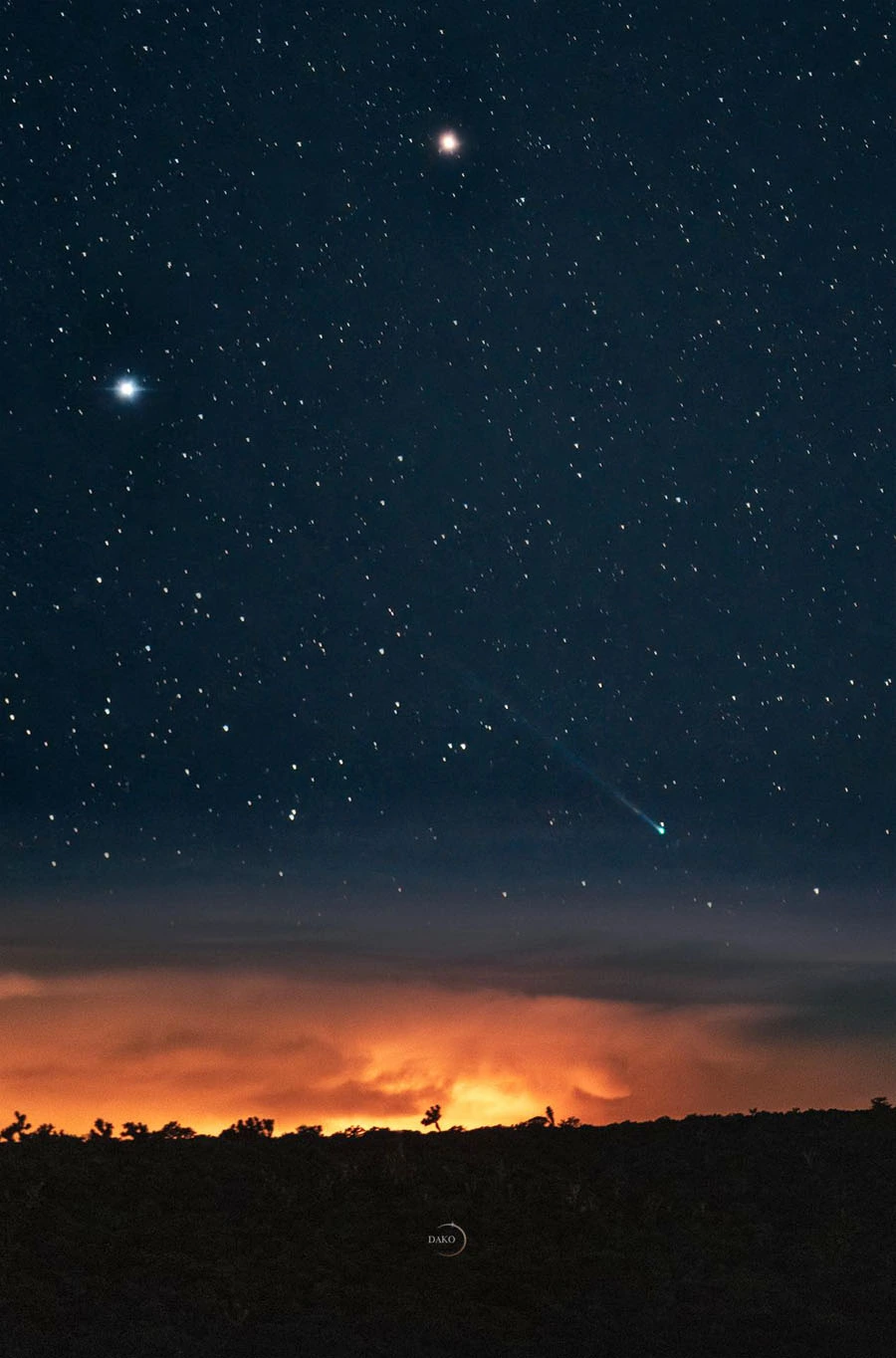
Da Ko
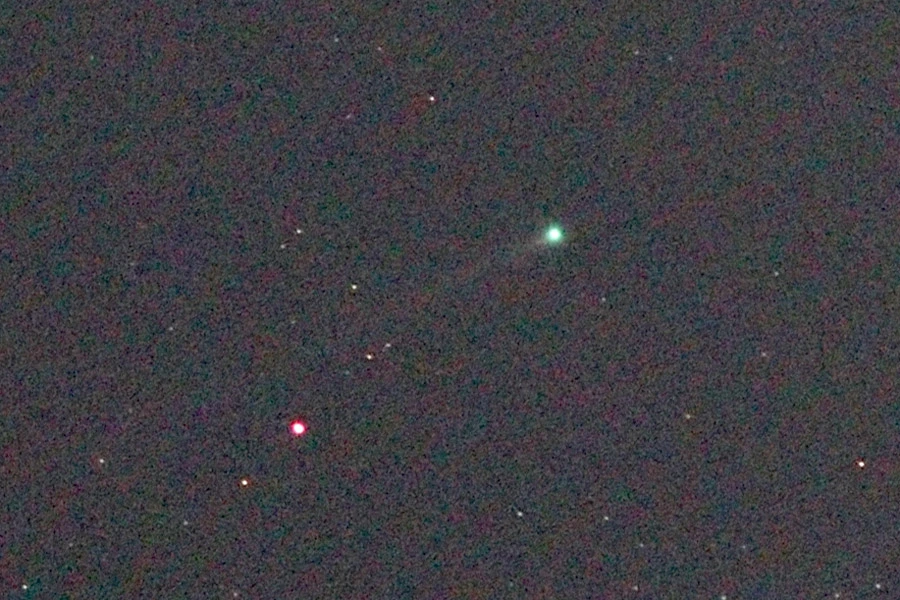
Rob Kaufman
We'll have more on the comet in the next days, so please check back. In the meantime, you can learn more about what the comet is doing right now in the online discussion group comets-ml.
About Bob King
I love the sky (day and night) and have been a skywatcher and amateur astronomer since childhood. I'm also a long-time member of the American Association of Variable Star Observers (AAVSO) and Astronomical League. I pen the Astro Bob blog and have written four books: Night Sky with the Naked Eye (2016); Wonders of the Night Sky You Must See Before You Die (2018) and Urban Legends from Space (2019) and Magnificent Aurora, published in 2024. The universe invites us on an adventure every single night. To accept the invitation, we only need look up.



Comments
Alan MacRobert
September 15, 2025 at 10:05 am
Here's ongoing current discussion on comets-ml, including by Vladimir:
https://groups.io/g/comets-ml/topic/swan25b_on_pccp/115202920
You must be logged in to post a comment.
bob kelly
September 30, 2025 at 6:56 pm
Thank you, Bob, for all this really helpful information about SWAN.
Any update on possibility for a meteor shower from SWAN?
You must be logged in to post a comment.
You must be logged in to post a comment.