 SUNSET:

 3
3
Bob King
Venus is about to go bye-bye. If you haven't looked at the dazzling evening planet recently, time's running out. On March 12th its solar elongation will be just under 18° and decreasing daily by more than 1°. As it departs, Venus pals up with Mercury. The two inner planets will be closest at 5.5° apart on March 12th. Binoculars will help in spotting fainter Mercury to the left of its scintillating sibling.
On March 23rd, Venus will be in conjunction with the Sun and transition into the dawn sky, reprising its role as Morning Star. In classical times, it went by the Latin Lucifer, when observed at dawn, and Vesper, at dusk. While these names are rarely used to describe the planet in our time, the ancient duality persists in the traditional appellations of Morning Star and Evening Star.
Normally, Venus is hidden in the solar glare for a week or so around the time of conjunction and invisible with the unaided eye. During this time, determined observers are keen to track it telescopically in the daytime sky while taking care to steer clear of the Sun. There's great motivation to do so. Backlit by the Sun and closest to Earth, the planet reaches its greatest apparent size and displays a jaw-droppingly thin crescent.

Shahrin Ahmad
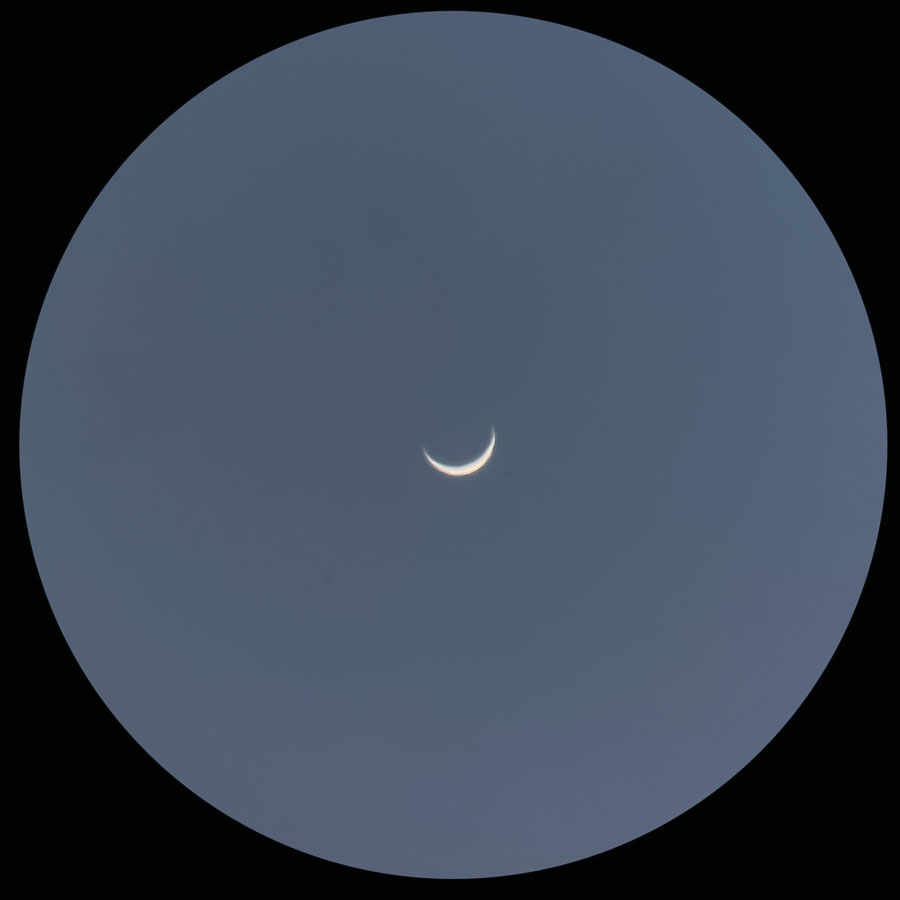
Around the time of conjunction, when we view Venus in nearly the same line of sight as the Sun, the cusps of the crescent extend beyond 180° due to forward-scattering of sunlight by the planet's atmosphere. I've often seen the fragile horns continue as tentative threads of light for about 270°. In fleeting moments, they reach even farther and touch horns to form a complete circle. Watch for the extensions to appear when the crescent dips below about 2.5%-illuminated, from March 16-29. Minimum illumination of 1.0% illumination occurs on March 22–23.
Bob King
Venus reaches its great latitude north of the ecliptic on March 18th at 8.5°. Since this occurs just a few days before inferior conjunction, the planet will pass well north of the Sun, making it relatively easy (and safer!) to hunt in daylight. I use a small refractor equipped with a safe solar filter on an equatorial mount. After looking up the right ascension (RA) and declination (Dec) for both the Sun and Venus, I center the Sun in the field of view of a low magnification eyepiece and bring it to focus. Then I offset the scope in RA and Dec toward Venus, remove the filter and look through the eyepiece.
Naked-eye crescent quest
If you have exceptional vision you may even be able to discern the Venusian crescent without optical aid. The human eye has a visual acuity of about 60" or 1 arc-minute. Venus comes tantalizingly close to that size during the current apparition with a maximum diameter of 59.5"on March 22-23. Unfortunately, aberrations of the eye like astigmatism can warp the true shapes of objects of such small angular size.
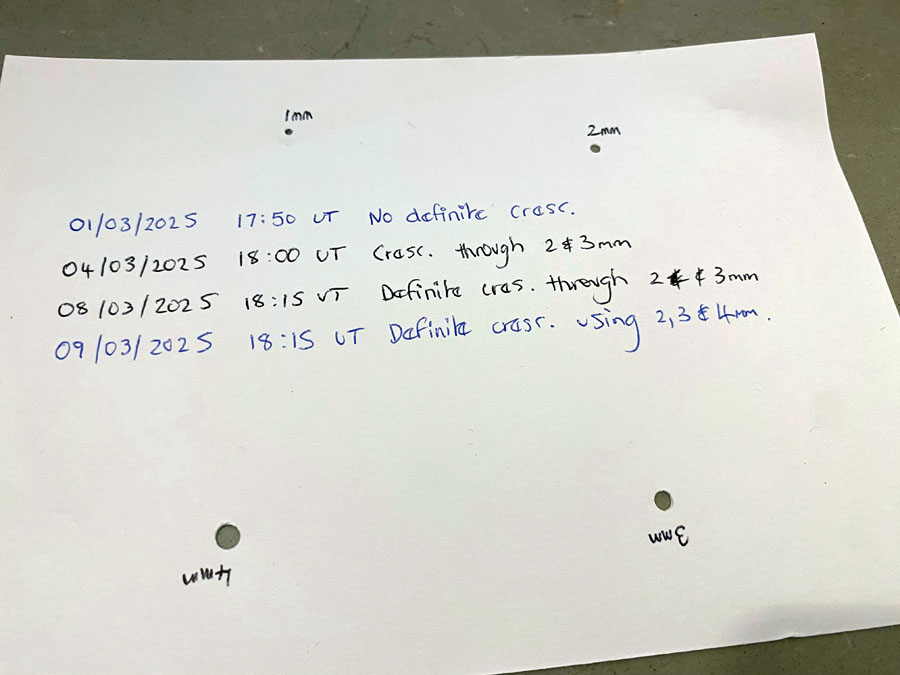
To reduce ocular distortions, Sky & Telescope senior editor Alan MacRobert suggests "sighting through a clean, round hole in a thick piece of paper about 1 mm, 2 mm, or 3 mm in diameter held right next to your eye (try them all). It will mask out optical aberrations that are common away from the center of your eye's cornea and lens. Try each eye." The best time to attempt this is when Venus is in a bright sky (preferably before sundown) to minimize the planet's glare.
Jeff Stevens
Amateur astronomer Jeff Stevens of England has been following Venus with the naked eye and binoculars for many weeks. Recently, he took MacRobert up on the suggestion. Stevens used a multi-diameter hole punch to make 2 mm, 3mm, and 4mm diameter holes in a card, and a separate pointed tool to create the 1 mm hole. On March 1st, despite his best attempts, the result was inconclusive. On March 4th he detected an elongation in the planet using the 2 mm and 3 mm holes. Five evenings later, on March 9th, he met with success:
"The 2mm, 3mm, and this time the 4mm, all allowed me to see a very subtle but clear tiny curve of light representing the crescent Venus," writes Stevens. "The phase was 7% illuminated and 55″ in diameter."
Bob King
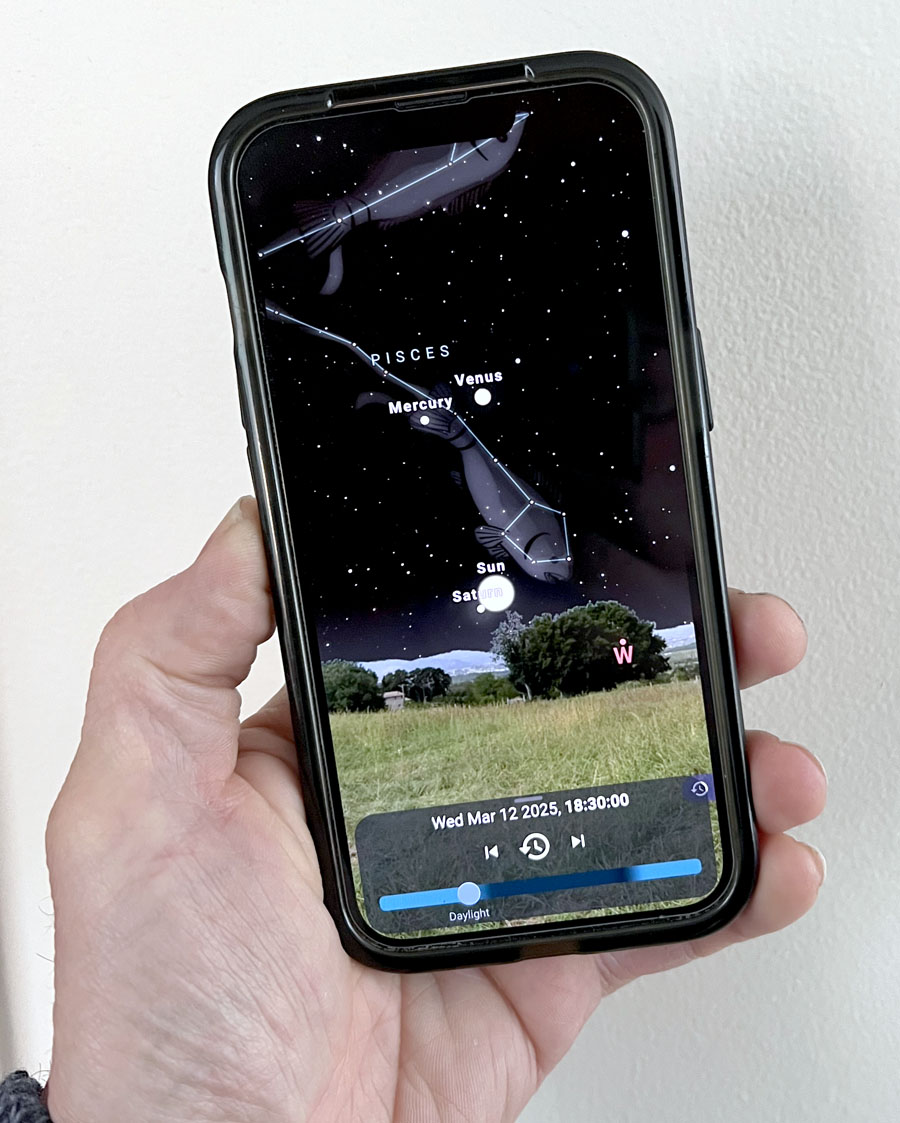
"Weather permitting I will continue to view Venus, until it is lost to the Sun," said Stevens. I encourage you to do the same. If possible, observe the planet before sunset when its higher altitude makes for a sharper image. For naked-eye Venus-spotting in daylight, I use an app to pinpoint its location, then (carefully) sweep it up in binoculars. I'd love to hear how your crescent quest turns out — good luck!
Stellarium
See the evening star before sunrise?
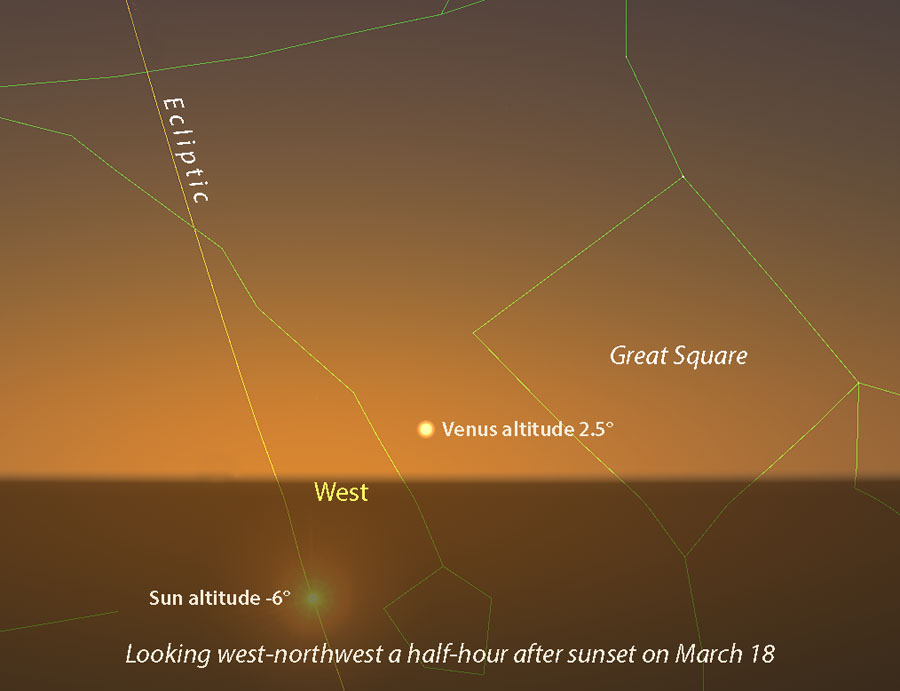
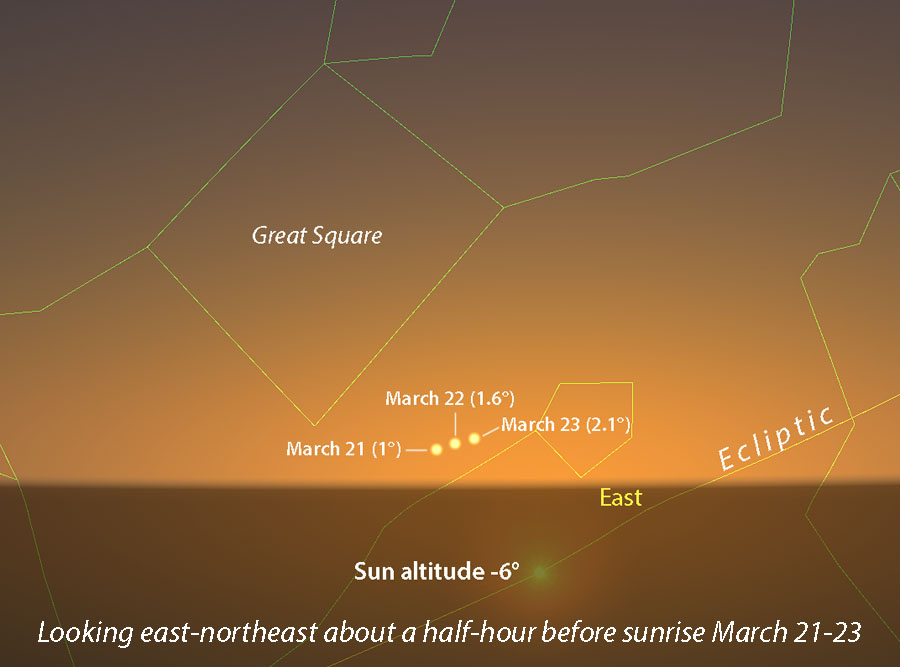
Because Venus lies so far north of the ecliptic, mid-northern-latitude observers have a unique, if challenging, opportunity to observe the planet in the dawn sky before conjunction when it's still officially the Evening Star. Expect Venus's last gasp at dusk around March 18th. At the end of civil twilight, when the center of the Sun is 6° below the horizon, the planet will stand about 2.5° high.
Stellarium
Then on March 21st, we can start watching for Venus at dawn, but beware — it'll be in the mud! I'm hopeful a few of us will still succeed in pulling it out with binoculars. I've set the map time to the start of civil twilight, but it may be possible to spot Venus a bit later when it's higher above the eastern horizon. I did say challenging, right?
About Bob King
I love the sky (day and night) and have been a skywatcher and amateur astronomer since childhood. I'm also a long-time member of the American Association of Variable Star Observers (AAVSO) and Astronomical League. I pen the Astro Bob blog and have written four books: Night Sky with the Naked Eye (2016); Wonders of the Night Sky You Must See Before You Die (2018) and Urban Legends from Space (2019) and Magnificent Aurora, published in 2024. The universe invites us on an adventure every single night. To accept the invitation, we only need look up.


Comments
Anthony-Mallama
March 13, 2025 at 12:32 pm
Bob - That’s a wonderful article. The thin crescent of Venus is a beautiful sight especially with foreground objects in the field of view.
You must be logged in to post a comment.
Bob KingPost Author
March 16, 2025 at 1:51 am
Thank you for saying, Anthony. I appreciate that very much. Happy crescent-gazing!
You must be logged in to post a comment.
Joe Stieber
March 18, 2025 at 9:20 am
Indeed, a great article -- as usual.
I spotted Venus this morning, March 18, 2025, with 12x50 binoculars at 7:01 am EDT, five minutes before sunrise after it cleared an appx. 2° high cloud bank along that part of the horizon. The crescent was discerned, but it didn't look especially thin because of the poor seeing at the low altitude. I followed it until 7:17 am when the Sun broke out of the clouds.
That was coupled with a sighting on the evening of March 17 when I spotted it at 7:04 pm with 8x42 binoculars, five minutes before sunset and followed it until 7:27 pm when it was visible with unaided eyes until it dipped into clouds along the horizon. Seeing was horrible so the thin crescent was really woozy with my 88 mm spotting scope at 60x.
In any case, I saw Venus at both ends of the night of March 17-18. I hope to look at it mid-day today and have a nice view of the thin crescent with my 88 mm spotting scope, then look again at sunset (to see Venus at sunrise and sunset on the same calendar date). I'll be out looking again in the coming days as the weather permits.
You must be logged in to post a comment.
You must be logged in to post a comment.