 SUNSET:

 0
0Note to Editors/Producers: This release is accompanied by high-quality graphics; see the end of this release for the images and links to download.
On Saturday night, December 13th, and continuing into the early hours of Sunday, December 14th, be sure to head outside and look up — you may very well see brief streaks of light crossing the sky from the annual Geminid meteor shower.
It’s worth venturing forth into the cold for this meteor shower. “Although the Perseids, which arrive every August, are better known, the Geminids usually put on a better show,” says Sky & Telescope Editor in Chief Diana Hannikainen. “Just make sure to bundle up!”
Observers in North America have the best chance of catching the Geminids, which are expected to peak around 3 a.m. EST (midnight PST) on Sunday, December 14th.
It is, however, worth looking for meteors on both evenings bracketing the peak, on Saturday evening, December 13th, and Sunday evening, December 14th (so long as the skies are clear, of course). This way, families can enjoy the event together, since kids won’t have to miss their bedtimes by too much.
The Moon is not expected to hamper viewing opportunities. "A 26%-illuminated waning crescent Moon rises in Virgo around 2:30 a.m. local time," notes S&T Contributing Editor Bob King. "Its modest glare has little impact on the year's richest meteor event."
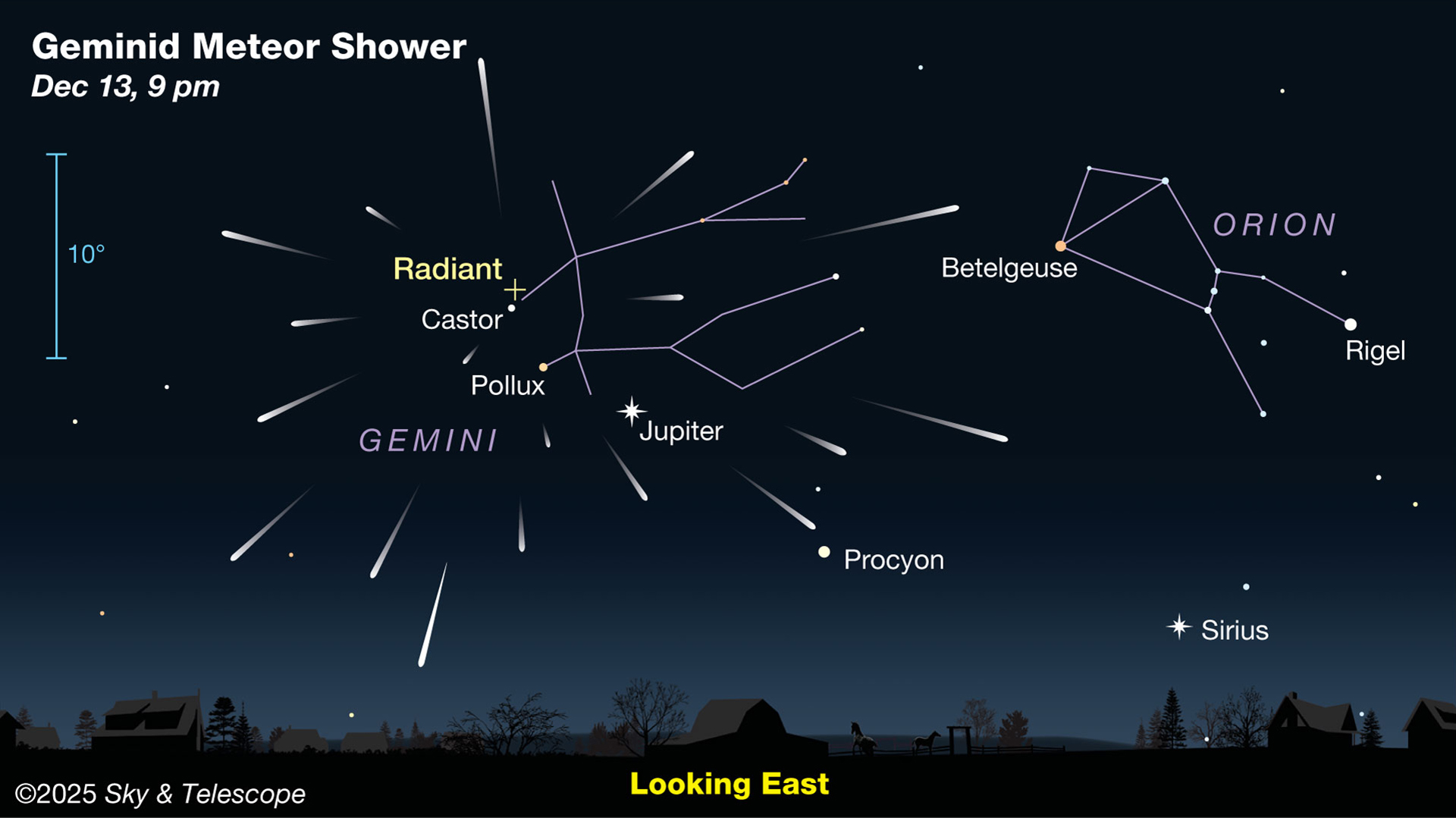
The shower’s radiant — the spot in the sky from which all Geminid meteors appear to emanate — is near the relatively bright star Castor in the constellation Gemini, the Twins. For viewers at mid-northern latitudes, the radiant is well above the eastern horizon by around 9 p.m. local time on December 13th. The radiant will stand highest at 2 a.m. local time on December 14th, which is ideal viewing time for those who can stay out late.
The number of meteors you see will depend very much on the darkness of your location, and what time you’re out looking. If you’ve got a clear, dark sky with little light pollution, you might see a meteor streak across the sky every minute or two from about 10 p.m. until dawn on the night of the peak.
How to Watch for Geminids
"Meteor-watching is easy — you need no special equipment other than your eyes," says S&T Associate Editor Edwin L. Aguirre. "But you'll see more of them if you allow at least 20 minutes after going outside for your eyes to adapt to the darkness."
Find a dark spot with an open view of the sky and no glaring lights nearby. Lie back in a reclining lawn chair and gaze up into the stars. Bundle up as warmly as you can in many layers.
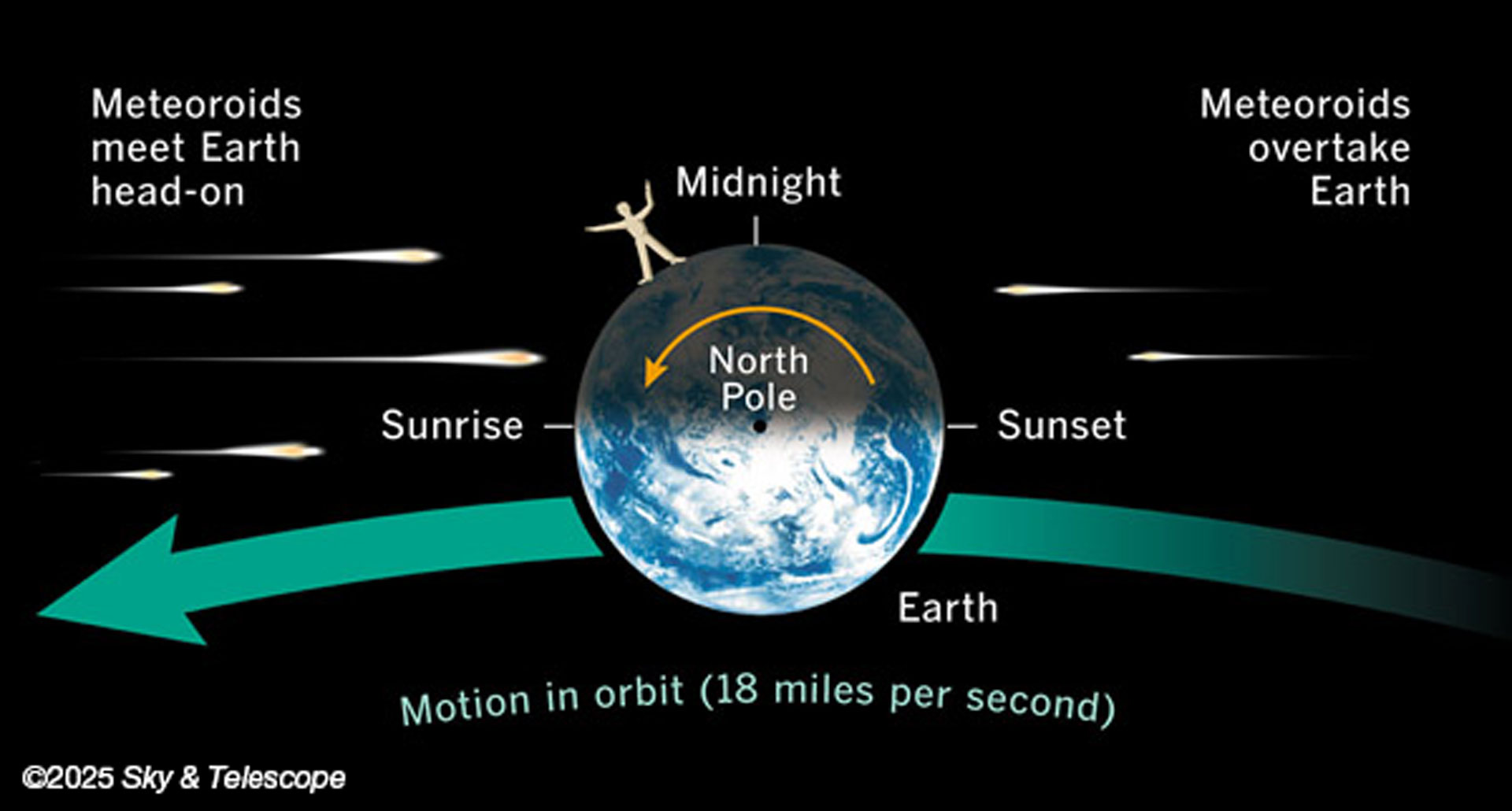
Geminids can appear anywhere in the sky, so the best direction to watch is wherever your sky is darkest, probably straight up. Small particles create tiny, quick streaks. The occasional bright one might leave a brief train of glowing smoke. The few that you may see early in the evening will make longer, dramatic trails, continuing for a few seconds as they graze sideways through Earth's uppermost atmosphere.
The Source of the Geminid Meteors
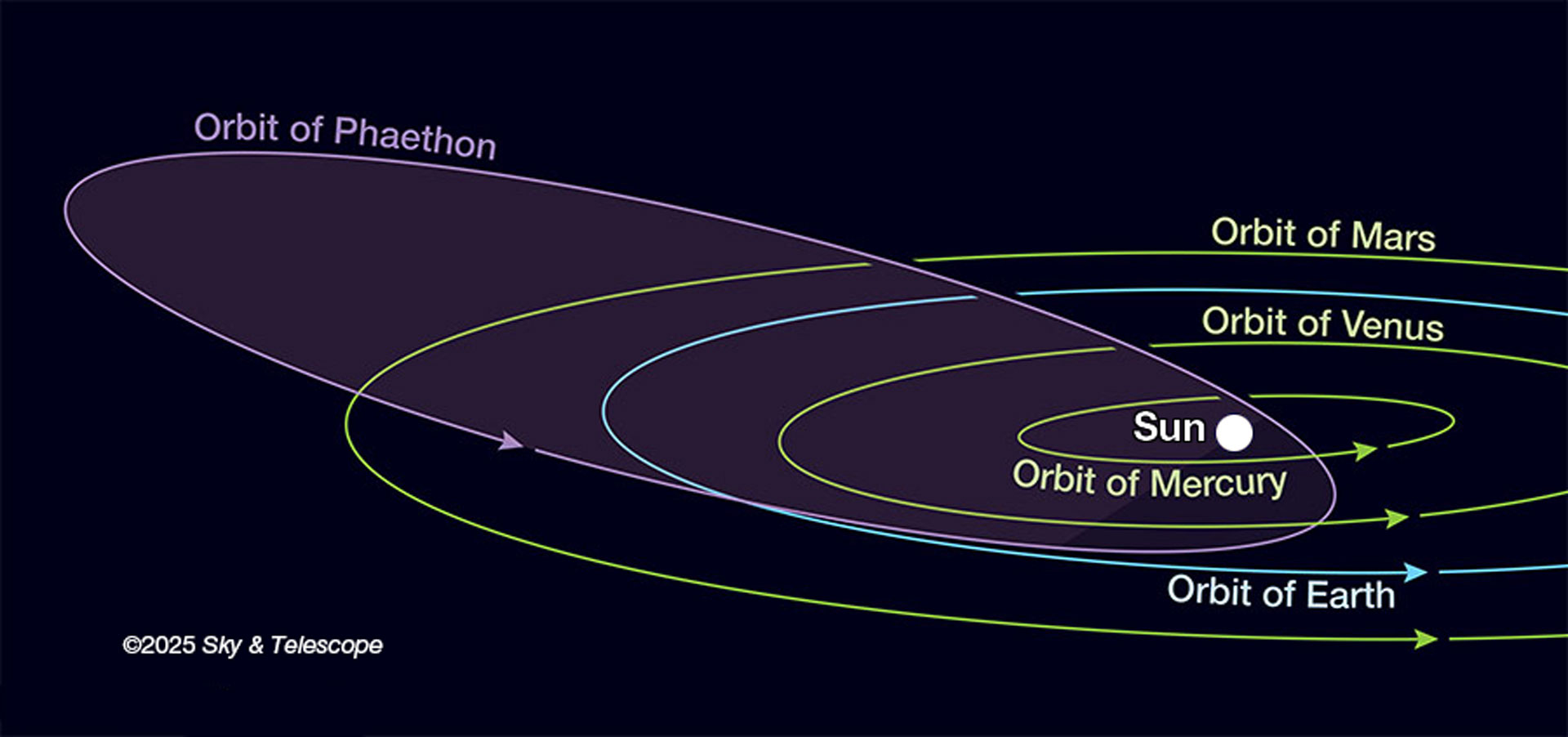
The last major meteor shower of the year is brought to us courtesy of 3200 Phaethon (FAY-uh-thon), a unique asteroid referred to as a rock comet since it shares characteristics with both asteroids and comets. The Geminids were first reported in 1862 and have been recognized as an annual phenomenon since then, but the source of the shower was unknown until Phaethon was discovered in 1983.
Phaethon is small, only about 3 miles (5 kilometers) across, and it loops around the Sun every 1.4 years in an orbit that approaches the Sun closer than any other named asteroid. Scientists are still uncertain as to the exact mechanism for producing the Geminids, but research suggests that every time Phaethon passes near the Sun, its surface heats to roughly 1300°F (700°C), which is hot enough to vaporize sodium from the rocks and produce a tail of gas.
Over the centuries, bits of Phaethon ranging in size from sand grains to peas have spread all along the asteroid’s orbit to form a sparse, moving “river of rubble” that Earth passes through in mid-December every year. When we encounter these particles, they are traveling 22 miles per second (79,000 mph) with respect to Earth. So every time one of them dives into our planet’s upper atmosphere, about 50 to 80 miles up, air friction vaporizes it in a quick, white-hot streak.
Read more on this year’s Geminids on S&T's website and in the December 2025 issue of Sky & Telescope.
Contact Us
Edwin L. Aguirre, Associate Editor, Sky & Telescope
+1 617-500-6793 ×131, [email protected]
Diana Hannikainen, Editor in Chief, Sky & Telescope
+1 617-500-6793 ×22100, [email protected]
Susanna Kohler, Communications Manager and Press Officer, American Astronomical Society
+1 202-328-2010 ×127, [email protected]
Illustrations
Sky & Telescope is making the illustrations below available to editors and producers. Permission is granted for nonexclusive use in print and broadcast media, as long as appropriate credits (as noted) are included. Web publication must include a link to skyandtelescope.org.
Sky & Telescope diagram
Sky & Telescope diagram
Sky & Telescope diagram

Sean Walker
For skywatching information and astronomy news, visit skyandtelescope.org or pick up Sky & Telescope magazine, the essential guide to astronomy since 1941. Sky & Telescope and skyandtelescope.org are published by the American Astronomical Society, along with books, star atlases, posters, prints, globes, apps, and other products for astronomy enthusiasts.
The American Astronomical Society (AAS), established in 1899, is a major international organization of professional astronomers, astronomy educators, and amateur astronomers. Its membership of approximately 8,000 also includes physicists, geologists, engineers, and others whose interests lie within the broad spectrum of subjects now comprising the astronomical sciences. The mission of the AAS is to enhance and share humanity’s scientific understanding of the universe as a diverse and inclusive astronomical community, which it achieves through publishing, meetings, science advocacy, education and outreach, and training and professional development.



Comments
You must be logged in to post a comment.