 SUNSET:

 0
0Is it possible, with better than normal eyesight, to see the crescent of Venus?
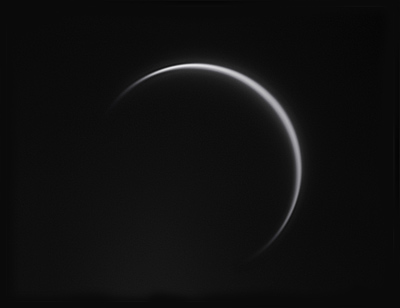
That question has been controversial, but in fact some people can. The rough rule of thumb is that someone with excellent vision can just resolve two image elements 60 arcseconds (60") apart. At times, this is enough resolution to make out the crescent.
To reduce glare, examine Venus in bright twilight rather than in darkness. You can improve your chances by looking through a clean, round hole 2 or 3 millimeters in diameter held just in front of your eye. This reduces spikes and blurring due to optical aberrations away from the center of your pupil. Experiment with different-size holes, as Fred Schaaf urged in the November 2002 issue, page 104.
— Alan MacRobert
About Alan MacRobert
Alan M. MacRobert became an avid Sky & Telescope subscriber in 1966 at age 14, joined the editorial staff in 1982, and is now a senior contributing editor, semi-retired. He played a role in practically every part of the magazine and the company's other products for more than a generation, both on the amateur-observing side and the science-reporting side. In 1994 a book collection of his observing how-tos and telescopic sky tours was published as Star Hopping for Backyard Astronomers. He has produced This Week's Sky at a Glance online every week since 1989.



Comments
You must be logged in to post a comment.