 SUNSET:

 0
0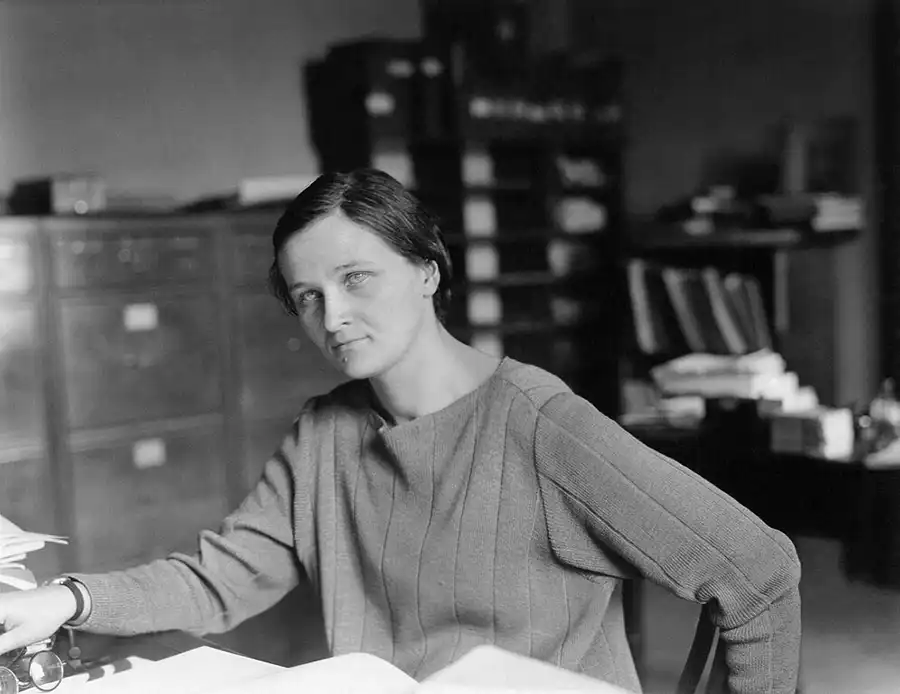
Smithsonian Institution
A young woman sat in the dimly lit corridors of the Harvard College Observatory, delving into the mysteries of the cosmos. It was the 1920s and, surrounded by celestial spectrograms, Cecilia Payne was on the verge of a cosmic discovery that would redefine our understanding of not only stars but also the entire universe. In an era when women were often relegated to the sidelines of scientific inquiry, Payne (later Payne-Gaposchkin) would not only rise to prominence but would pave the way for future astronomers and astrophysicists.
Early Life: Young Scientist
Cecilia Helena Payne was born on May 10, 1900, in Buckinghamshire, England, to Emma Leonora Helena Pertz and Edward John Payne, a barrister. Her father died when she was four years old, leaving only her mother to take care of the family. At the age of 12, her family moved to London for the education of her brother Humfrey, who later became an archaeologist. She attended St. Mary’s College; however, the school didn’t offer much in the way of math or science, so in 1918 Payne transferred to St. Paul’s Girls’ School.
The very next year, Payne won a scholarship to Newnham College at the University of Cambridge, which is where her higher education in science began. She initially chose botany, physics, and chemistry, though she dropped botany after her first year. But then she attended a lecture by Arthur Eddington on his recent expedition to observe the 1919 solar eclipse, an observation that provided evidence for Einstein’s general theory of relativity.
When she met Professor Edington, he encouraged her ambition in his terse way. As she later recounted in her autobiography, “I blurted out that I should like to be an astronomer . . . he made the reply that was to sustain me through many rebuffs: ‘I can see no insuperable objection.’” He allowed her to use the Observatory's library, which had all the latest astronomical journals. She went on to complete her studies, but she wasn’t awarded a degree; the University of Cambridge didn’t award degrees to women until 1948.
New Shores
After completing her studies, she realized that there weren’t enough opportunities for female astronomers in England. When she attended a lecture by Harlow Shapley, the director of Harvard College Observatory, he offered her a graduate fellowship at Harvard. Payne accepted the opportunity and in 1923, she left England and moved to the United States, where she spent the rest of her life.
Since the early 1900s, astronomers have used spectroscopes to find the chemical composition of stars. A spectroscope spreads light across wavelengths, with the wavelengths increasing from the violet to the red end of the spectrum. The spectrum of the Sun was already known to have many narrow dark gaps where the light at certain wavelengths is missing, called Fraunhofer lines. We now know these gaps come about because various chemical elements in the Sun’s atmosphere absorb the light coming from hotter regions below.
In 1859, Gustav Kirchoff and Robert Bunsen, two German scientists, heated several chemical elements and observed the spectra of the light from the incandescent gas. They realized that each element has its own characteristic set of spectral lines, which gives it a unique identity, like a fingerprint. In 1863, William Huggins, an English scientist, noticed many of these same lines in stellar spectra. Astronomers at the time figured you could obtain the composition of the stars by comparing their spectra to the fingerprints of known chemical elements observed in the lab. Iron, for example, is responsible for some of the most prominent lines, which led astronomers to think stars are made of the same chemical elements as those found on Earth.
By the time Payne came to Harvard, Annie Jump Cannon had categorized the spectra of hundreds of thousands of stars into seven classes: the famous OBAFGKM sequence. However, why would stars exhibit only seven types of spectra when there could be many different combinations of elements?
Payne, who had studied quantum physics at Cambridge, now applied that knowledge to her research at Harvard. From the work of Meghnad Saha, she knew that the pattern of features in a spectrum for a particular atom depends on the configuration of that atom’s electrons. And that configuration depends on temperature: At higher temperatures, atoms in a gas move faster, colliding with one another more often. Such collisions lead to the loss of electrons, and these ionized atoms absorb different wavelengths than their neutral atoms.
Revolutionizing Stellar Astronomy
Payne concluded her analysis of stellar absorption lines in 1925, becoming the first person to receive a PhD in astronomy from Radcliffe College. (Harvard didn’t confer degrees to women at that time.) In her doctorate thesis, titled “Stellar Atmospheres: A Contribution to the Observational Study of High Temperature in the Reversing Layers of Stars,” she explained that the variation in stellar absorption lines was due to different ionization states, and thus different temperatures of the stars.
She had found that the seven groups of patterns of stellar spectra corresponded to seven types of hydrogen ions — each of which only existed at a certain temperature range. Payne also looked at what other ions could exist at those temperatures. She discovered that the only other element that could be found in the spectral lines was helium, with only a few trace amounts of other elements. In other words, the composition of not only our Sun but also other stars is predominantly hydrogen and helium.
A Struggle for Recognition
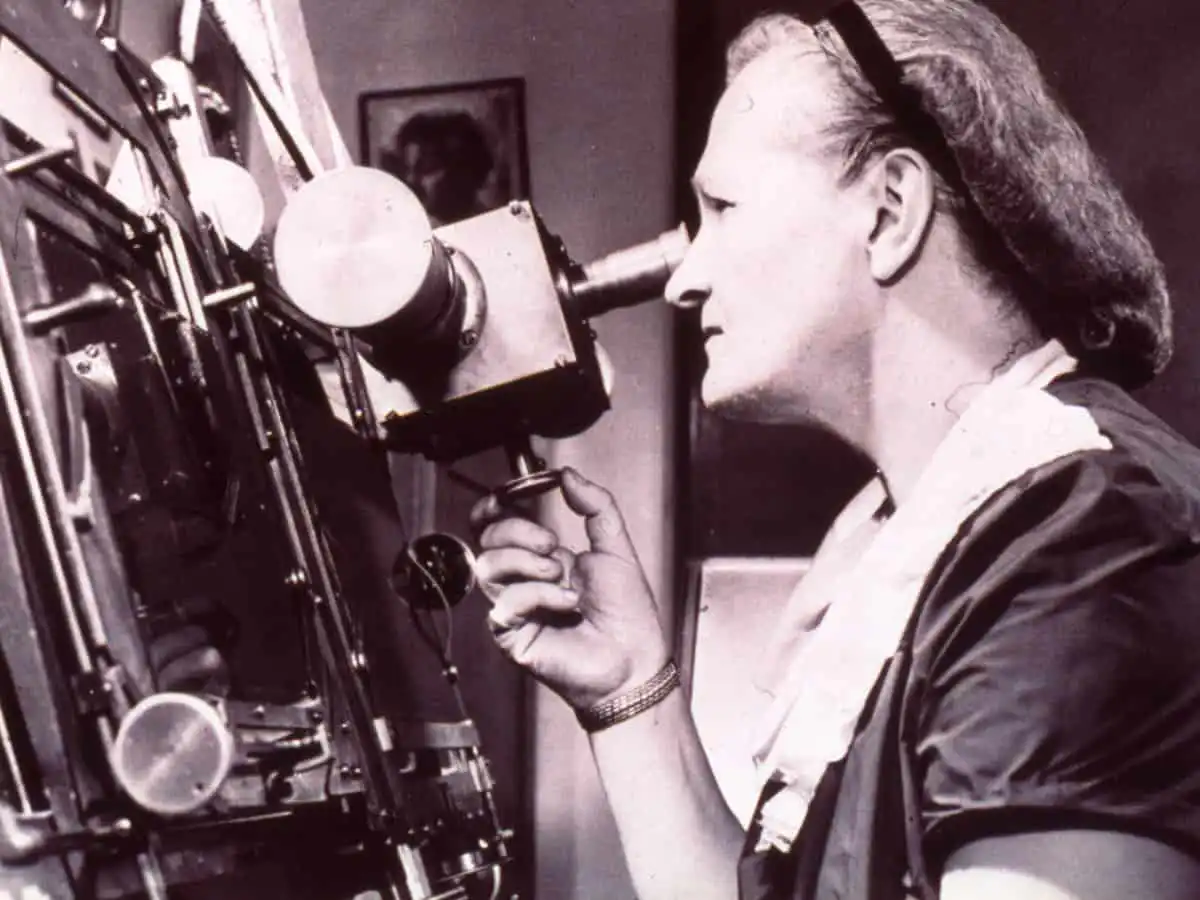
Astronomical Society of the Pacific, courtesy AIP Emilio Segrè Visual Archives / Physics Today Collection)
Decades later, astronomer Otto Struve would call the work “undoubtedly the most brilliant Ph.D. thesis ever written in astronomy.”
However, it wasn’t seen so at the time. When Harlow Shapley sent Payne’s thesis to Henry Norris Russell at Princeton University, Russell described her conclusion as “spurious” and “clearly impossible.” He was still convinced the stars were made of the same stuff as Earth. He dissuaded her from stating this conclusion outright in her thesis. Yet four years later in 1929, even Russell realized she was correct when he derived the same results using a different method. He briefly credited Payne's work in his publication, although he was still credited by many for the discovery she had made years earlier.
After her doctorate, Payne stayed at Harvard. In 1934, she married Russian-born astronomer Sergei Gaposchkin, and they had three children: Peter, Edward, and Katherine. However, although Payne-Gaposchkin performed all the duties of a professor, such as conducting research and lecturing and advising students, her title remained “technical assistant.” Shapley approached the president of Harvard University, Abbott Lawrence Lowell, to promote her, but Lowell adamantly refused, stating that Payne-Gaposchkin "would never have a position in the University as long as he was alive.”
Nevertheless, things began to change in the coming decades. When Donald Menzel was appointed director of Harvard College Observatory, he promoted Payne-Gaposchkin to the post of a professor in 1956; he also appointed her as the Phillips Professor of Astronomy in 1958. Later, with her promotion to the Chair of the Department of Astronomy, she became the first woman to head a department at Harvard University.
A Lasting Legacy
Payne-Gaposchkin, in collaboration with her husband, continued to make significant contributions to the study of variable stars. In 1938 they published a book on the subject, which organized variable stars by their patterns in brightness, or light curves. Payne-Gaposchkin also studied stars of high luminosity, including all stars intrinsically brighter than 10th magnitude, to understand the structure of the Milky Way. She made more than 1 million observations over her lifetime, many of which helped determine the paths of stellar evolution.
Payne-Gaposchkin continued her work until her death in 1979. She received many awards and honors, including the Annie J. Cannon Award in Astronomy (1934), the Henry Norris Russell Prize (1976), Professor Emerita (1967), Rittenhouse Medal (1961), and honorary degrees from several universities. An asteroid in the main belt and a volcano on Venus were named after her (2039 Payne-Gaposchkin and Payne-Gaposchkin Patera, respectively).
Ultimately, Cecilia Payne-Gaposchkin was a pioneering scientist whose ground-breaking research revolutionized our understanding of stellar composition. She continued to make significant contributions to astrophysics throughout her career despite the challenges she faced in receiving equal recognition (and pay) for her work. While her work was often overlooked and her legacy almost forgotten, more recently her contributions have achieved recognition. Payne-Gaposchkin is now remembered as a brilliant astronomer whose groundbreaking work has inspired generations of women scientists.


Comments
You must be logged in to post a comment.