 SUNSET:

 2
2Working 30 years for the legendary astrophysicist, the self-taught mathematician calculated a key value necessary for a planet to sustain a magnetic field, and thus life — a breakthrough overlooked for half a century.

Photo courtesy of Susan Steele
For a postdoctoral fellowship at UCLA, Susanne Horn returned to the book long regarded as a foundation of her science, fluid dynamics. On page 208, the mystery lay in plain sight. Horn aimed to crack it.
In the book, Hydrodynamic and Hydromagnetic Stability, published in 1961, legendary astrophysicist Subrahmanyan Chandrasekhar made a bold mathematical case that fluid dynamics could reveal the universe. But for the breakthrough on page 208, the author gave all the credit to his computer.
“The fact that the curve R(a) defined by equations (59) and (60) has two minima for certain ranges of the parameters Q1 and T1 was first observed by Donna Elbert.”
But no one followed up, until Horn nearly fifty years later, and she realized that the table described a key mechanism for a planet to generate a magnetic dynamo — and thus support and protect life. As she prepared to publish on what she named “the Elbert range,” Horn searched for Elbert the mathematician. She found an obituary, from the month before.
Early Days
Donna DeEtte Elbert remembered the summer day when she was nine, and Chandra and his wife came from India to Williams Bay, Wisconsin. She felt sad they were far from home, but she soon thought of them as much a part of the scenery as the nearby Yerkes Observatory where Chandra worked.

Photo courtesy of Susan Steele
The only daughter of the only barber in town, the popular, artistic Donna sewed her own clothes and dreamed of studying fashion. But tuition was out of reach, and her little brother Phil teased that girls didn’t go to college. She worked in Milwaukee for a while, then her father said Chandra, in for a haircut, mentioned he had a job to fill.

Photo courtesy of M. Joanne Kantner
Born in 1910 in Madras, first son of his Brahmin family, and a math prodigy, Chandra earned a place at Cambridge at 19 years old. He passed the lonely sea voyage to England by calculating a critical threshold in the evolution of a star as it exhausts its fuel.
Six years later, Chandra joined the University of Chicago at its Yerkes Observatory, 100 miles northwest of the main campus. He had been there a decade when he hired Elbert, who found him kind and polite, honest and direct, and, at 38, incredibly old.

Photo courtesy of Susan Steele
Her official title was technical assistant, but the informal term was “computer.” Processing data at an American observatory was one of the few science jobs available to women from the mid-19th century to the 1960s. Elbert handled Chandra’s correspondence and his students, but her biggest task was double-checking his math on a Marchant mechanical calculator. She liked the work, and she was good at it.
He told biographer Kameshwar C. Wali, “The fact that she was there and could do such work meant I could carry on the work until it was aesthetically complete and not merely complete as far as in the kind of information I wanted.”
Theoretical physicist Marvin Goldberger also told Wali, “I used to accuse Chandra of chaining her into a closet and making her carry out his horrendous calculations.”
By 1957, Elbert and Chandra had gone deep into the math of fluid dynamics, and she even published a paper as sole author. Their years of work coalesced into the foundational textbook Hydrodynamic and Hydromagnetic Stability. In the preface, Chandra wrote of “the extent of my obligation to Miss Donna D. Elbert: In a real sense, this book is the outcome of our joint efforts over the years and without her part, there would have been no substance.”
Insight
The textbook tackles fluid dynamics as a branch of experimental physics, walking through how a planet’s liquid metal core generates the global magnetic field necessary for a planet to sustain life.
Theories at the time suggested that rotation and magnetism needed to be relatively equal in strength to stabilize the action in the planet’s core.
But on her own, Elbert found that the forces did not have to be equal, that large-scale magnetic forces and small-scale rotation could also do the job. With Elbert’s insight, Chandra built a hypothesis of how the constantly shifting environment of a planet’s liquid metal core can regenerate a magnetic field strong enough for a planet to shield its atmosphere and protect life on its surface.
For the table on page 208, he credited Elbert for the “two minima for certain ranges of the parameters Q1 and T1.”
When Chandra packaged the manuscript for the publisher, he invited Elbert to go with him to the Walworth post office to drop the book in the late mail.
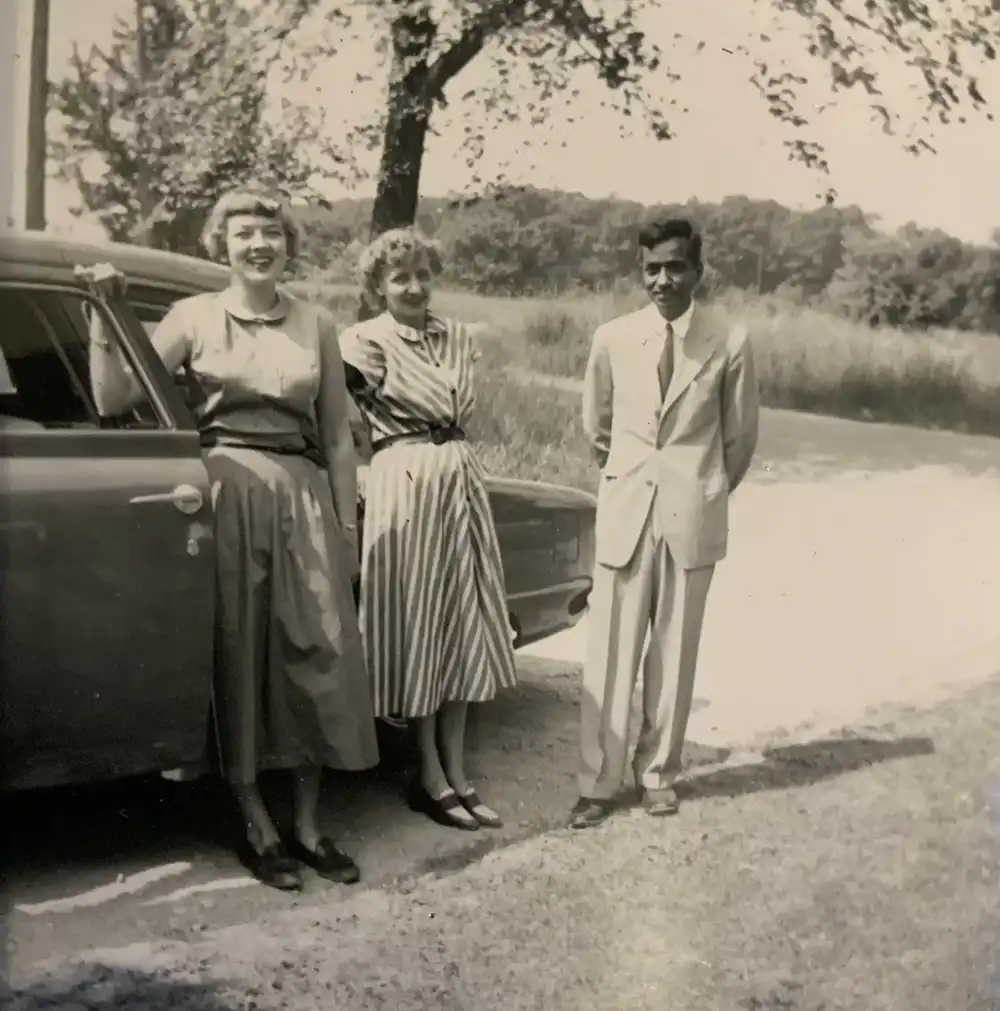
M. Joanne Kantner
Elbert told her family Chandra was a genius. But as happens with some geniuses, honesty and directness can come off as gruffness, even anger. His students took wounded feelings to Elbert, who consoled them: He doesn’t mean it, he cannot help it.
Her steadfast defense was even enshrined in the literature. One student parodied Chandra’s writing style in a paper by “S. Candlestickmaker,” which thanked “Miss Canna Helpit, who carried out the laborious numerical work involved in deriving equation (8).” With Chandra’s delighted blessing, the author’s friends took up a collection to publish the paper.
But Miss Canna Helpit could get irritated with the genius, too. Once Chandra came on too strong, and Elbert fired back, “Yes, master.” Chandra was quiet a moment, then he laughed, and the air cleared.
Legacy
Elbert’s nieces Susan Steele and M. Joanne Kantner, her brother Phil’s daughters, said Aunt Donna often predicted Chandra would win the Nobel Prize. If Phil ribbed his sister, Elbert turned to Susan and said she had been published more than any of them. At 46, she at last earned her bachelor’s degree in fine arts from the School of the Art Institute of Chicago.
In 30 years of collaboration, Elbert coauthored 18 publications, and in dozens more, Chandra credited her in some way. And then, the machines eliminated the computer’s job. In 1979, Chandra arranged for Elbert to become office manager for the university’s astronomy and astrophysics department.
In 1983, the king of Sweden presented Chandra with the Nobel Prize in physics for his insight on that sea voyage to England: that some dying stars hit a threshold and collapse into black holes. That threshold is called the Chandrasekhar limit.

Photo courtesy of Susan Steele
Aunt Donna was joyful for her old friend, her nieces said, but Kantner also sensed a little disappointment. When he did that work, Aunt Donna said, Chandra was young, and alone. He had broken so much more ground since then.
Chandra died in 1995 at 85. For the centennial of his birth, physicist Russell J. Donnelly, a Chicago colleague and friend, took note of Chandra’s pioneering work in an area “essentially forgotten in mainstream physics.”
“Chandra had the bad luck of turning to fluid dynamics just before computers became generally available, and his numerical methods are not used today,” Donnelly wrote. “His calculations were done on a Marchant mechanical calculator by his incredibly hard-working assistant, Donna Elbert. We used to call her ‘Miss Canna Helpit.’”
The Elbert Range
Susanne Horn, a native of Schleiz, Germany, earned a doctorate in physics from the University of Göttingen in 2014. She did her postdoctoral fellowship at University of California, Los Angeles, with Jonathan Aurnou, a professor of Earth, planetary and space sciences. Her goal: to understand the table on page 208 of Hydrodynamic and Hydromagnetic Stability.
Horn had never heard of a person as a computer. But turning the UCLA machines on Elbert’s math left Horn astonished. Earth is the only planet in the solar system where all the necessary ingredients came together support life. But Horn found that the magnetic dynamos of Mars, Jupiter, Saturn, Neptune, and Uranus — even Jupiter’s moon Ganymede — also register in the Elbert range, meaning these worlds support global magnetic fields. At least, Horn argued, Elbert gave astrophysics a better tool when hunting for planets where life might spring.
“She clearly did not just type a number. She quite often also simplified the equations from Chandrasekhar,” Horn said. “She understood what she was doing and was not just a calculator. She’s completely self-taught, in a sense. So, yes, she got the support from Chandrasekhar, but clearly she was extremely smart to do this.”
Elbert enjoyed a long, pleasant retirement in Williams Bay. She died on January 15, 2019, a week shy of 91. One month later, Susanne Horn read her obituary.

Photo courtesy of Susan Steele
In August 2022, Horn’s paper, “The Elbert range of magnetostrophic convection. I. Linear theory,” was published in the Proceedings of the Royal Society A. She plans two more papers about the science in the table on page 208. But she also has found that Elbert’s life story resonates, especially with women scientists, and they now are paying tribute to the self-taught mathematician from small-town Wisconsin.
Noted California astronomer Virginia Trimble has long sponsored a student workshop at Lick Observatory, and she named the May 2024 event for Elbert. Three months later, Czech geographic researcher Alexandra Guy published a paper naming a feature in Antarctica the Elbert magnetic anomaly.
“People were not aware of her, even though everyone had somehow come across this name,” Horn said. “She was always the footnote in all the papers. Everyone always thinks, oh, the only smart person on this paper is Chandrasekhar. But she actually did a lot. These computations, they are not that easy.”
Anne Saker, a career daily journalist, was a member of the Cincinnati Enquirer team that earned the 2018 Pulitzer Prize in local reporting. She is in the Hall of Fame of the Greater Cincinnati Society of Professional Journalists. Email: [email protected]
About Anne Saker
Anne Saker ([email protected]) is a Cincinnati writer.


Comments
accurateye
February 6, 2025 at 10:01 pm
Excellent ! Another opening to a formative era of astronomy.
You must be logged in to post a comment.
jpb.astro
February 7, 2025 at 6:57 pm
Great story. But note that the Chandrasekhar limit is the mass limit for a collapsing stellar core or white dwarf to collapse into a neutron star, not to a black hole.
You must be logged in to post a comment.
You must be logged in to post a comment.