 SUNSET:


This Week's Sky at a Glance, January 13 – 21
On Saturday, the waning gibbous Moon and Regulus rise around 8 p.m. They'll part ways through the night as the Moon moves east along its orbit.
This Week's Sky at a Glance, January 6 – 14
The waxing gibbous Moon shines below the Pleiades and right of Aldebaran Saturday evening - watch the Moon's dark limb occult a star later that night.
This Week's Sky at a Glance, December 30 – January 7
Can you spot the fingernail-thin crescent Moon in twilight Friday night? It's less than two days old as seen after sunset from North America.
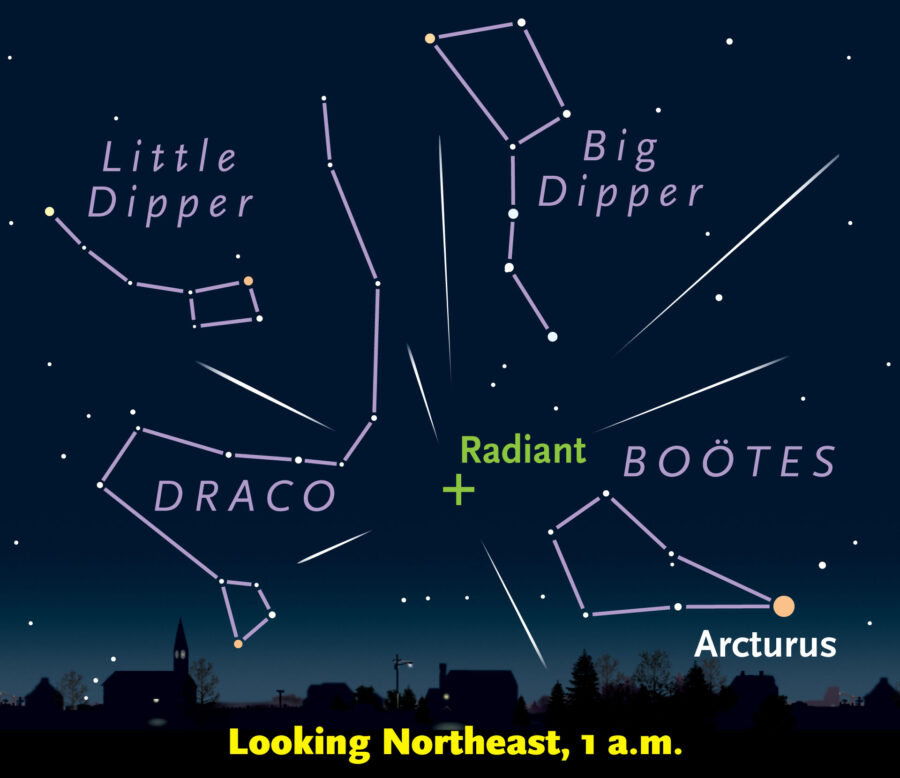
Catch the Quadrantid Meteors (If You Can)
The Quadrantids, one of the year's best meteor showers, peaks on the morning of January 3rd, is. But be ready for it — most of the action takes place over just a few hours.
This Week's Sky at a Glance, December 23 – 31
After dark you'll find the Pleiades high in the east, with Aldebaran and the Hyades below them. Far below these, Orion is beginning to clear the horizon.
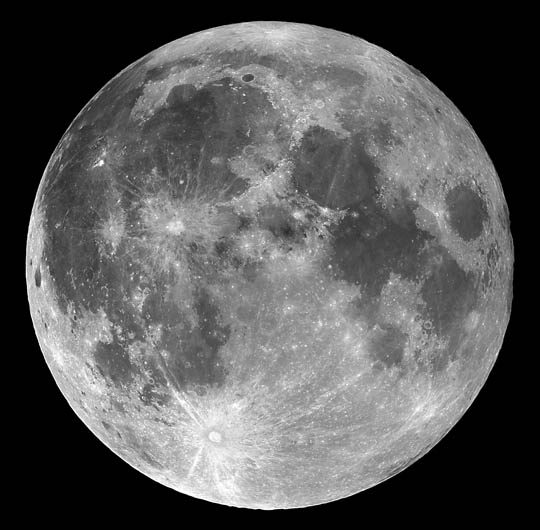
What to See with Your New Telescope During 2016 Holidays
Maybe this gift-giving season you got a shiny new telescope to call your own. Congratulations — you could be on your way to discovering many amazing far things in the night sky. Although most of them are so far and faint that just finding and detecting them is the challenge!…
This Week's Sky at a Glance, December 16 – 24
Have you ever watched a Sirius-rise? Watch for Sirius to come up about two fists at arm's length below Orion's Belt, around 8 p.m. local time.
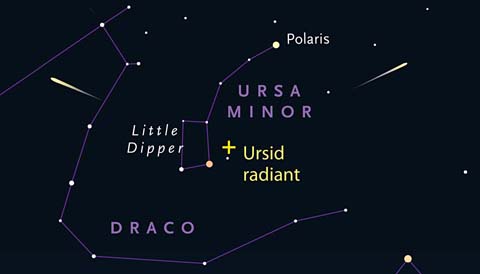
Can You Spot December's Ursid Meteors?
Try your hand at observing the handful of "shooting stars" delivered by this little-known annual meteor shower.
This Week's Sky at a Glance, December 9 – 17
The Moon, just a day before full, occults Aldebaran Monday night for nearly everyone in North America. And watch for the Geminid meteor shower!
This Week's Sky at a Glance, December 2 – 10
Friday and Saturday evenings, the thickening crescent Moon poses with bright Venus in the southwest at dusk. Wednesday marks the year's earliest sunset.
This Week's Sky at a Glance, November 25 – December 3
Before and during dawn Saturday morning, the thinning crescent Moon in the southeast is at the bottom of an arc that it now forms with Spica and Jupiter.
This Week's Sky at a Glance, November 18 – 26
With the Moon gone from the evening sky, explore deep-sky sights in Lacerta. Or use only your eyes to see Andromeda Galaxy and the Perseus Double Cluster.
This Week's Sky at a Glance, November 11 – 19
Saturn is falling ever farther away to the lower right of Venus at dusk. And in the coming weeks and months, watch Venus and Mars draw closer together.
This Week's Sky at a Glance, November 4 – 12
Mars shines to the left or lower of the Moon early Saturday evening. On Tuesday, the Moon is in Aquarius - look to its left for Fomalhaut, the Autumn Star.

Moon to Cover Bright Star Aldebaran
This eye-catching occultation occurs late on October 18th (West Coast) and early on the 19th (East Coast). It's a grazing event as seen from Los Angeles and Denver.
This Week's Sky at a Glance, October 14 – 22
The full Moon rises around sunset on Saturday. Almost 20° to its left are the brightest stars of Aries. Like the Moon, faint Uranus is also at opposition.
This Week's Sky at a Glance, October 7 – 15
Jupiter and fainter Mercury have a close conjunction on Tuesday morning, October 11th. Look low due east about 45 minutes before your local sunrise time.

Fall Astronomy Day: Saturday, October 8th!
Amateur astronomy clubs, planetariums, science museums, and parks celebrate Astronomy Day twice a year.
This Week's Sky at a Glance, September 30 – October 8
A twilight challenge: About half an hour after your local sunset time, look for Venus very low in the west-southwest through the twilight.
This Week's Sky at a Glance, September 16 – 24
Parts of Europe, Africa, and Asia will see a penumbral lunar eclipse Friday. Eclipse or no, look for the Great Square of Pegasus to the Moon's upper left.
