 SUNSET:


This Week's Sky at a Glance, May 13 – 21
As twilight fades, look upper left of the first-quarter Moon for Regulus. Brighter Jupiter shines much farther to the Moon's left (for North America).

Mercury Transit: Everything You Need to Know
The littlest planet will cross the enormous Sun for viewers in most of the world.
This Week's Sky at a Glance, May 6 – 14
After sunset Saturday, catch the hairline crescent Moon just above the horizon. Bring out your scope to see a double-shadow transit on Jupiter Friday night.

Eta Aquariid Meteor Shower Reaches Its Peak
If you'd like to see bits of debris shed by Halley's Comet, then head out before dawn during the next few days.
This Week's Sky at a Glance, April 29 – May 7
The last-quarter Moon shines above Capricornus before dawn's first light. These evenings, the long, dim sea serpent Hydra snakes across the southern sky.
This Week's Sky at a Glance, April 15 – 23
Comet 252P/LINEAR is crossing Ophiuchus very high before the first light of dawn. The Moon Friday evening forms a gently curving row with Regulus and Jupiter.

$100 Million for Fast Probes to Alpha Centauri. Yes, Really.
Yuri Milner commits $100 million to Breakthrough Starshot, a research and development project toward sending interstellar nanoprobes to Alpha Centauri.
This Week's Sky at a Glance, April 8 – 16
Looking west in twilight, use the thin crescent Moon as your guidepost to Mercury. And have you tried yet for Comet 252P/LINEAR?

Crescent Moon To Cover Aldebaran
On Sunday afternoon, April 10th, you'll see the waxing crescent Moon hanging high in a sunny blue sky if the weather is as good as we hope it'll be. Look with a telescope from nearly anywhere in North America, and you can find something else too. Somewhere in the Moon's…
This Week's Sky at a Glance, April 1 – 9
Spring is here! Which means Arcturus shines brightly in the east. The Big Dipper, high in the northeast, points its handle toward it.
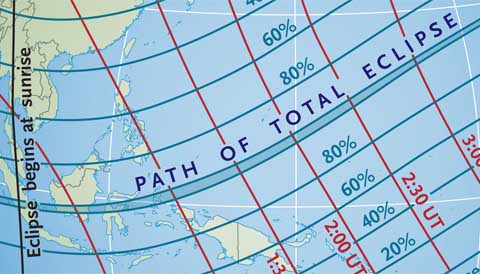
March's Total Solar Eclipse in Indonesia
On March 9th, a total solar eclipse will cross parts of Sumatra, Borneo, Sulawesi, and the Pacific. Use our map to find out what you'll see at any location.
This Week's Sky at a Glance, February 26 – March 5
After dinnertime this time of year, four carnivore constellations stand in a row from the northeast to south: Ursa Major, Leo, Hydra, and Canis Major.
This Week's Sky at a Glance, February 12 – 20
The biggest well-known star pattern is the Winter Hexagon, marked by the stars Sirius, Procyon, Pollux, Castor, Beta Aurigae, Capella, Aldebaran, and Rigel.

Planet Hunter Wins Amateur Research Award
The Chambliss Amateur Achievement Award, issued annually by the American Astronomical Society (AAS) "for exemplary research by an amateur astronomer" if there is a suitable candidate, goes to Darryll LaCourse of Marysville, Washington.
This Week's Sky at a Glance, February 5 – 13
See all five naked-eye planets at dawn, though Mercury is getting low. On Saturday morning, the crescent Moon, Venus, and Mercury form a triangle low in the southeast.
This Week's Sky at a Glance, January 29 – February 6
The last-quarter Moon rises around 1 a.m. Sunday night, in company with Mars. By the dawn of Monday the 1st they're high in the south.
This Week's Sky at a Glance, January 22 – 30
See all five planets at dawn! The nearly-full Moon shines in Gemini Friday evening — with Castor and Pollux to its left and Procyon to its lower right.
This Week's Sky at a Glance, January 15 – 23
The Moon shines in dim Pisces upper left of the Great Square of Pegasus. Does the half-lit Moon look just a trace bigger than usual? It's about at perigee.
This Week's Sky at a Glance, January 8 – 16
Comet Catalina (C/2013 US10) is fading but still within view. A special treat on January 9th: Venus and Saturn just half a degree from each other.
This Week's Sky at a Glance, January 1 – 9
Comet Catalina (C/2013 US10) remains visible very high in the southeast before the first light of dawn. For more to see, look to Orion in prime view.
