 SUNSET:


This Week's Sky at a Glance, September 2 – 10
A Friday twilight challenge: Shortly after sunset, use binoculars to look for the super-thin crescent Moon near Jupiter and Venus just above the horizon.
This Week's Sky at a Glance, August 26 – September 3
Venus-Jupiter conjunction on Saturday: about 20 minutes after sunset, look above the western horizon, left of where the Sun went down. Bring binoculars.
This Week's Sky at a Glance, August 19 – 27
Summer is on the decline, temperatures notwithstanding: when darkness falls, Cassiopeia has now risen as high in the northeast as the Big Dipper has sunk in the northwest.
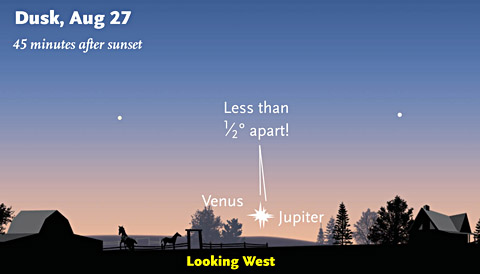
Two Planet Pairs Perform at Dusk
As twilight fades for the rest of August, follow two planetary groupings happening at dusk in different parts of the sky.
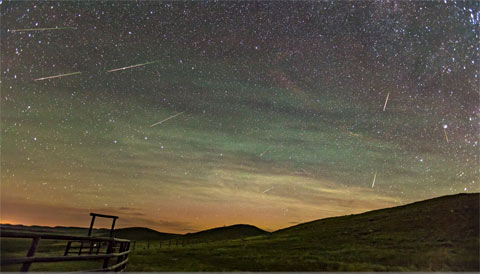
Yes, the Perseids Did Quite Nicely!
Many observers who had a dark, starry sky late last night (Aug. 11-12, 2016) were rewarded with an especially rich Perseid meteor shower. And it's probably not over yet.
This Week's Sky at a Glance, August 12 – 20
This Friday, look lower right of the waxing gibbous Moon for the ever-changing Saturn-Mars-Antares triangle. Full Moon on Wednesday night.
This Week's Sky at a Glance, August 5 – 13
The crescent Moon poses with Jupiter low in the west in twilight Friday. Early next week, Mars passes 0.9° beneath Delta Scorpii, the brightest star in the head of Scorpius.
This Week's Sky at a Glance, July 29 – August 6
As summer goes on, Scorpius shifts westward from its high southern stance just after dark; Sagittarius moves in from the east. Prime time for Messier objects!
This Week's Sky at a Glance, July 22 – 30
Starry Scorpius is sometimes called "the Orion of Summer" for its brightness, its blue-giant stars, and its 1st-magnitude red supergiant (Antares).
This Week's Sky at a Glance, July 15 – 23
The Moon shines over Mars, Saturn, and Antares at dusk. And after Saturday's sunset, use binoculars to look for Venus — with fainter Mercury a bit above.
This Week's Sky at a Glance, July 8 – 16
The waxing crescent Moon shines in the west at dusk on Friday. Jupiter is the bright "star" at its upper left (for North America).
This Week's Sky at a Glance, July 1 – 9
Is your sky dark enough to see the Coma Berenices star cluster naked-eye? Spot Jupiter in the west after twilight this week and the cluster just above.
This Week's Sky at a Glance, June 24 – July 2
This is the time of year when the two brightest stars of summer, Arcturus and Vega, hang about equally high overhead shortly after dark: Arcturus in the southwest, Vega in the east.
This Week's Sky at a Glance, June 17 – 25
The Moon, Mars, and Saturn make a wide, flattish triangle Friday night. At nightfall, look for the Big Dipper hanging straight down in the northwest.
This Week's Sky at a Glance, June 10 – 18
Friday evening the Moon poses between Jupiter and Regulus. Turn binoculars on Jupiter, and you'll find the star Chi Leonis among the Galilean satellites.
This Week's Sky at a Glance, June 3 – 11
The Mars-Antares-Saturn triangle rises higher at dusk every night, and halfway between Mars and Jupiter stands Spica. Cassiopeia lurks low in the north.
This Week's Sky at a Glance, May 27 – June 4
The last-quarter Moon doesn't rise until around 2 a.m. It'll be between the Aquarius's dim spilling bucket and the dim Circlet of Pisces.
This Week's Sky at a Glance, May 20 – 28
The nearly full Moon looms low in the east-southeast at sunset and shines above Mars as twilight fades. How soon can you pick out Mars?

Mars Opposition: Best Showing in a Decade
At last, a fine Mars apparition: on May 22nd the Red Planet reaches opposition, shining almost as bright as Jupiter, and the planet makes its closest approach to Earth on May 30th.
This Week's Sky at a Glance, May 13 – 21
As twilight fades, look upper left of the first-quarter Moon for Regulus. Brighter Jupiter shines much farther to the Moon's left (for North America).
