 SUNSET:

 1
1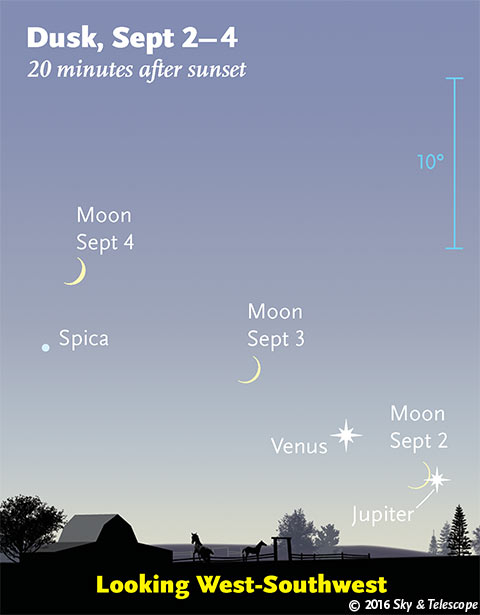
Friday, September 2
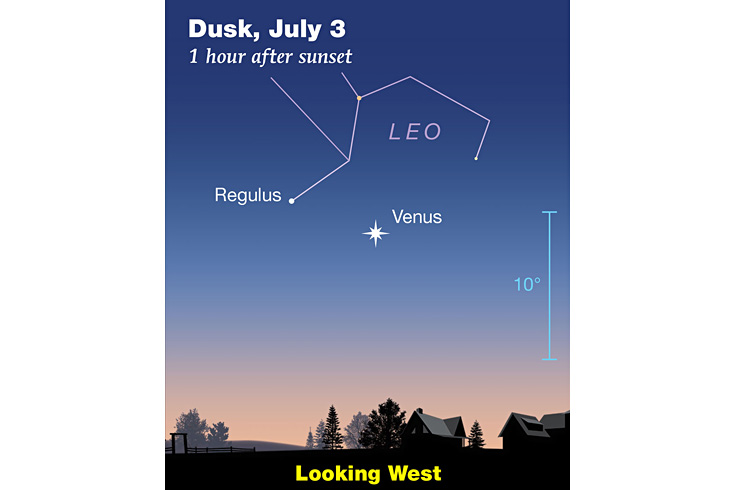
• A twilight challenge: Shortly after sunset, use binoculars or a wide-field scope to start looking for the super-thin crescent Moon near Jupiter and Venus in the bright sky just above the west-southwest horizon, as shown at right. The Moon will be much easier tomorrow.
Saturday, September 3
• Shortly after sunset, the crescent Moon low in the west-southwest points the way lower right to bright Venus and tougher Jupiter, as shown at right.
Sunday, September 4
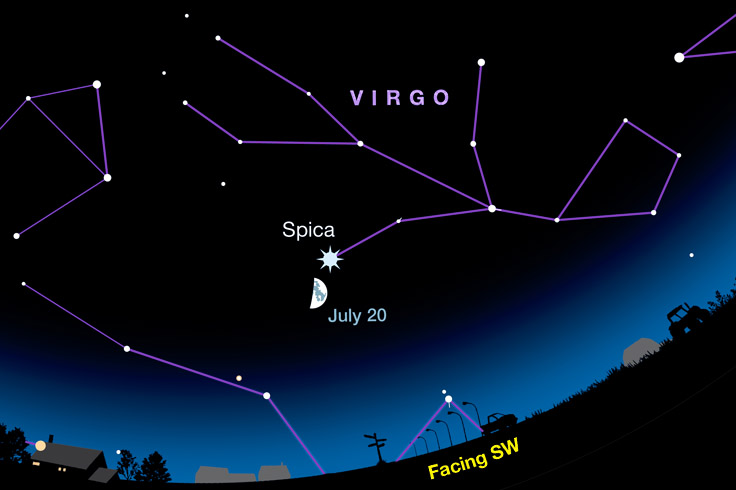
• The Moon has stepped farther to the upper left of Venus in the afterglow of sunset. Can you pick out little Spica twinkling below the Moon?
Monday, September 5
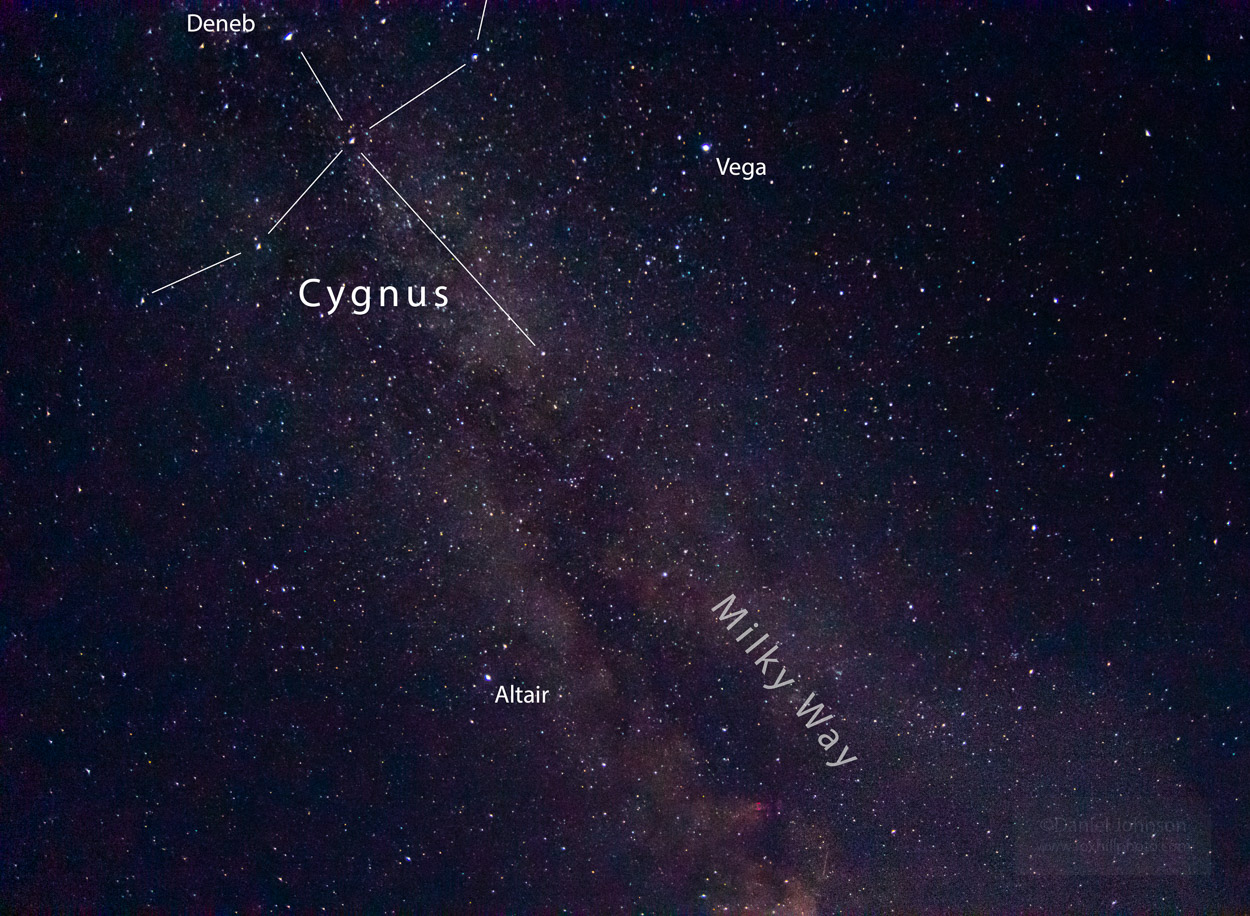
• Crisp nights of late summer are prime Milky Way time, as hot-weather humid hazes give way to dryer, clearer air (at least where a lot of us live). After dark, the Milky Way runs from Sagittarius in the south, up and left across Aquila, through the big Summer Triangle almost overhead, and on down through Cassiopeia to Perseus rising in the north-northeast. Enjoy it tonight before the Moon starts brightening the evening sky.
Tuesday, September 6
• As summer approaches its end, Vega becomes the zenith star around the end of twilight (for skywatchers at mid-northern latitudes). And Arcturus, its zero-magnitude equal for brightness, shines moderately low in the west.
Wednesday, September 7
• The asteroids 1 Ceres and 18 Melpomene, magnitudes 8 and 9, will both fit in a telescope's low-power eyepiece very late tonight and tomorrow night; they're 0.8° apart. See the September Sky & Telescope, page 51.
Thursday, September 8
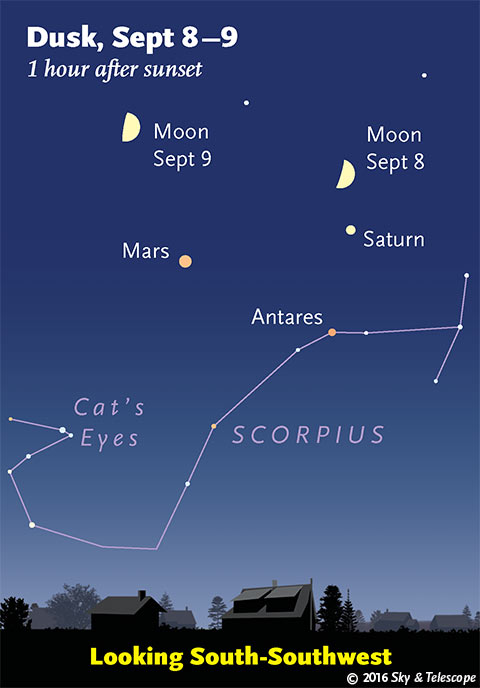
• The Moon this evening forms a roughly vertical lineup with Saturn and Antares below it, while brighter Mars glows yellow-orange to their left, as shown here.
Friday, September 9
• Now the Moon shines over Mars at dusk. The Saturn-Mars-Antares triangle, the emblem of this summer's evening sky, continues to morph. In the coming days and weeks Saturn and Antares will continue to move farther toward the lower right, while Mars hangs back and fades. By mid-autumn Saturn and Antares will be gone.
Saturday, September 10
• The Moon at nightfall shines over the Sagittarius Teapot. The Teapot is tipping and pouring to the right.
_________________________
Want to become a better astronomer? Learn your way around the constellations! They're the key to locating everything fainter and deeper to hunt with binoculars or a telescope.
This is an outdoor nature hobby. For an easy-to-use constellation guide covering the whole evening sky, use the big monthly map in the center of each issue of Sky & Telescope, the essential guide to astronomy.

Once you get a telescope, to put it to good use you'll need a detailed, large-scale sky atlas (set of charts). The basic standard is the Pocket Sky Atlas (in either the original or new Jumbo Edition), which shows stars to magnitude 7.6.
Next up is the larger and deeper Sky Atlas 2000.0, plotting stars to magnitude 8.5, nearly three times as many. The next up, once you know your way around, is the even larger Uranometria 2000.0 (stars to magnitude 9.75). And read how to use sky charts with a telescope.
You'll also want a good deep-sky guidebook, such as Sue French's Deep-Sky Wonders collection (which includes its own charts), Sky Atlas 2000.0 Companion by Strong and Sinnott, or the bigger Night Sky Observer's Guide by Kepple and Sanner.
Can a computerized telescope replace charts? Not for beginners, I don't think, and not on mounts and tripods that are less than top-quality mechanically (meaning heavy and expensive). And as Terence Dickinson and Alan Dyer say in their Backyard Astronomer's Guide, "A full appreciation of the universe cannot come without developing the skills to find things in the sky and understanding how the sky works. This knowledge comes only by spending time under the stars with star maps in hand."
This Week's Planet Roundup
Mercury is hidden in the glare of the Sun.
Venus (magnitude –3.8) is very low in the west in bright twilight. Look for it 20 or 30 minutes after sunset from a spot with a good open western view.
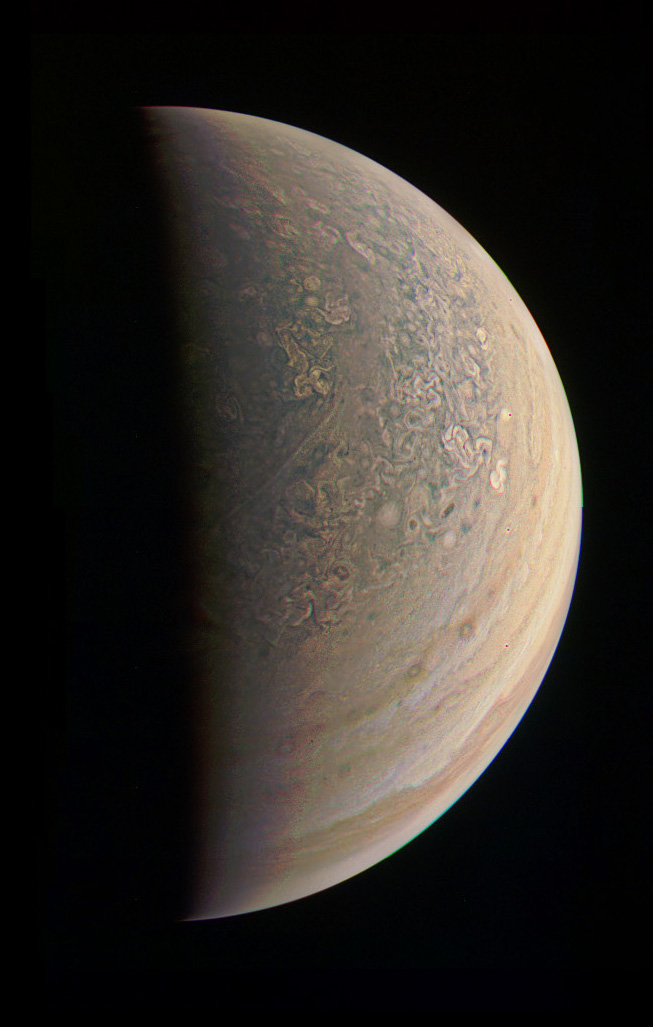
Jupiter, following its conjunction with Venus on August 27th, has slid away pretty much out of sight down to Venus's lower right. It's passing around the far side of the Sun.
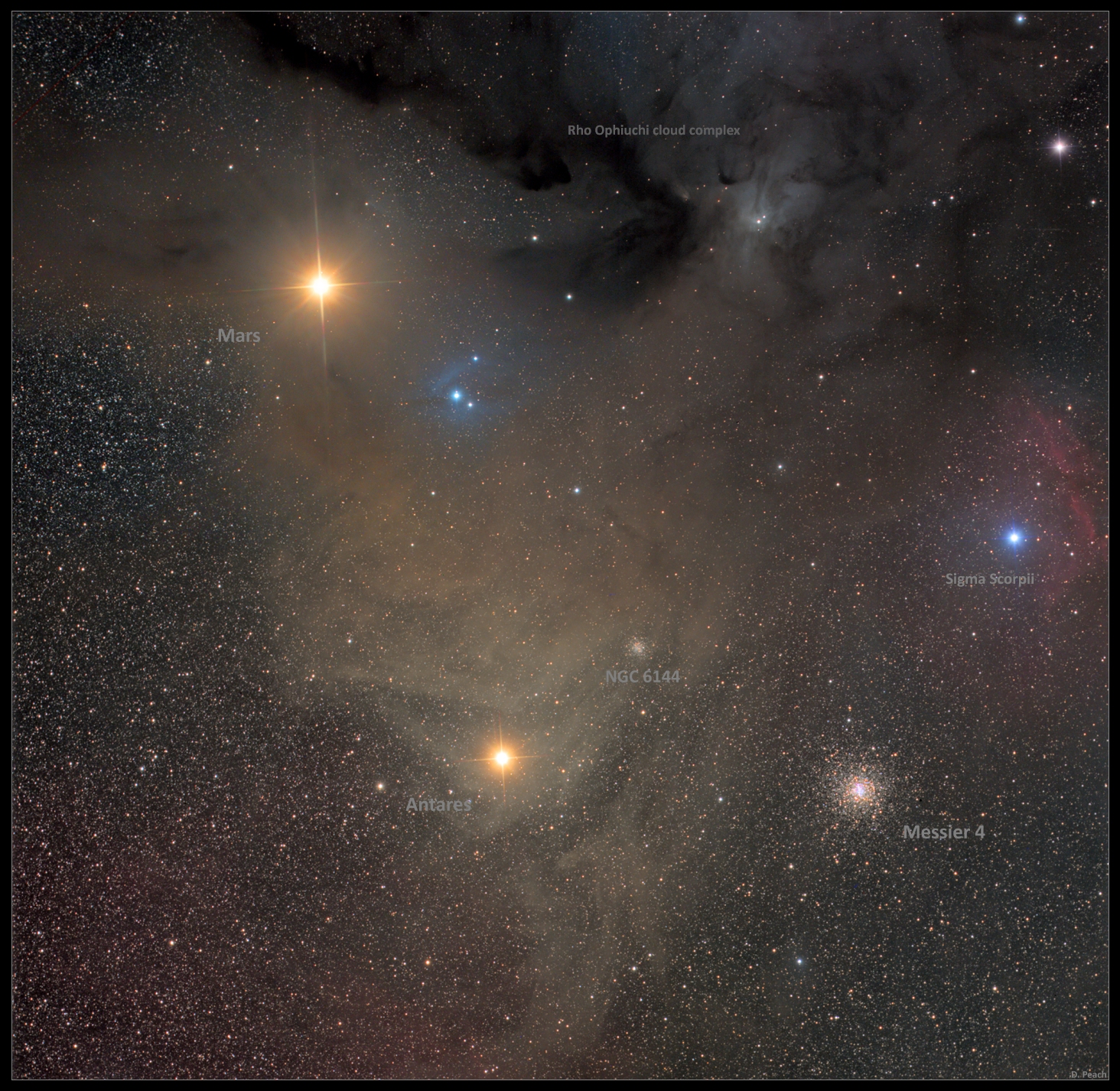
Mars (magnitude –0.2, in the feet of Ophiuchus) continues moving eastward away from Saturn (magnitude +0.5) and Antares (+1.0, below Saturn) in the south-southwest at nightfall. The triangle they make is widening.
Uranus (magnitude 5.8, in Pisces) and Neptune (magnitude 7.8, in Aquarius) are well up by midnight in the southeast and south, respectively. Info and finder charts.
__________________________
All descriptions that relate to your horizon — including the words up, down, right, and left — are written for the world's mid-northern latitudes. Descriptions that also depend on longitude (mainly Moon positions) are for North America.
Eastern Daylight Time (EDT) is Universal Time (UT, UTC, or GMT) minus 4 hours.
__________________________
"This adventure is made possible by generations of searchers strictly adhering to a simple set of rules. Test ideas by experiments and observations. Build on those ideas that pass the test. Reject the ones that fail. Follow the evidence wherever it leads, and question everything. Accept these terms, and the cosmos is yours."
— Neil deGrasse Tyson
About Alan MacRobert
Alan M. MacRobert became an avid Sky & Telescope subscriber in 1966 at age 14, joined the editorial staff in 1982, and is now a senior contributing editor, semi-retired. He played a role in practically every part of the magazine and the company's other products for more than a generation, both on the amateur-observing side and the science-reporting side. In 1994 a book collection of his observing how-tos and telescopic sky tours was published as Star Hopping for Backyard Astronomers. He has produced This Week's Sky at a Glance online every week since 1989.



Comments
John-Erickson
September 2, 2016 at 7:35 pm
For September 6, change the zenith star from "Venus" to "Vega."
You must be logged in to post a comment.
You must be logged in to post a comment.