 SUNSET:


Sky at a Glance | December 4th, 2009
Watch for Mercury to emerge low in the sunset this week, and watch for Sirius-rise after dinnertime on the other side of the sky. And get ready for the Geminid meteors, soon to arrive.
Sky at a Glance | November 27th, 2009
The waning gibbous Moon shines near Castor and Pollux in Gemini on Thursday and Friday evenings. Meanwhile Jupiter, edging farther from Earth every week, still shines high in the south in twilight. The Pleiades sparkle in the east after dark, Orion is well up by 9 p.m., Mars rises by 10, and Saturn rises around 2 a.m.
Cassini Visits a Science-Fiction World
NASA's Cassini probe grabbed three-dimensional views of a landscape of geysers, as the craft sped above an evening twilight zone on Saturn's moon Enceladus.
Sky at a Glance | November 20th, 2009
Jupiter, highest in the south at dusk now, continues its busy telescopic activity. Venus is disappearing low in the dawn, but thin-ringed Saturn is rising ever higher before the dawn into good telescopic view.
Sky at a Glance | November 6th, 2009
Orion is making its evening appearance. Jupiter, now highest in the south at dusk, is full of busy activity. And at dawn, Spica (and Saturn high above it) are moving higher while Venus sinks lower.
Sky at a Glance | October 30th, 2009
More mutual events among Jupiter's moons, Mars crossing the Beehive, and the Moon grazing the Pleiades highlight the night sky this week.
Blast from the Very Far Past
A gamma-ray burst seen to occur last April happened in the era of the earliest stars, when the universe was only 630 million years old and the "reionization era" was getting under way. But this news isn't exactly news.
Sky at a Glance | October 23rd, 2009
With Halloween approaching, it's the season for the annual Ghost of Summer Suns. This week also sees a busy schedule of mutual events among Jupiter's moons. And in the early-morning hours, fiery Mars is approaching the Beehive.
And Then There Were 400
Thirty new extrasolar planets are announced, including more super-Earths and some that orbit low-metallicity stars.
Sky at a Glance | October 16th, 2009
The waxing crescent Moon emerges from the sunset this week. But Jupiter, king of the gods and king of the planets, is also the king target for backyard telescope users these evenings, with lots going on.
Sky at a Glance | October 9th, 2009
Jupiter is a hub of backyard-telescope activity after dark. And Venus, Mercury, and Saturn dance at dawn.
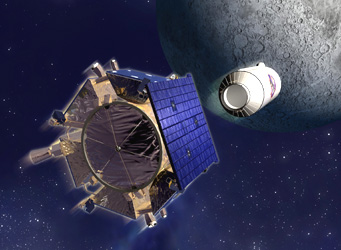
The LCROSS Impact, Continued
We've added updates our story on the Moon probe that NASA hoped would raise a big dust-and-vapor splash. The debris plume has indeed been seen. But how much information can be extracted from it?
Veteran S&T Editor Wins Reporting Award
J. Kelly Beatty has received plaudits from the planetary-science community he has covered for 35 years.
Sky at a Glance | October 2nd, 2009
Venus, Mercury, and Saturn dance at dawn this week. And get ready for the LCROSS impact on the Moon — whether you'll watch with a telescope, on TV, or on the web.
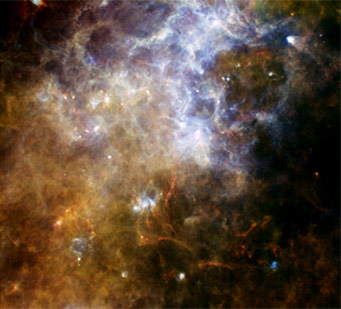
Big Pix from Herschel
Europe's new Herschel Space Observatory is up and running and showing what it can do. You've never seen the far-infrared sky like this.
Sky at a Glance | September 25th, 2009
The Moon waxes across the evening sky this week. Venus shines in the east at dawn, with challenging Mercury and Saturn coming into view below it.
Sky at a Glance | September 18th, 2009
Bright Venus and much fainter Regulus pair up closely on the morning of Sunday the 20th. Bring binoculars. And Jupiter dominates the evening sky, with its moons and bands awaiting your telescope.
Super-Earth "Planet From Hell" Refined
CoRoT-7b, a hot super-Earth orbiting an orange dwarf in Monoceros, had proved to be rocky, not gaseous. It's truly a Dante-like inferno, with liquid-lava temperatures on one side and unearthly cold on the other.
Sky at a Glance | September 11th, 2009
The waning Moon passes Venus in the dawn this week, as Venus nears Regulus. Jupiter dominates the evening sky, awaiting your telescope.
Refurbished Hubble Shows Its Stuff
Hubble's upgraded cameras and instruments are fully up and running. NASA has released a bunch of new pictures and results showing off what the buffed-up scope can do.
