 SUNSET:

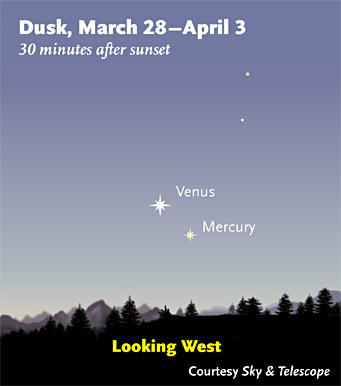
Sky at a Glance | March 26th, 2010
Venus and Mercury begin their lovely early-spring pairing low in the western sunset.
Mercury Takes the Spotlight
The normally elusive innermost planet has its best apparition of the year — with dazzling Venus to point the way!!

Sky at a Glance | March 19th, 2010
The Moon pairs with the Pleiades and then runs under the arc of Castor, Pollux, and Mars this week. Saturn comes to opposition. And as spring begins, Sirius leaves the meridian behind.
Sky at a Glance | March 12th, 2010
The thin Moon passes Venus low in the west in bright twilight this week. And Mars remains shining near Castor and Pollux high overhead after dark.
Sky at a Glance | March 5th, 2010
This week Mars is as near as it will get to Castor and Pollux, high in the east after dark. Narrow-ringed Saturn rises soon after dark.
Sky at a Glance | February 26th, 2010
Mars is fading and shrinking, but on the other hand it's now very high early in the evening. And narrow-ringed Saturn rises soon after dark.
Sky at a Glance | February 19th, 2010
Mars is high in the evening sky below Pollux and Castor. It's starting to fade and shrink a bit, but it's in best view for your scope earlier in the evening now.
WMAP Refines "Precision Cosmology"
With seven years of data, the WMAP cosmology satellite has refined the age of the universe and other key cosmic parameters. The results strengthen the "standard model" of inflationary cosmology.
Sky at a Glance | February 12th, 2010
Mars is high in the evening sky, still bright but starting to fade and shrink. Asteroid 4 Vesta is brightest and closest to Earth this week. And Venus and Jupiter have a challenging conjunction just above the west-southwest horizon after sunset.
Sky at a Glance | February 5th, 2010
Mars, just past opposition and still blazing brightly, rises higher in the east each evening. And Saturn is now up in the east by about 10 p.m.
Sky at a Glance | January 29th, 2010
Fiery Mars, at opposition, shines as brightly as icy Sirius. Catch Jupiter departing low in twilight. And Saturn is now up in the east by 10 or 11 p.m.
Sky at a Glance | January 22nd, 2010
This week Mars comes to opposition and passes closest to Earth, shining its brightest in the evening sky. Meanwhile, Jupiter slinks offstage low in the southwest.
Sky at a Glance | January 14th, 2010
Jupiter remains an eye-catcher as twilight fades, but it sinks low and sets early in the evening. Meanwhile Mars climbs high in the eastern sky during evening, shining nearly its brightest of the year.
Sky at a Glance | January 8th, 2010
Jupiter sinks lower at dusk, Mars rises earlier and earlier, Mercury begins to emerge in the dawn, and the Rabbit's Ruby reaches its maximum brightness.
Kepler's First Exoplanet Results
NASA scientists announced this morning that the Kepler planet-hunting probe is working great, has produced a slew of results, and is working at high enough precision that it should be able to determine the abundance, or rarity, of Earth-size worlds galaxy-wide.
Sky at a Glance | January 1st, 2010
The waning Moon passes Mars and Regulus, Orion climbs higher, and Auriga rules the late-evening zenith. And this week the year's latest sunrises happen for mid-northern latitudes — near Earth's perihelion date, by pure coincidence.

An Accidental Asteroid Occultation?
It's probably the smallest Kuiper Belt object ever seen, but the evidence is indirect, and not all are persuaded.
Sky at a Glance | December 18th, 2009
The crescent Moon points to Mercury in the sunset, then goes by Jupiter. And Jupiter has a conjunction of its own with Neptune.
Sky at a Glance | December 11th, 2009
The Big Dipper is at its lowest in the north in early evening. Mercury is looking good in twilight. Neptune is nearing conjunction with Jupiter. And you may still catch a few stray meteors from the Geminid shower.
Has Iapetus Finally Been Solved?
Saturn's bicolored moon, snowy white on one side and coal-black on the other, has puzzled astronomers for three centuries. Planetologists now think they have it all figured out.
