 SUNSET:

 0
0This year offers an interesting mix of celestial coverups: a total solar eclipse viewable from Spain and two deep lunar eclipses (one total, one not quite) visible across North America. The fourth, an annular solar eclipse, will be confined to the bottom of the world.
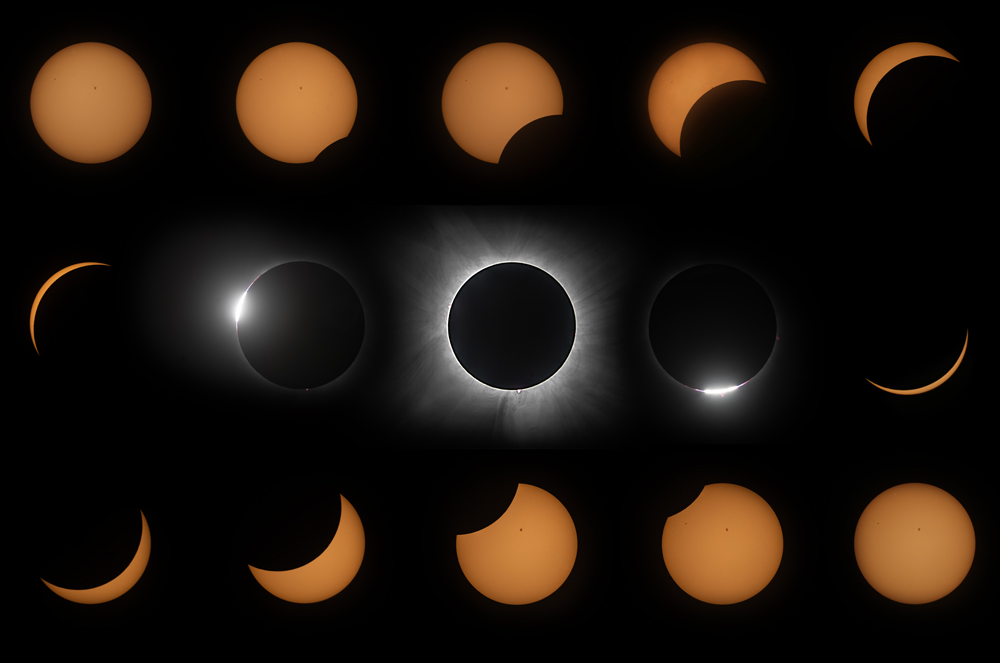
Rod Pommier
Up to seven eclipses of the Sun and Moon can take place in one year, though the last time that happened was 1982, and the fewest possible is four. This year, as in 2025, we’ll once again settle for the minimum of four — but the mix in 2026 will be different!
Last year, we witnessed two partial solar eclipses — certainly exciting, but only to a point. On the other hand, we were treated to two total lunar eclipses. This year, the Moon and Sun flip the script a bit. There’ll be a total lunar eclipse (the last one until mid-2028) and a second lunar eclipse that is almost total. But the Sun gets its turn with one solar eclipse that’s annular and a second that’s total.
First, we present the circumstances of this year’s events — but keep reading if you wish to explore the basics of how and why eclipses happen.
The Four Eclipses of 2026
The following are brief descriptions of the four eclipses that take place in 2026. You’ll find more details for each event in Sky & Telescope magazine or on this website as the date of each draws near.
Note that times are given in Universal Time (UT), except as noted. Adjust the given times to your own time zone; for example, PST = UT – 8, and EST = UT – 5. (But be sure to allow for daylight or “summer” time, when PDT = UT – 7, EDT = UT – 4, and so on.)
| Date | Type | Maximum | Visibility |
| February 17 | Annular solar eclipse | 12:13 UT | Antarctica |
| March 3 | Total lunar eclipse | 11:35 UT | North & South America, eastern Asia and Australia |
| August 12 | Total solar eclipse | 17:47 UT | Greenland, Iceland, Spain |
| August 27-28 | Partial lunar eclipse | 4:14 UT | North & South America, western Europe, Africa |
February 17: Annular Solar Eclipse
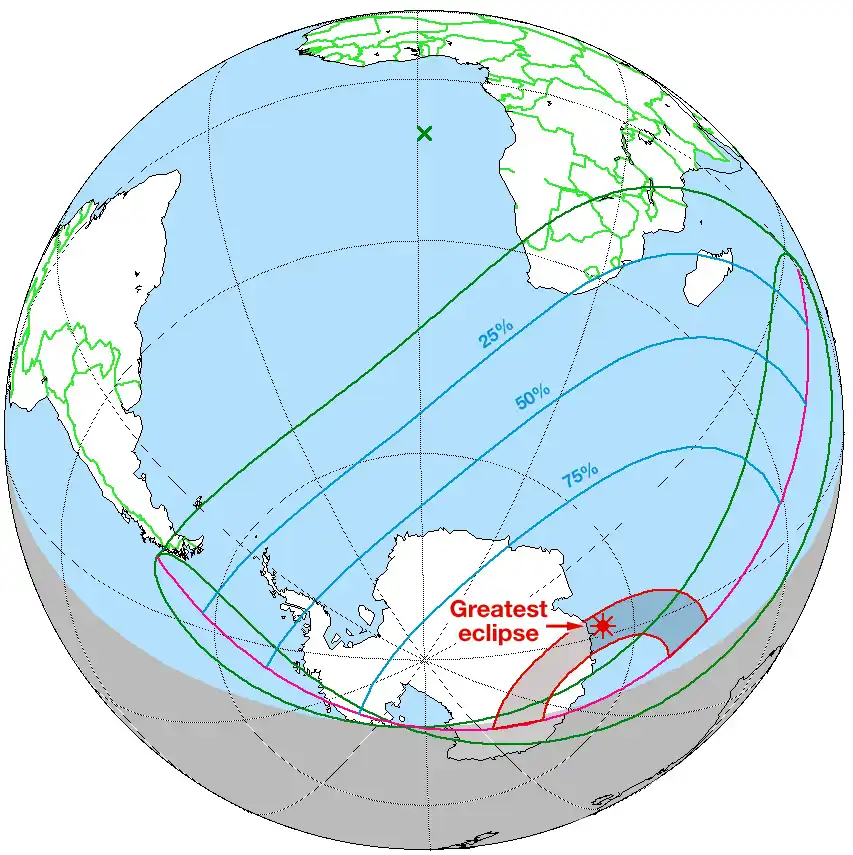
The year’s first eclipse would be more exciting if it were visible from a more populated area. Unfortunately, the path of annularity is confined to Antarctica and a portion of the Southern Ocean. Given that the latter is almost always cloudy at this time of year, the only humans likely to witness this event will be a handful of researchers and others at Russia’s Mirnyy Station on the Antarctic coast and at France’s Concordia Station deep on the continent.
Fred Espenak / eclipsewise.com
Even views of a partly covered Sun will be hard to come by, limited to the tip of South America, southernmost Africa, and Madagascar. Conceivably, anyone on a cruise ship puttering along the Antarctic Peninsula might get to see roughly a third of the Sun’s disk missing.
Nonetheless, the Sun and Moon are putting on a show even if only a very few can watch it. Greatest eclipse (lasting a modest 140 seconds) is at 12:12 Universal Time on February 17th, not quite 7 days after the Moon passes through its orbital apogee (farthest from Earth). At the moment of greatest eclipse, the annular path is a broad 383 miles (616 kilometers) wide, owing to the Sun being just 12° above the horizon and the lunar shadow striking Earth at a very oblique angle.
March 3: Total Lunar Eclipse
Two weeks after February 17th’s solar eclipse, with the Moon having swung around to the opposite side of its orbit and becoming full, it plunges through Earth’s shadow to create a total lunar eclipse. In the Western Hemisphere, the event occurs in the hours before dawn, while across Asia it happens during the evening.
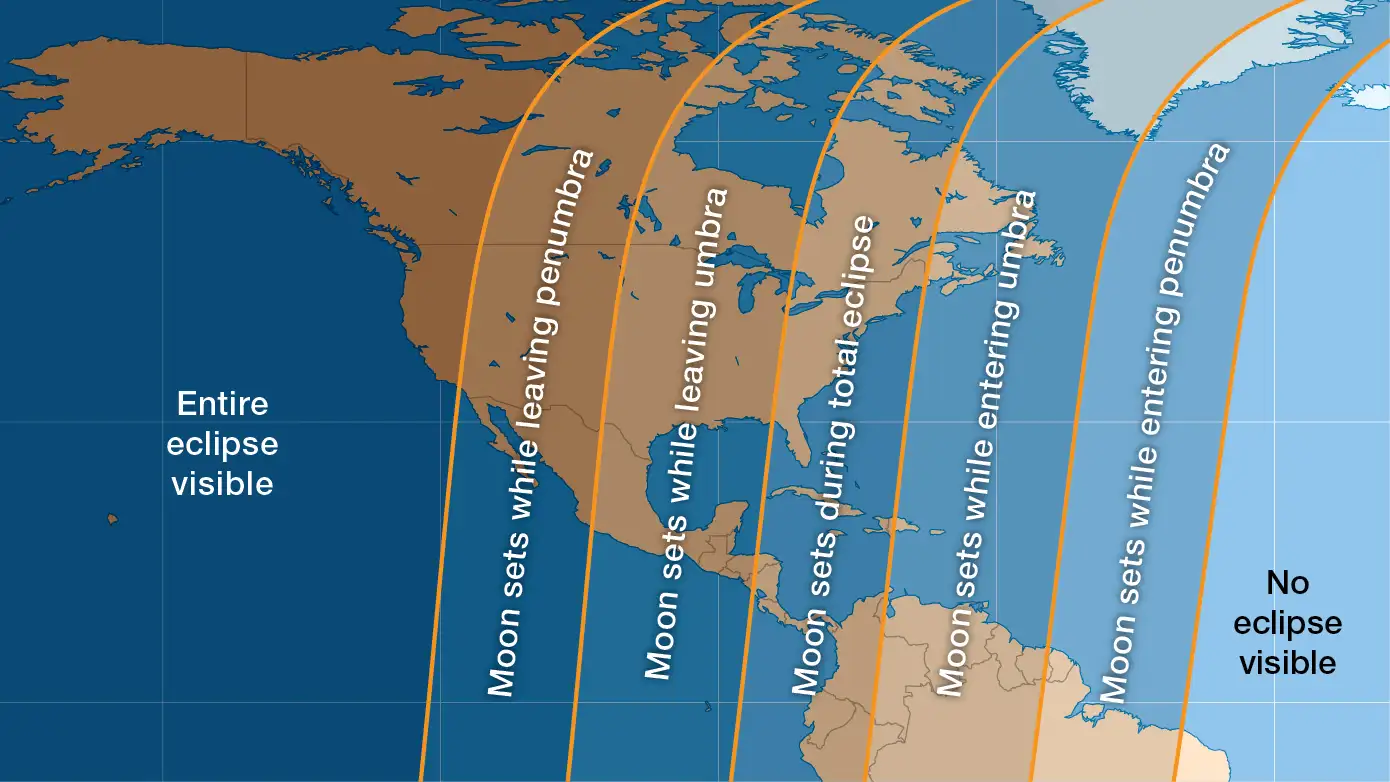
In the U.S. and Canada, those in the Far West are in the best position to take in the entire show. But on the East Coast, moonset and dawn occur while the Moon is still in Earth’s umbral shadow — in fact, as dawn approaches, you’ll be hard-pressed to find the Moon at all low in the western sky. Here’s a map of the geometric situation:
Leah Tiscione / Sky & Telescope; source: Fred Espenak / eclipsewise.com
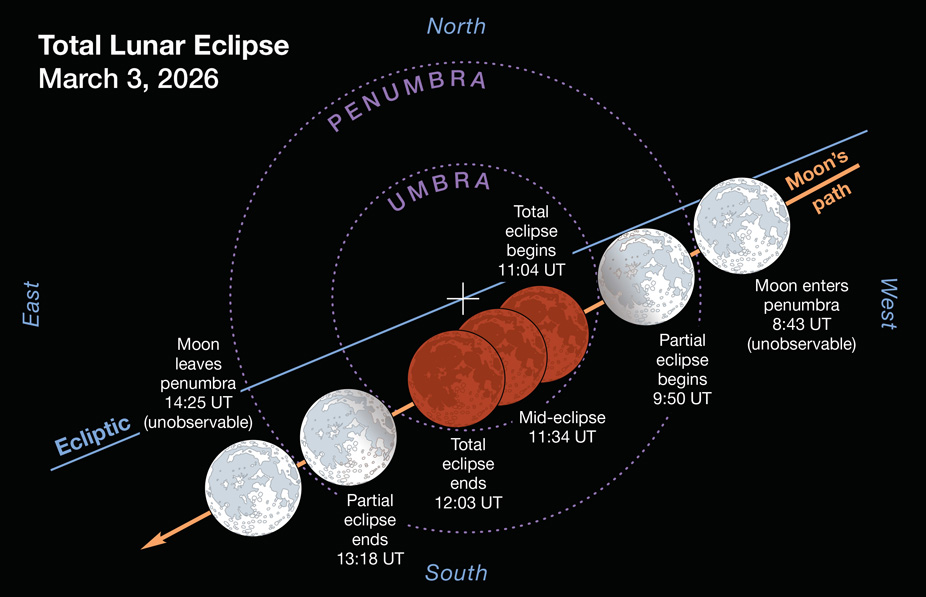
The Moon first touches Earth’s outer penumbral shadow at 12:43 a.m. PST (3:43 a.m. EST; 8:43 UT), but the penumbral shading likely won’t be apparent to your eyes until roughly 45 minutes later. The main event gets under way when the partial eclipse begins at 1:50 a.m. PST (4:50 a.m. EST). Totality lasts for a relatively brief 59 minutes, 3:04 a.m. to 4:03 a.m. PST (6:04 a.m. to 7:03 a.m. EST) — meaning those on the East Coast can (just barely) experience all of totality before the Moon sets. Those in or west of the Rockies can enjoy the waning partial eclipse until it concludes at 5:18 a.m. PST.
Leah Tiscione / Sky & Telescope
For this peekaboo event, the Moon glides through the southern half of the umbra. If prior eclipses are any guide, this geometry means the lower (or lower-left) half of the Moon should be distinctly brighter than the rest of it — and that the eclipsed lunar disk should be relatively bright over all.
For viewers in the Western Hemisphere, a long hiatus follows the Moon’s umbral exit, with the next total lunar eclipse not occurring until New Year’s Eve 2028 (for Alaska and far-western Canada) and June 26, 2029 (for the rest of North and South America).
August 12: Total Solar Eclipse
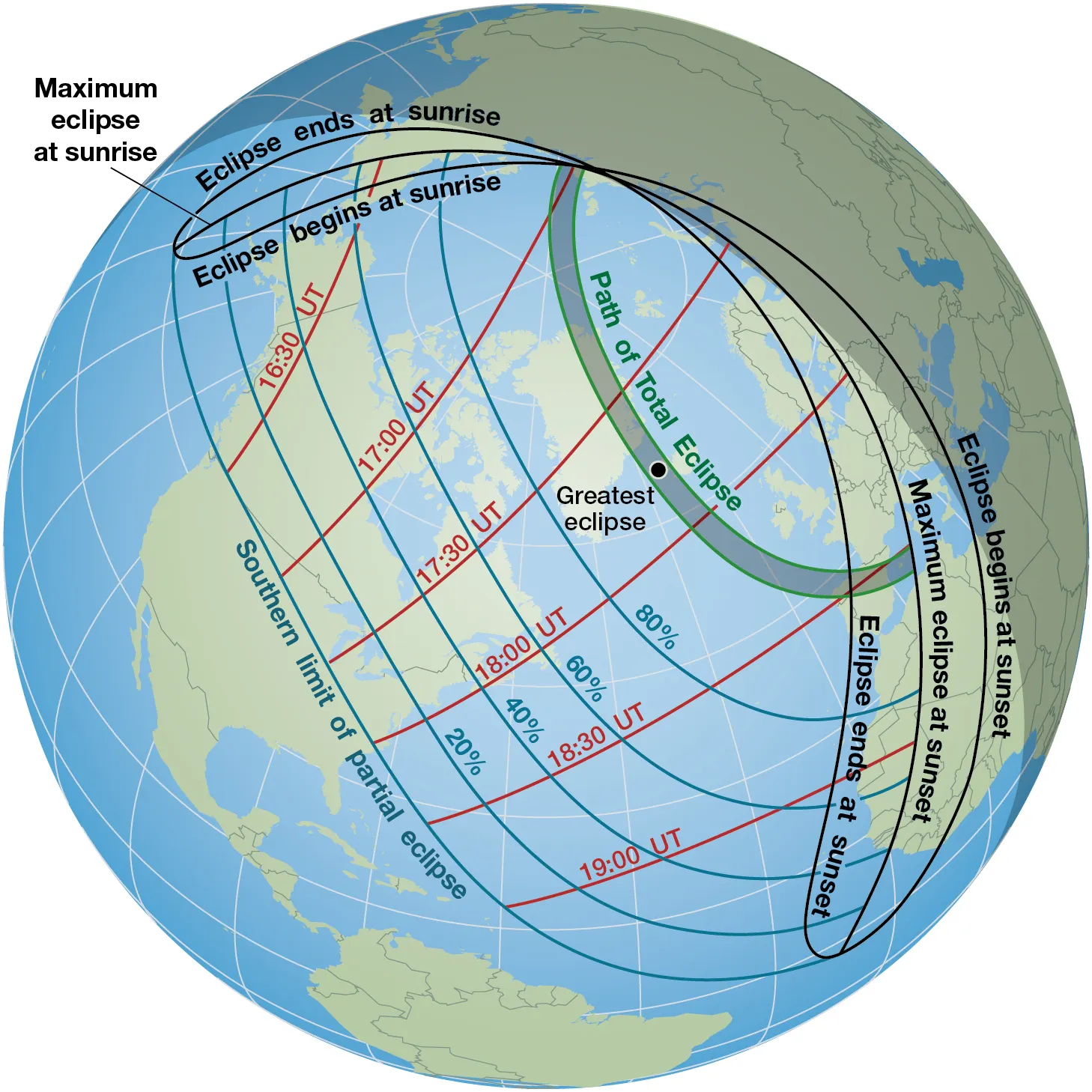
On average, a total solar eclipse occurs every 18 months, but eclipse-chasers have endured a long dry spell (starting April 2024) since the Moon’s umbral shadow last swept across Earth. Given all the millions across the U.S. who saw totality in both 2017 and 2024, a wait of nearly 2½ years for the next one has made many eclipse-chasers antsy. So there’s been tremendous anticipation surrounding August 12th’s total solar eclipse, especially in Iceland and Spain.
Leah Tiscione / Sky & Telescope; source: Fred Espenak
Notably, the path of totality starts nowhere near Europe but instead along Russia’s frigid and uninhabited Taymyr Peninsula, a bleak location even by Siberian standards. Rapidly racing northward (and for a short time moving slightly westward in longitude), the lunar shadow just misses the North Pole and then plunges southward along Greenland’s eastern shore. From there, it clips western Iceland — the point of greatest eclipse (2m 18s) is not far offshore, and the capital city of Reykjavík should get 57 seconds of totality.
But the weather prospects for Greenland’s eastern shore and Iceland are relatively poor, as shown below, though a number of cruise ships are planning to position themselves near one or the other anyway. Instead, most “eclipsophiles” are heading to Spain, the island of Mallorca, and the Balearic portion of the Mediterranean Sea that lies between them. Based on two decades of weather data, eclipse-weather guru Jay Anderson predicts that portions of the eclipse track in that stretch of late-summer warmth enjoys a likelihood of cloud-free skies as high as 65%.

Jay Anderson / eclipsophile.com; source data: CM SAF / EUMETSAT
An especially attractive aspect of August 12th’s circumstances is that the eclipsed Sun will be quite near the western horizon — no higher than 12° as seen from Spain and a scant 2½° high along the northwestern coast of Mallorca. At such low angles, the Moon’s shadow often surrounds the eclipsed Sun with a broad darkened circle. And of course, the low Sun angle invites photographers to include interesting foreground objects. (Digital platforms will no doubt be awash with solar selfies.)
Meanwhile, those in much of Europe and all of Asia won’t see anything of this eclipse, because the Sun will have already set. But prospects are better in the north-northeastern third of the contiguous U.S. and all of Canada. From Sky & Telescope’s office in Cambridge, Massachusetts, maximum eclipse (16% coverage of the Sun’s disk) occurs at 1:55 p.m. locally. That climbs to 31% in Halifax, Nova Scotia (3:00 p.m.) and 53% at St. John’s, Newfoundland (3:35 p.m.).
The partial-eclipse circumstances are much better in the northwestern corner of Europe. Londoners can thrill at seeing a 91% bite out of the Sun at 7:13 p.m. local time, and 83% as seen from Oslo, Norway (7:57 p.m.) For the circumstances and times for hundreds of other cities (or your location specifically), see the eclipse calculator provided by the late Fred Espenak at eclipsewise.com.
August 27–28: Partial Lunar Eclipse
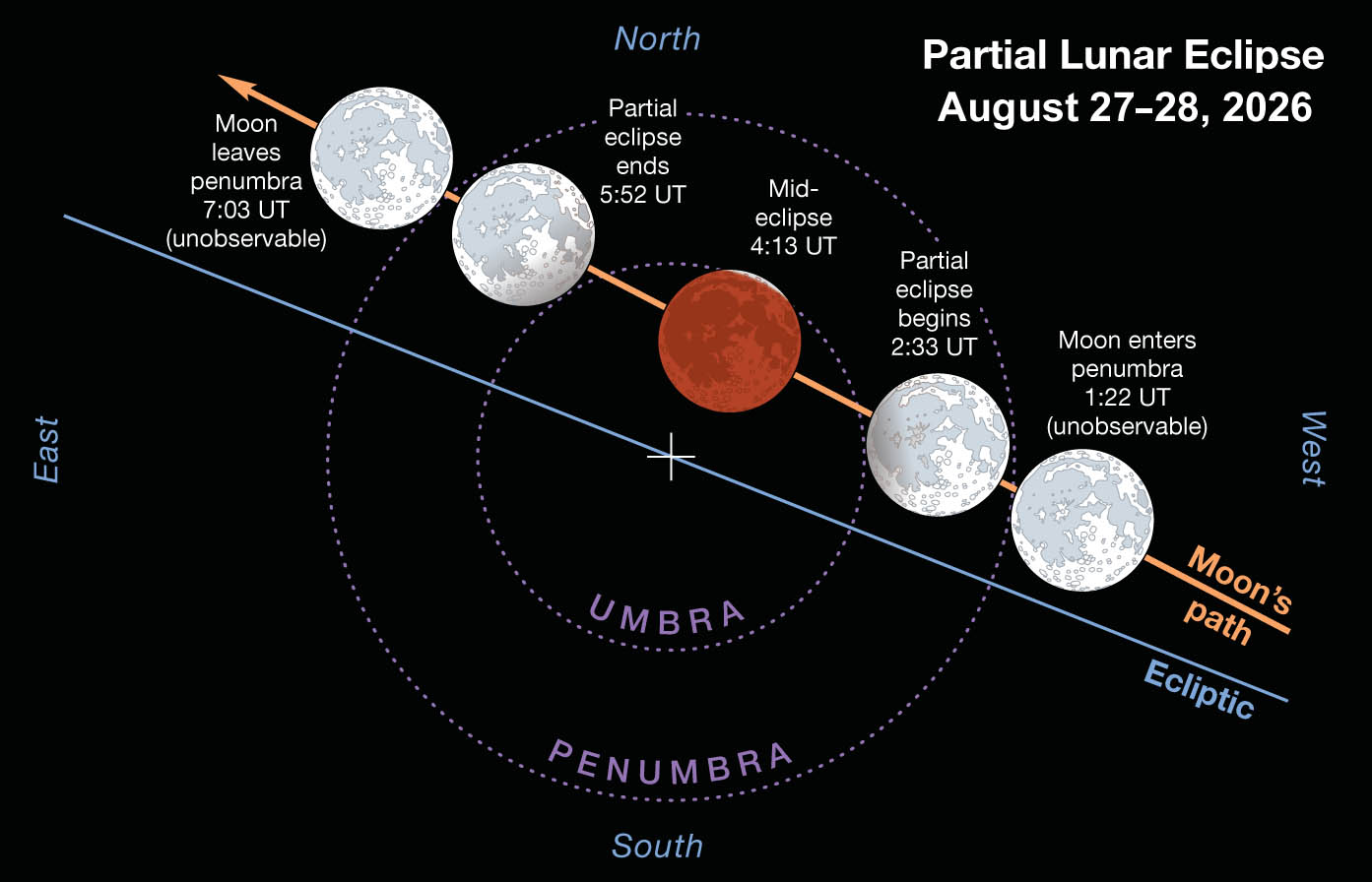
Two weeks later, it’s the full Moon’s turn to be covered by shadow. This is technically a “partial” lunar eclipse, but for all practical purposes it’s “total.” That’s because 93% of the lunar disk gets inside Earth’s dark umbra, and the sliver along the northeastern limb that remains outside it will be deeply tinted by penumbral shadow. It should be fun to watch — and a challenge to photograph!
Leah Tiscione / Sky & Telescope
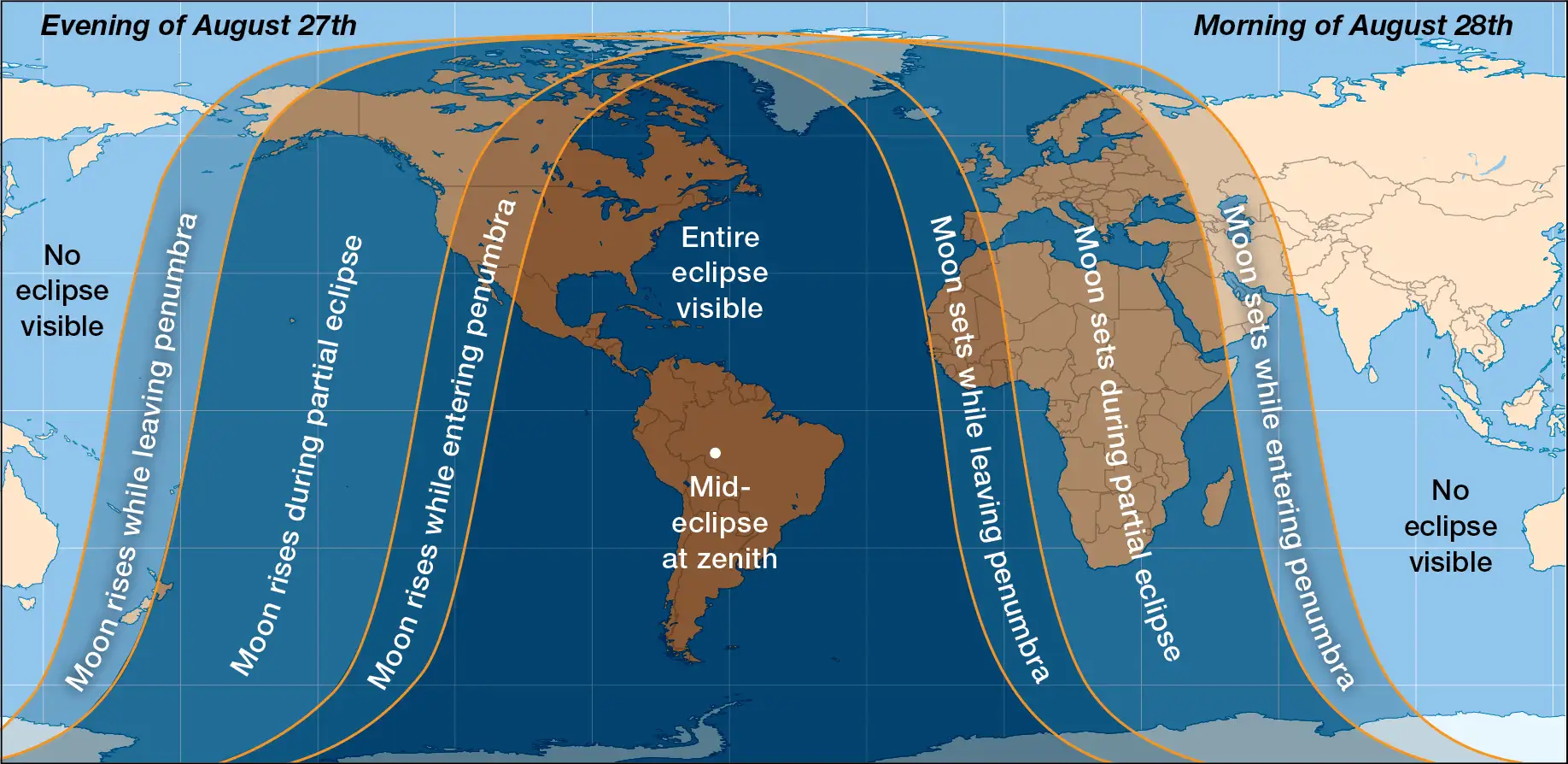
August’s eclipse is much better positioned for observers in the Americas that the one in March; virtually all of the contiguous U.S., the eastern two-thirds of Canada, and all of South America will get to watch the umbral shadow cover and uncover the lunar disk in its entirety.
Be aware that in these locations most of the eclipse occurs on the evening of August 27th in your local time zone. For example, on the East Coast, the partial eclipse begins at 10:33 p.m. Eastern Daylight Time; the darkening is greatest just after midnight (12:13 a.m.) on the 28th; and the Moon leaves the umbra at 1:52 a.m. On the West Coast, the corresponding Pacific times are 7:33 p.m., 9:13 p.m., and 10:52 p.m., all on the evening of the 27th.
Leah Tiscione / Sky & Telescope
Why Do Eclipses Happen?
Jay Anderson
A solar eclipse, such as the one seen coast to coast across the U.S. in 2017 and the follow-up U.S. event in 2024, occurs only at new Moon, when the lunar disk passes directly between the Sun and us and, consequently, the Moon’s shadow falls somewhere on Earth’s surface.
Conversely, a lunar eclipse takes place during full Moon, when our satellite passes through Earth’s shadow.
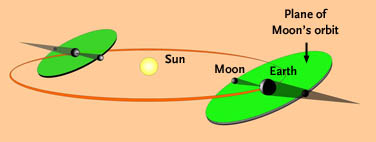
These alignments don’t happen at every new and full Moon because the lunar orbit is tipped about 5° to Earth’s orbital plane — only occasionally do the Sun, Earth, and Moon line up exactly enough for an eclipse to occur. (The technical name for that, by the way, is syzygy.) And, as the diagram above implies, those alignments occur roughly a half year apart.
Lunar Eclipses
Three types of lunar eclipse are possible — total, partial, and penumbral — depending on how deeply the full Moon plunges into or near the umbra, our planet’s dark, central shadow.
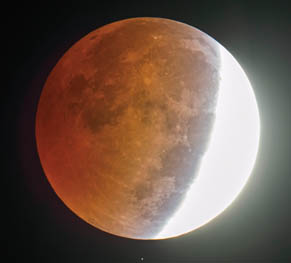
Johnny Horne
If the Moon goes all the way in, we see a total lunar eclipse that’s preceded and followed by partial phases. That was the case during the widely viewed event in September 2015, which marked the conclusion of a series of four consecutive total lunar eclipses! Such eclipse tetrads are not common — the last one occurred during 2003–04, but the next won’t begin until 2032.
If the Moon ventures just partly into the umbra, as pictured here, only partial phases occur — you’ll see some of the Moon in nearly full sunlight, and some of it steeped in the deep, red-tinged umbral shadow.
And if its disk passes just outside the umbra, the Moon still encounters the weak penumbral shadow cast by Earth. A sharp-eyed observer will notice that one side of the full Moon’s disk looks a little dusky. All four of 2020’s lunar eclipses were of the penumbral variety — and the ones next year will be as well.
Fortunately, every lunar eclipse is observable anywhere on Earth where the Moon is above the horizon. (But there’s still an element of luck involved — after all, the sky has to be clear!)
Solar Eclipses
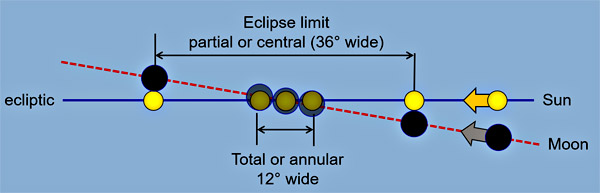
Annular and total solar eclipses require the Moon to cross directly in front of the Sun as seen from Earth — and, as the graphic below shows, such “central” solar eclipses can only occur within a two-week-long interval when the Moon crosses the ecliptic during one of its two nodal crossings each year. However, the geometric window for partial solar eclipses is wider, roughly five weeks long.
Jay Anderson
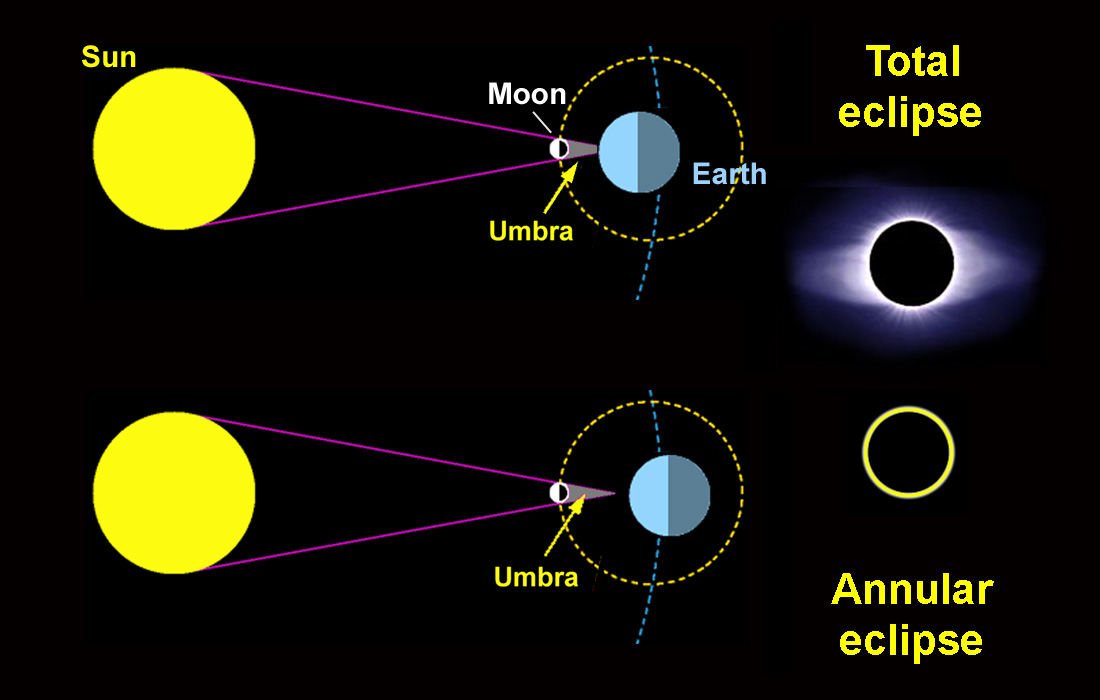
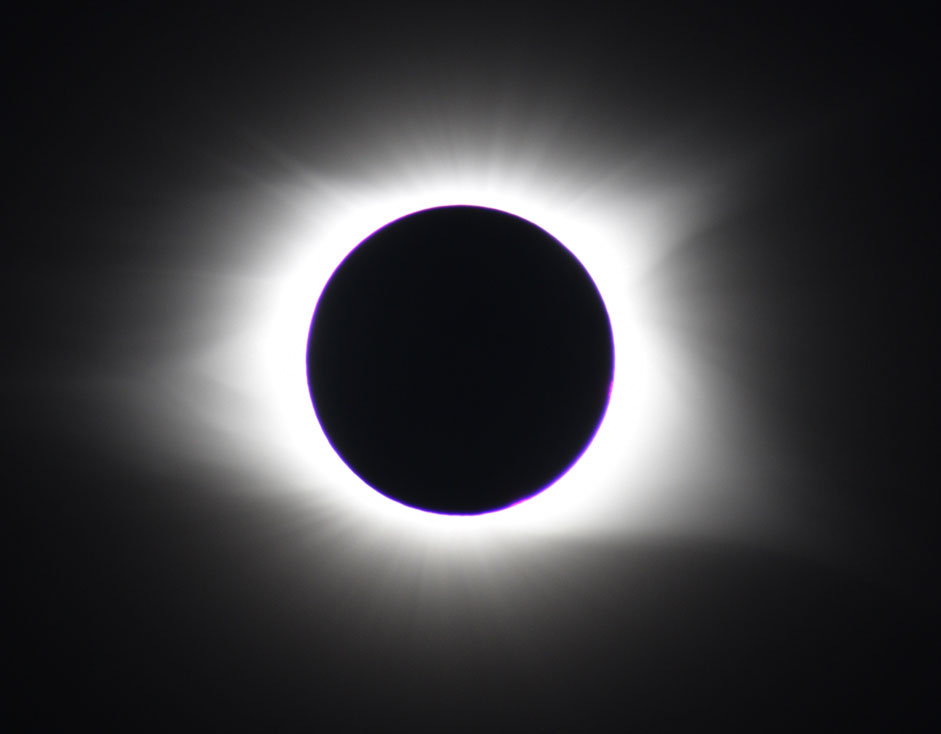
If the Moon completely hides the Sun, the eclipse is considered total. With its brilliant disk completely covered, the Sun’s ghostly white outer atmosphere, called the corona, is momentarily revealed for durations from seconds to several minutes.
Occasionally, the Moon passes directly in front of the Sun but doesn’t completely cover it. When that occurs, it’s usually because the Moon is farther from Earth than its average distance. (The Moon’s orbit isn’t perfectly circular; its eccentricity is about 5%.) This geometric circumstance is known as an annular eclipse, so-called because you can see a ring, or annulus, of sunlight surrounding the lunar disk. Annular eclipses of the Sun occur about as often as the total ones do.
Sky & Telescope
Unlike total lunar eclipses, which can be viewed from roughly half of Earth’s surface, total and annular solar eclipses tightly restrict where you can see them because the Moon casts a much smaller umbral shadow than Earth does — and you need to be within that shadow to view the event. A completely eclipsed Sun can be viewed only from a narrow track or path on Earth’s surface that’s typically just 100 miles (160 km) wide. Outside of that path, about half of the daylit hemisphere of Earth is able to watch a partial solar eclipse as the Moon obscures a portion of the Sun.
Sky & Telescope / J. Kelly Beatty
Getting to the path of a total or annular eclipse often involves long-distance travel. In November 2013, for example, planeloads of eclipse-chasers (including yours truly) thronged to a remote corner of northern Kenya to watch just 11 seconds of totality. On December 4, 2021, a small armada of 15 cruise ships converged on the eclipse path in a remote stretch of the Southern Ocean hundreds of miles northeast of the Antarctic Peninsula. Yet only one of those ships succeeded in dodging the early morning clouds and glimpsing totality. What dedication!
Every location on Earth experiences a total solar eclipse every 375 years on average, with the Northern Hemisphere enjoying a slight statistical advantage right now. (To explore the worldwide distribution of total solar eclipses more closely, check out Sky & Telescope’s beautiful eclipse globe.)
Looking Ahead to 2027
Next year, there’ll be three lunar eclipses — each a penumbral lunar eclipse and thus the most minimal of coverups. But an annular solar eclipse takes place on February 6th (observable from South America). And August 2, 2027, has been circled on the calendars of diehard eclipse-chasers for many years. On that date, the longest total solar eclipse for the remainder of the 21st century occurs. It promises up to 6.4 minutes of totality (!) across a swath of northern Africa, central Egypt, and the Arabian Peninsula — a path that’s almost guaranteed to be cloud free.
| Sky & Telescope offers great opportunities to view the solar eclipses in 2026 and beyond. Our treks to Spain and Mallorca for August’s total solar eclipse are sold out, but there’s still availability for the four total and annular solar eclipses in 2027 and 2028. Check out all S&T’s upcoming tours and events, and subscribe today to stay updated on major events like solar and lunar eclipses!! |
About J. Kelly Beatty
J. Kelly Beatty, S&T Senior Editor, joined the staff of Sky Publishing in 1974 and specializes in planetary science and space exploration. Learn more about him here.


Comments
You must be logged in to post a comment.