 SUNSET:

 0
0This month’s episode showcases the stars and planets visible on March evenings. First up: March 3rd’s predawn a total lunar eclipse! Then track down three planets after sunset, and savor the easy-to-spot Winter Triangle of bright stars.

Listen Here:
Podcast: Play in new window | Download
Subscribe: Apple Podcasts | Spotify | Email | RSS | More
Check out the illustrated version of this podcast on Sky & Telescope’s YouTube channel!
March is the month we associate with two celestial happenings. One is the change to daylight time — at least in the United States, Canada, and much of Europe. The second is the equinox, which this year occurs on March 20th at 10:46 a.m. Eastern Time. But this particular March will also be remembered for the total lunar eclipse that occurs (or occurred) on March 3rd.
Did you know about the “once-in-a-lifetime planet parade/alignment” that took place on February 28th? We at Sky & Telescope have no idea who makes this stuff up. Why that date? No one knows! But it is true that in late February most of the planets were positioned in the evening sky. The trouble is that Mercury, Venus, and Saturn were all frustrating low in the west. Meanwhile, Uranus and Neptune — also part of the ubiquitously promoted alignment — weren’t visible except with optical aid, and Neptune was pretty hopelessly lost from view low in the west.
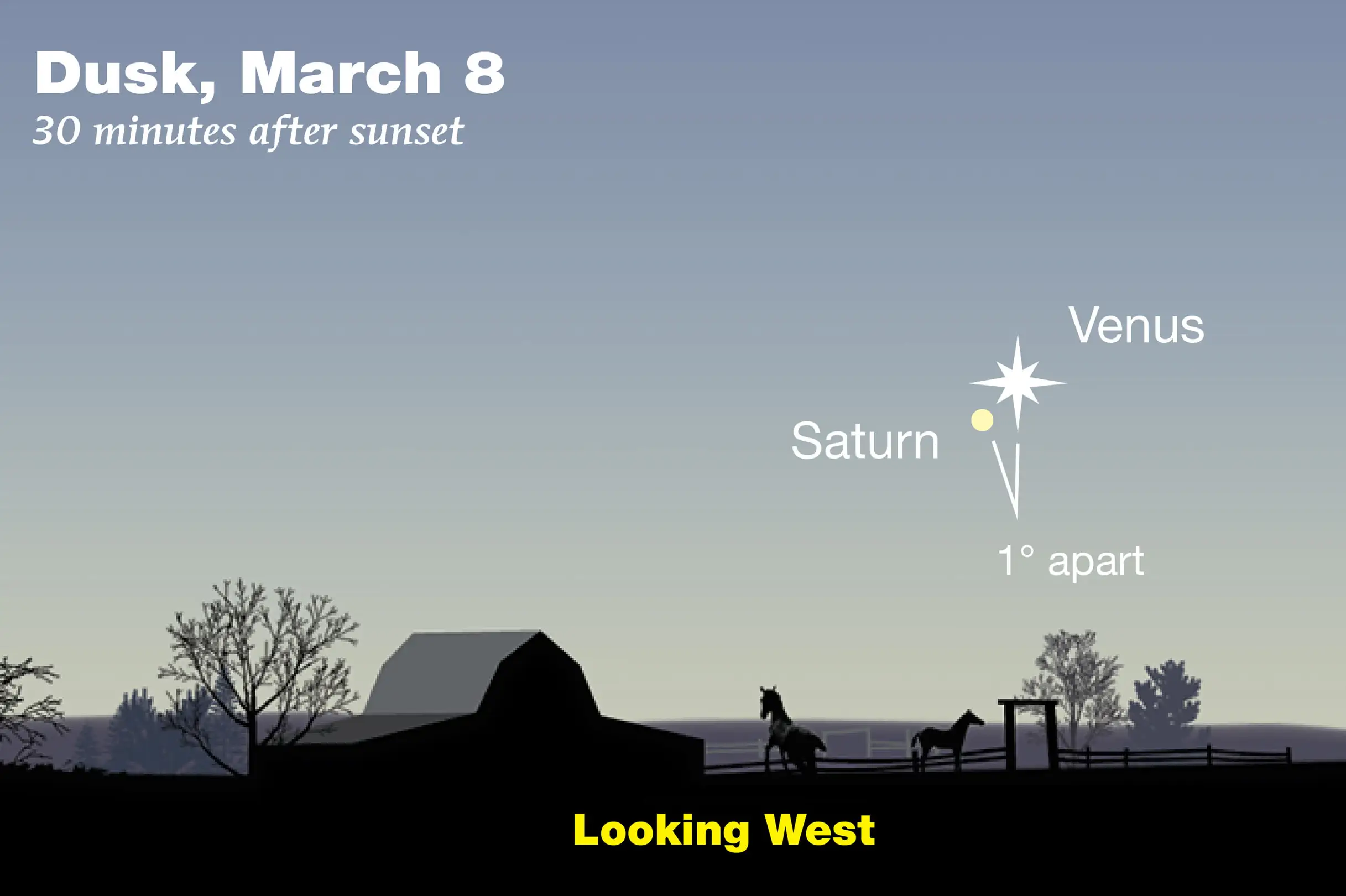
So here’s what you can really expect this month. Jupiter continues its dominance in the evening sky. Look for it very high up, almost overhead, at nightfall. Then watch a planetary transition take place very low in the west. You’ll need a clear view in that direction, and you’ll want to be looking 30 to 45 minutes after sunset.
Sky & Telescope
You’ll most likely spot very bright Venus, which is emerging from the twilight glare. Saturn is lurking nearby. It starts the month nearly one fist to the upper left of Venus. But Saturn is shining just 1% as bright as Venus, so it’ll be challenging to spot. Your best chance might come on March 7th and 8th, when the two will be just 1° apart. After that, Saturn soon sinks from view and Venus climbs a little higher. Mercury and Mars are both near the Sun in the sky right now, hopelessly lost in its glare.
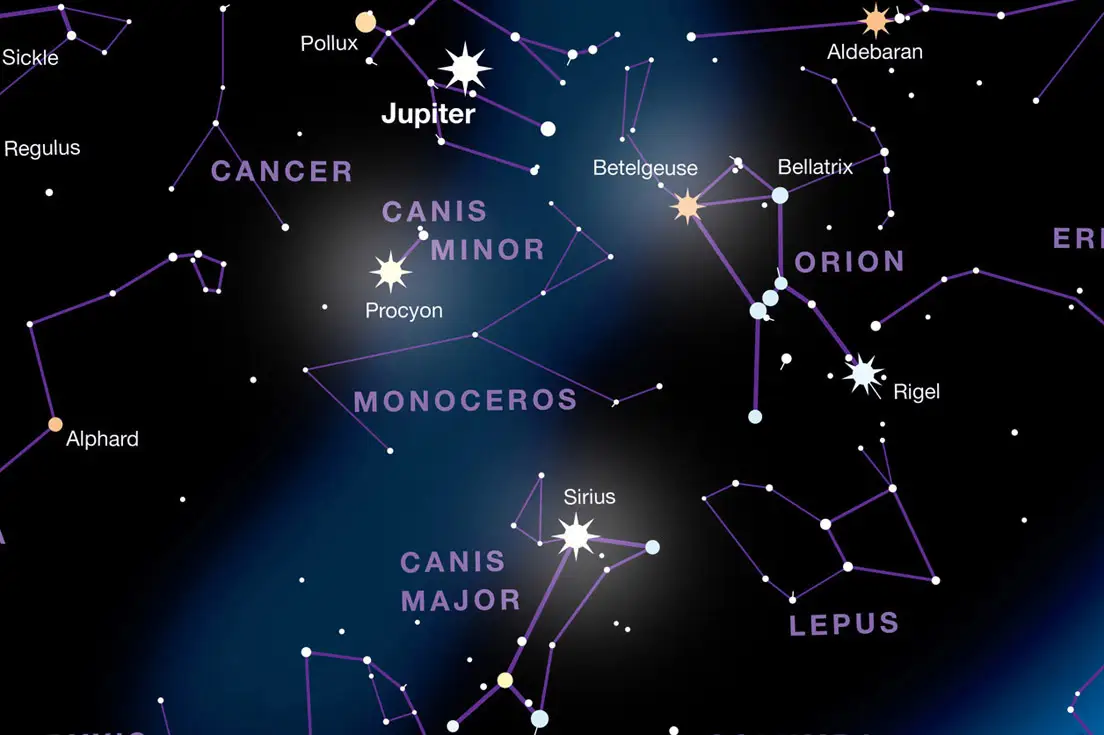
Meanwhile, the evening sky is literally on fire with bright stars accompanying Jupiter. As the twilight fades, turn left, away from the sunset point, until you’re looking south. There in the deepening blue, you’ll find the first true star of the evening: brilliant Sirius. To its upper right is Orion, the mighty Hunter. Its two brightest stars are white Rigel, which marks his lower-right foot, and orange-red Betelgeuse, his upper-left armpit.
Sky & Telescope
Look to the left of Betelgeuse for Procyon, the alpha star of Canis Minor. This constellation might be small, but Procyon itself ranks as the eighth brightest star in the nighttime sky. The stellar trio of Procyon, Betelgeuse, and Sirius form a big, equilateral triangle in the sky — known as the Winter Triangle to skywatchers.
This is just a sample of the fun and educational guided exploration of the night sky that awaits you with this month’s Sky Tour Astronomy Podcast. Click on the link above to listen!
About J. Kelly Beatty
J. Kelly Beatty, S&T Senior Editor, joined the staff of Sky Publishing in 1974 and specializes in planetary science and space exploration. Learn more about him here.


Comments
You must be logged in to post a comment.