 SUNSET:

 2
2March opens with a spectacular total lunar eclipse. Our guide will help you make the most of it.
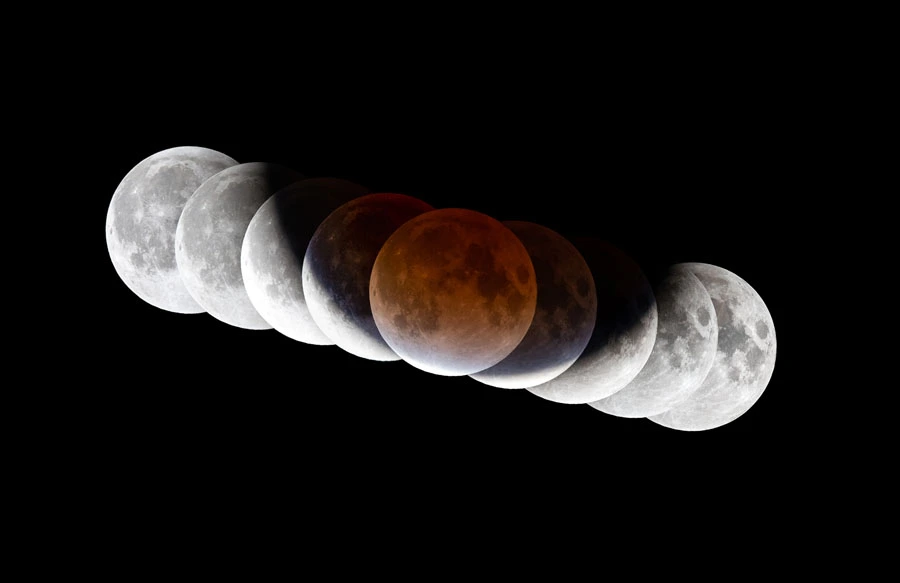
Zoltan Levay
We're on a roll! It will be less than a year since the last total lunar eclipse visible from the Americas, and already the next one is upon us. After this one, a deep partial eclipse will occur on August 28th, with 96% of the Moon covered during totality. No complaints here. Lunar eclipses are long, leisurely affairs that rarely require travel and aren't fussy about precision timing, unlike total solar eclipses. There's so much to enjoy and appreciate, and plenty of time to savor it all.
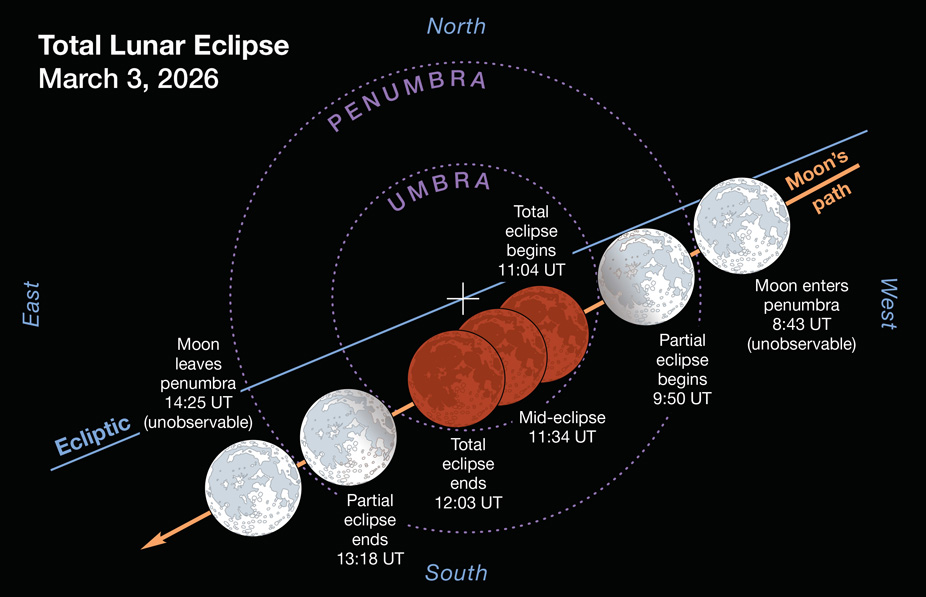
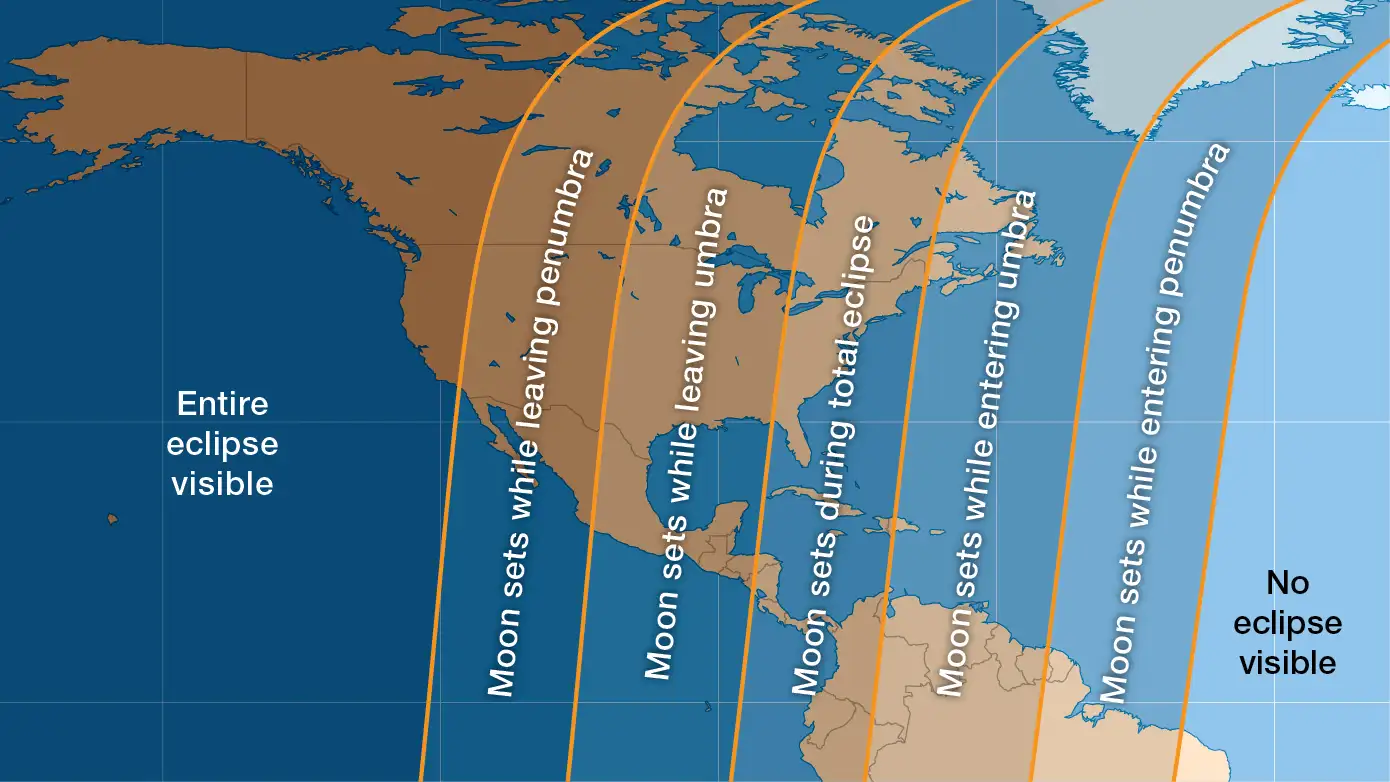
On Tuesday morning, March 3rd, as the full Worm Moon wriggles through Earth's shadow, we'll get to see a total lunar eclipse. Lunar eclipses occur when the Moon is full at the same time it passes through Earth's orbital plane. Only then can our planet's shadow darken the lunar visage. Observers in North America will see the colorful cosmic coincidence unfold during the wee hours, with the western part of the U.S. and Canada favored. For much of Australia and east Asia, it happens during the evening. That said, not all of the Americas will see all of the phases of the eclipse.
Leah Tiscione / Sky & Telescope
Tempered by Twilight
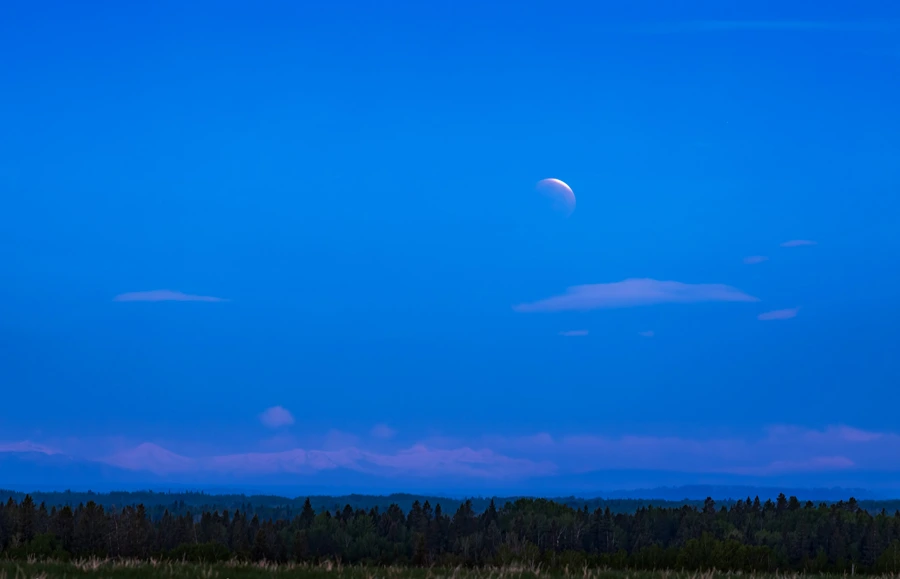
In the Eastern time zone, much of the eclipse plays out in a brightening dawn sky with the Moon low in the west. If possible, observe from a location with an unobstructed view in that direction. In Philadelphia, totality begins at 6:04 a.m., only about half an hour before moonset and the Sun's rising. Bring binoculars, as the Moon will grow pale and faint as it leaves the scene (see photo below) while still in total eclipse.
Farther west, from Chicago, the partial eclipse takes place in dark sky, with totality starting at 5:04 a.m. local time, shortly after the beginning of morning twilight. The Moon peeks out from the umbra at 6:03 a.m., marking its return to partial eclipse, about 20 minutes before sunrise.
Alan Dyer
Since the Moon and the Sun will be almost exactly opposite each other in the sky, try this little exercise. From a location with an all-around vista, extend your arms horizontally on either side of your body — one pointing to the Sun and the other at the Moon — and picture yourself (and Earth) smack dab in the middle. Doing this it's easy to visualize the grand celestial alignment we're all part of during a total lunar eclipse and picture how Earth's shadow falls in the Moon's direction. For those living in the Eastern time zone, the Moon will set in total eclipse just as the Sun rises. Since the Moon's red color derives from the refracted light of all the sunsets and sunrises around Earth's circumference, your local sunrise will directly contribute to the Moon's ruddy hue.
Leah Tiscione / Sky & Telescope; source: Fred Espenak / eclipsewise.com
Denverites will experience totality undiluted by twilight, then watch the Moon pass through partial eclipse before it fully exits Earth's inner shadow minutes before sunrise. Meanwhile, West Coast observers will see the whole shebang with time to spare. When the partial eclipse ends at 5:18 a.m. local time, it will still be early twilight. The Moon's relatively low altitude during much of the eclipse, as well as it happening at dawn from many locales, will make for excellent opportunities to capturing photos of our satellite in a favorite horizon scene — even with a cellphone camera.
The lunar image is notoriously small in a smartphone but when framed with a landscape or a person, and when balanced by twilight-sky illumination, you can create something to be proud of and want to share. For those with digital cameras, the late Fred Espenak, a.k.a. Mr. Eclipse, offered some great tips. (Share your photos on Sky & Telescope's online gallery!)
Eclipse sightseeing

Sky & Telescope illustration
Here are a few suggestions on how to catch different aspects of an eclipse:
- Penumbral shadow — From the Moon's perspective, this is where Earth's globe only partially covers the Sun. Partial sunlight dilutes the outer shadow, so it only becomes obvious to the eye about 30 minutes before the start of partial eclipse and up to 30 minutes after the partial phase ends. The penumbra suffuses the Moon's eastern side (going into eclipse) with a sooty, grayish cast.
- Southern passage — The Moon will pass south of the umbra's center, so its southern hemisphere will pass closer to the shadow's outer edge and shine more brightly than the northern hemisphere around mid-eclipse. Watch as the brighter lunar limb gradually shifts from west through south and then east as the Moon advances through the umbra.
- Moon meteors — If you can spare a telescope and video camera, monitor the eclipsed Moon for meteor impacts. The darkened lunar landscape is ideal for capturing the flash of impact. If you're lucky you might just see one while observing the Moon with a telescope during totality.
- Journey into darkness — Watching the sky darken and stars return as the Moon dims is one of my favorites parts of an eclipse. Since it happens in the early morning, observers with dark skies will get to see the summertime Milky Way materialize in the eastern sky as the Moon slips into shadowland. The quenching of moonlight feels like that quiet, reflective movement in the middle of a symphony.
- Moon in stellar company — Through binoculars, the fully eclipsed Moon will be surrounded by stars, an otherwise impossible sight due to its usual overpowering glare. The juxtaposition gives you the visceral sense of the lunar orb floating in space. Although the Moon won't occult any particularly bright stars, you can watch fainter ones disappear along its eastern limb and others reappear at the following limb during totality. The brightest is HD 94515 (SAO 118571) at magnitude 7.4. It's occulted toward the end of totality. Be sure not to miss the first moments of the Moon exiting the umbra. The contrast between the bright, sunlit edge and the rusty-red portion creates a striking 3D effect.
- Do science — A total lunar eclipse is as much an exploration of Earth's atmosphere as it is a color fest. Estimating the brightness of the totally eclipsed Moon informs our knowledge of the clarity of our planet's atmosphere, and in particular, the role of volcanic eruptions and the natural pollutants they release into the air. Dust and aerosols can make for darker totalities. You can also determine the time the umbra crosses a select set of lunar craters to help astronomers monitor the variable size of Earth's umbra. For details about both, please see S&T Senior Contributing Editor Roger W. Sinnott's recent post on the topics.
I hope you have clear skies, but if clouds threaten to eclipse your eclipse, you have a couple options. Drive to where the sky is clear or accept Italian astronomer Gianluca Masi's invitation to watch the eclipse online. He'll livestream it starting at 8:30 UT (3:30 a.m. EST) on March 3rd.
I've had to drive to the last two total lunars. Before leaving, I carefully check satellite images to determine the clouds' extent and trajectory. My favorite app for this is Windy, which is also available at the windy.com website. Click on the Satellite heading for a bird's-eye view of your region. If it's nighttime, select Infra from the menu at bottom for an infrared photo. Animate the scene, so you can check the direction and movement of the clouds, then plan accordingly.
May you find yourself staring down the barrel of Earth's shadow soon!
About Bob King
I love the sky (day and night) and have been a skywatcher and amateur astronomer since childhood. I'm also a long-time member of the American Association of Variable Star Observers (AAVSO) and Astronomical League. I pen the Astro Bob blog and have written four books: Night Sky with the Naked Eye (2016); Wonders of the Night Sky You Must See Before You Die (2018) and Urban Legends from Space (2019) and Magnificent Aurora, published in 2024. The universe invites us on an adventure every single night. To accept the invitation, we only need look up.



Comments
Rod
March 4, 2026 at 8:38 am
I was unable to see this lunar eclipse. Weather was light snow; some rain for me in MD. In Leo and west sky, I could see it if skies were clear. I stayed in bed and enjoyed the woodburning stove 🙂
You must be logged in to post a comment.
Bob KingPost Author
March 6, 2026 at 2:23 pm
Hi Rod,
Sorry you missed it. I can relate. Most of Minnesota was cloudy, but there appeared to be partly skies to the northwest. I got in the car and drove over 100 miles, but no dice.
I caught just a bit of the penumbral. Looking forward to August's near-total eclipse.
You must be logged in to post a comment.
You must be logged in to post a comment.