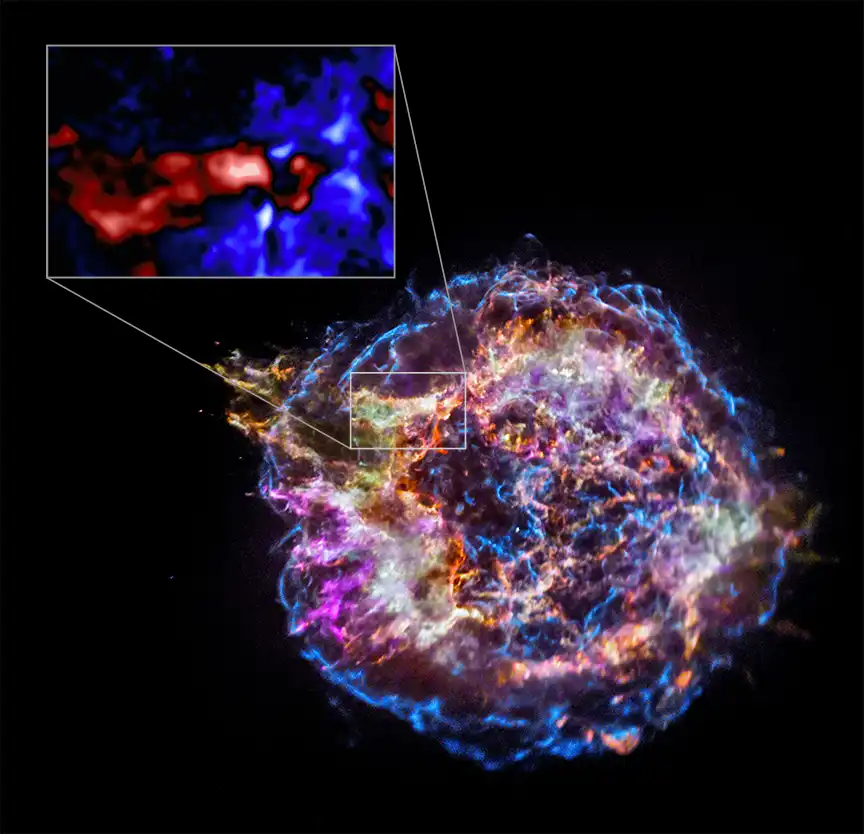
This release features a composite image of Cassiopeia A, a donut-shaped supernova remnant located about 11,000 light-years from Earth. Included in the image is an inset closeup, which highlights a region with relative abundances of silicon and neon. Over three hundred years ago, Cassiopeia A, or Cas A, was a star on the brink of self-destruction. In composition it resembled an onion with layers rich in different elements such as hydrogen, helium, carbon, silicon, sulfur, calcium, and neon, wrapped around an iron core. When that iron core grew beyond a certain mass, the star could no longer support its own weight. The outer layers fell into the collapsing core, then rebounded as a supernova. This explosion created the donut-like shape shown in the composite image. The shape is somewhat irregular, with the thinner quadrant of the donut to the upper left of the off-center hole. In the body of the donut, the remains of the star's elements create a mottled cloud of colors, marbled with red and blue veins. Here, sulfur is represented by yellow, calcium by green, and iron by purple. The red veins are silicon, and the blue veins, which also line the outer edge of the donut-shape, are the highest energy X-rays detected by Chandra and show the explosion's blast wave. The inset uses a different color code and highlights a colorful, mottled region at the thinner, upper left quadrant of Cas A. Here, rich pockets of silicon and neon are identified in the red and blue veins, respectively. New evidence from Chandra indicates that in the hours before the star's collapse, part of a silicon-rich layer traveled outwards, and broke into a neighboring neon-rich layer. This violent breakdown of layers created strong turbulent flows and may have promoted the development of the supernova's blast wave, facilitating the star's explosion. Additionally, upheaval in the interior of the star may have produced a lopsided explosion, resulting in the irregular shape, with an off-center hole (and a thinner bite of donut!) at our upper left.

Astronomy & Observing News

From the Sun to the Stars, Astronomy in Photos

New observations reveal turbulent flows in the supernova remnant Cassiopeia A and in the solar corona.

Light echoes around Cassiopeia A

Astronomy & Observing News

Supernova Echoes Probe Clouds in the Milky Way

As a blast from the past reverberates through our galaxy, it illuminates the fine structure of dusty gas that may someday form new stars.

Astronomy & Observing News

What Happens After a Supernova Blows? Watch and Find Out

New time-lapse videos from the Chandra X-ray Observatory show the Crab Nebula and the Cassiopeia A supernova remnant over more than 20 years.

round, expanding shell with intricate, knotty filaments

Astronomy & Observing News

Cassiopeia A: A Festive Supernova Remnant

New near-infrared observations from the Webb telescope reveal intricate strands of debris from the exploded star.

A star goes poof!

Observing

Seeking Cas A, the Ghostly Remains of a Mysterious Supernova

We still don't know for sure if anyone saw the supernova explosion in Cassiopeia around 1680, but there's no question we can observe what remains of it today.

Stellar Science

Quark Nova Spotted in Cas A?

Two elements deep within Cassiopeia A, hint the supernova remnant underwent a quark nova — a theoretical second explosion that leaves behind a quark star — just days after the original supernova.

Astronomy & Observing News

Cassiopeia A in 3D

Explore a supernova remnant with this fun interactive simulation, created from detailed space- and ground-based observations in multiple wavelengths.
