 SUNSET:

 2
2A new coronagraph mission is now orbiting Earth on a mission to provide direct observations of the Sun for space-weather forecasts.

Lockheed Martin / NOAA
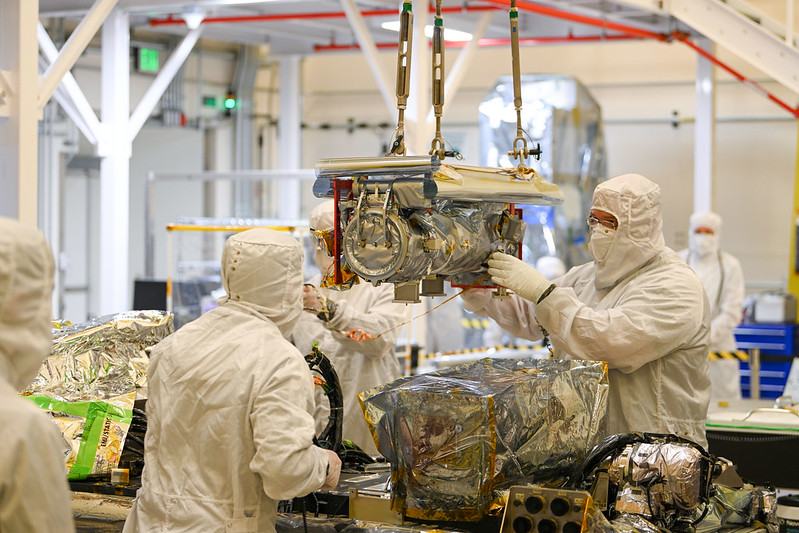
There’s a new Sun-observing instrument in orbit, set to fill a potential future gap. The National Oceanic and Atmospheric Administration (NOAA) shared the first images this week from the Compact Coronagraph (CCOR 1) instrument aboard its 19th Geostationary Operational Environmental Satellites (GOES) satellite. Though GOES 19 is primarily an Earth-observing weather satellite, it carries an instrument platform that points toward the Sun. In addition to the coronagraph, the platform also holds imagers that photograph the Sun at X-ray and ultraviolet wavelengths.

NOAA / CCOR 1
Why Use Coronagraphs?
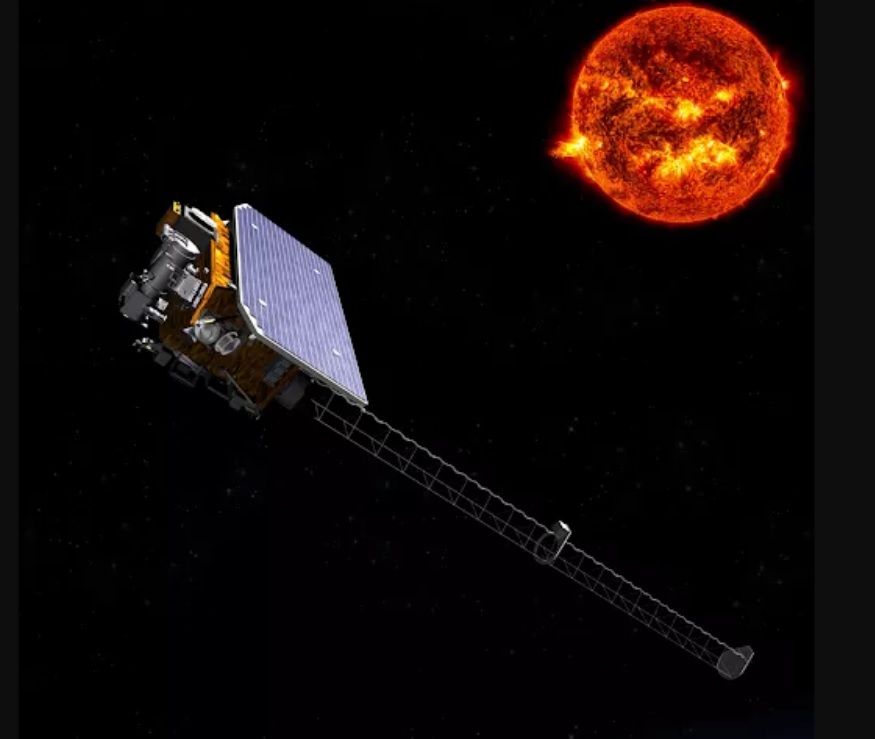
The primary aim for CCOR 1 is to watch for large eruptions called coronal mass ejections (CMEs) coming from the Sun. A coronagraph does this by blocking out the dazzling light from the Sun with an occulting disk, thus enabling images of the region very near the solar limb. Although there are coronagraph-type instruments on Earth and the method is almost a century old, this sort of imaging is much easier to achieve in space, where there's no atmospheric scattering affecting imaging performance.
Lockheed Martin
The GOES 19 mission launched on a SpaceX Falcon Heavy rocket from pad LC 39A at the Kennedy Space Center on June 25, 2024. Now in geostationary orbit, the spacecraft is part of a long legacy of NOAA satellites — the first GOES satellite dates back to 1975. The nominal mission lifetime for GOES 19 is at least 5 years and up to 10 years.

SpaceX
CCOR 1 is a dedicated, space-based coronagraph designed by the U.S. Naval Research Laboratory for the NOAA. Although other missions use coronagraphs — including the LASCO C2 and C3 instruments aboard the Solar Heliospheric Observatory (SOHO) — they’re fundamentally science-driven. As much as they are currently used for space-weather monitoring and forecasts, they are not designed for them. GOES 19’s coronagraph observes the Sun strictly for NOAA’s space-weather predictions, with no interruptions for other observations.
“NOAA issues the government’s official space weather forecast,” says solar physicist Monica Bobra. “NASA does not issue forecasts. NOAA and NASA do try to collaborate, but basically people stay in their own lanes. Getting another coronagraph up there for redundancy in case LASCO dies is definitely a good thing.”
The data CCOR 1 collects will be publicly available via the NOAA Space Weather Prediction Center starting at the end of February 2025, after the spacecraft has gone through its commissioning phase.
Space weather and keeping close tabs on the Sun is crucial in our modern technological era. Inbound solar radiation and particles and the geomagnetic storms that result can affect satellites, communications, and GPS signals. Space weather even impacts human activities on the International Space Station. We all saw a manifestation of this on October 10th during the recent storm that created near-global aurora.
There’s also a national-security dimension to space-weather monitoring. The 2020 ProSWIFT Act of Congress outlines the need for an operational coronagraph to ensure space-weather monitoring occurs. U.S. interests in this area have helped to keep SOHO running for almost 29 years now — long past its original nominal mission of two years.
CIRA / NOAA
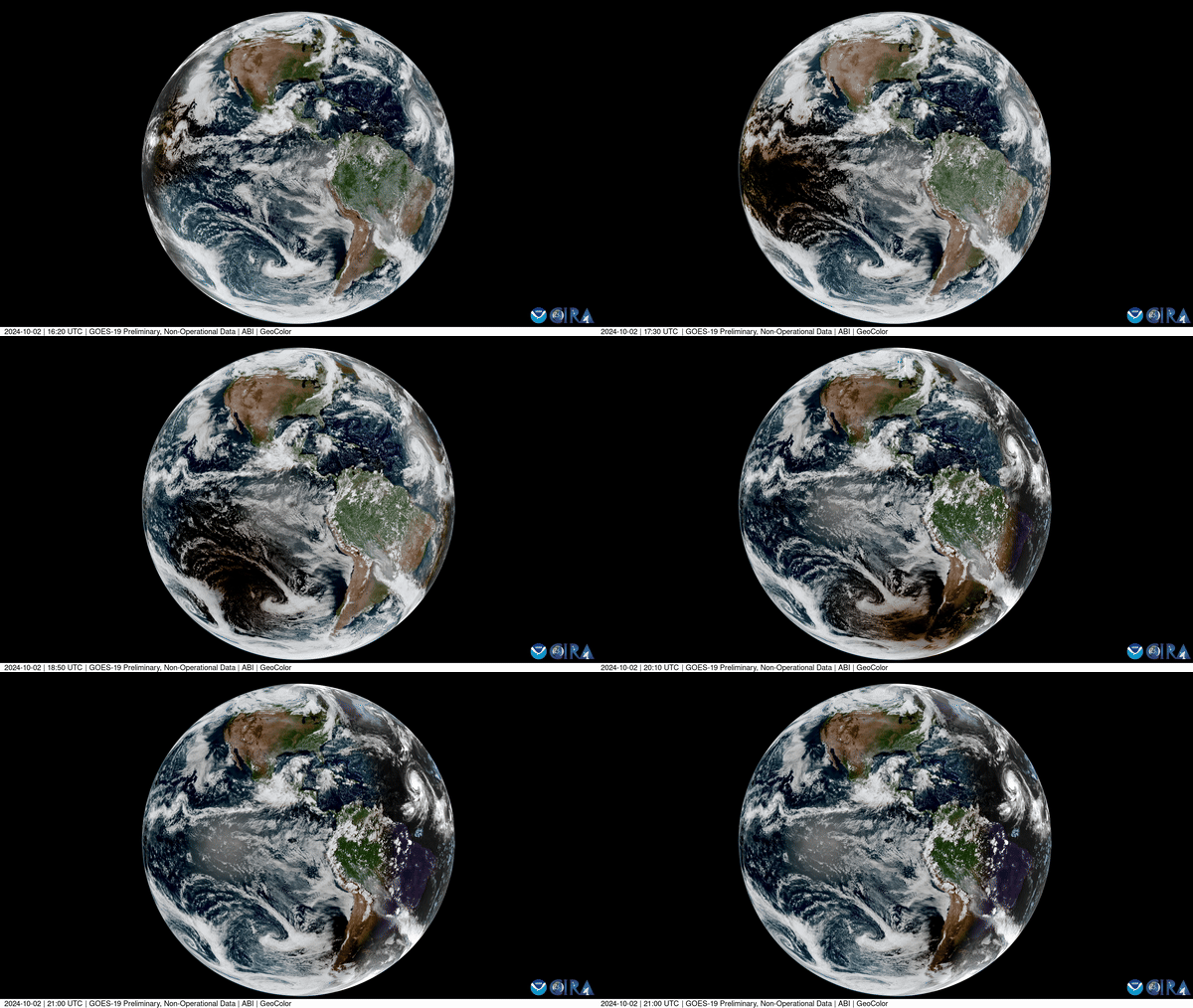
From GEOS 19's geostationary orbit, CCOR 1 will deliver an uninterrupted view of the near-solar environment every 15 minutes. (This differs from SOHO’s view from the Earth-Sun L1 Lagrange point, 1.5 million kilometers, or 1 million miles, from Earth in the sunward direction). The geostationary orbit means Earth will obstruct the spacecraft's view biannually, around each equinox. To compensate for this, NOAA plans to launch another coronagraph (CCOR 2) aboard the Space Weather Follow-On Lagrange point One mission early next year.
NOAA
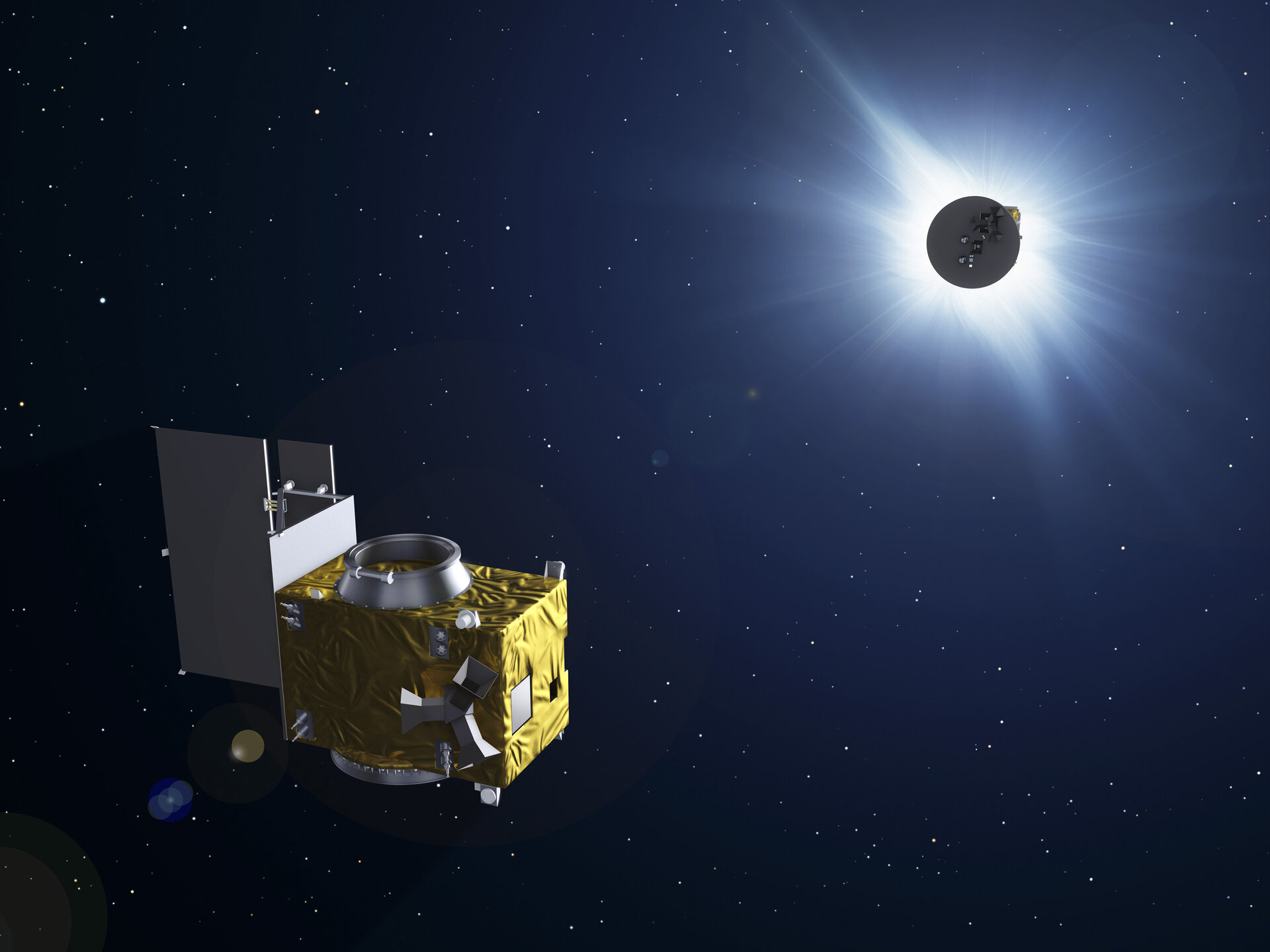
SOHO and GOES 19 are not the only coronagraph-carrying missions; India’s Aditya L1 observatory, launched in 2023, also carries a coronagraph for solar observations. More of these types of instruments will soon headed spaceward. ESA’s Proba 3 mission, which will also observe the Sun, is launching late next month. That mission will be flying a proof of concept of a free-flying coronagraph, which must fly in formation with the imaging spacecraft.
ESA
Further down the road, the Nancy Grace Roman Space Telescope will also feature a coronagraph, but rather than feature the Sun, it will serve as part of its mission to directly image exoplanets.
Incidental Comet Hunters
Like SOHO, CCOR 1 isn't designed to hunt for comets, but it will nevertheless pick up sungrazers near perihelion. SOHO has proven itself a prolific comet-hunter of opportunity, with 5,065 sungrazers found and counting. It offered an amazing view of Comet Tsuchinshan-ATLAS (C/2023 A3 ) during earlier this month. In fact, Comet ATLAS (C/2024 S1) could pop into both SOHO's and GOES 19's views by October 26th — it'll be passing just 330,600 miles from the Sun on October 28th. The comet is unlikely to survive that close approach.
It’s great to know that SOHO now has a backup in place to continue the legacy of space-weather observations.
-Thanks to the Naval Research Laboratory with information on CCOR 1 for the article.
About David Dickinson
David Dickinson is a freelance science writer, high school science teacher, retired enlisted U.S. Air Force veteran and avid stargazer. He currently resides with his wife Myscha in Bristol, Tennessee. David also writes science fiction in his spare time. He posts as @AstroDave on BlueSky about space news and sky-watching worldwide.



Comments
Adam Shinabarger
October 25, 2024 at 8:14 am
It's great to see CCOR in the news... but no mention of the Naval Research Lab's involvement in the instrument's development?
You must be logged in to post a comment.
David DickinsonPost Author
October 25, 2024 at 9:20 am
Hi Adam,
Thanks for pointing that out... I didn't catch that from the original NOAA press release, no. I did talk to Karl Battams at NRL while researching the piece, about CCOR and SOHO.
Thanks,
Dave Dickinson
You must be logged in to post a comment.
You must be logged in to post a comment.