 SUNSET:

 0
0Astronomers might have spotted a star in the Andromeda Galaxy collapsing directly into a black hole, without the accompanying fanfare of a supernova.
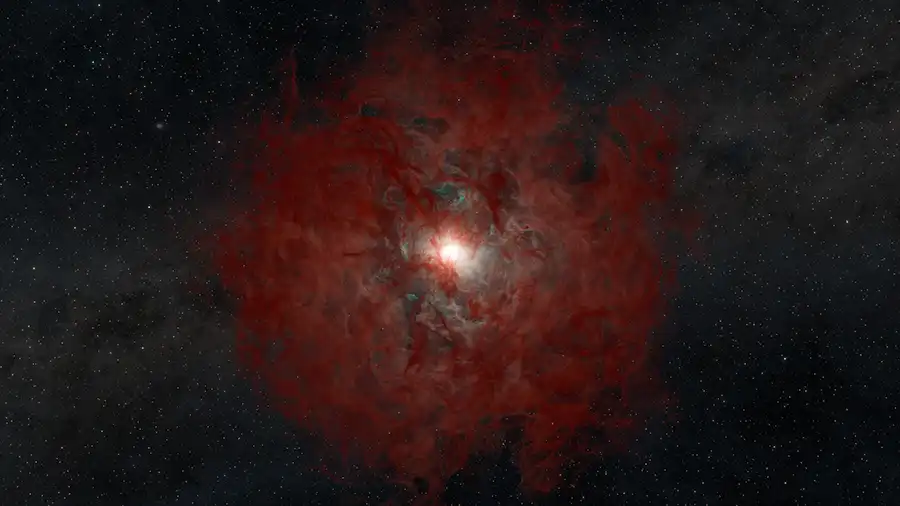
Keith Miller (Caltech / IPAC – SELab)
Astronomers might have seen a star in the Andromeda Galaxy collapse directly into a black hole, without the accompanying supernova. If confirmed, it would be the most complete observational record ever made of a star’s transformation into a black hole.
Andromeda (M31) is the nearest major galaxy to the Milky Way at 2.5 million light-years away. In 2014, a supergiant star in Andromeda known as M31-2014-DS1 brightened slightly at infrared wavelengths, before swiftly dimming well below its original luminosity by 2016.
To investigate further, a team led by Kishalay De (Flatiron Institute) examined almost two decades’ worth of archival data on the star from the Near-Earth Object Wide-Field Infrared Survey Explorer (NEOWISE) space mission. The team’s findings are published in Science.

The team found that, by 2022, the star had essentially vanished from visible sight. At slightly longer near-infrared wavelengths, it had faded by a factor of 10,000. Its remnant is now only detectable in the mid-infrared, presumably from the glow of previously ejected dust; even here, it shines 10 times fainter than before.
“This star used to be one of the most luminous stars in the Andromeda Galaxy, and now it was nowhere to be seen,” says De. “Imagine if the star Betelgeuse suddenly disappeared. Everybody would lose their minds!”
De believes the star’s core collapsed directly into a black hole without the usual fanfare of a supernova.
Normally, when a star of this mass runs out of nuclear fuel, it collapses in on itself. This would produce a flood of neutrinos, tiny particles that help power a blast wave that rips through the star’s outer layers in a supernova explosion. What’s left of the stellar core would then become a neutron star or a black hole.
But in this case, De argues, the supernova failed. The material that would have been blasted outwards instead continued to fall inwards, increasing the mass of the stellar core and leading to the formation of a black hole.
The team suggests the pattern of the star’s brightness changes can be explained if the outer layers of the original star swirled around the black hole like water around a plughole.
Keith Miller (Caltech / IPAC – SELab)
“Instead of taking months or a year to fall in, it’s taking decades,” says Andrea Antoni (also Flatiron Institute). “And because of all this, it becomes a brighter source than it would be otherwise, and we observe a long delay in the dimming of the original star.”
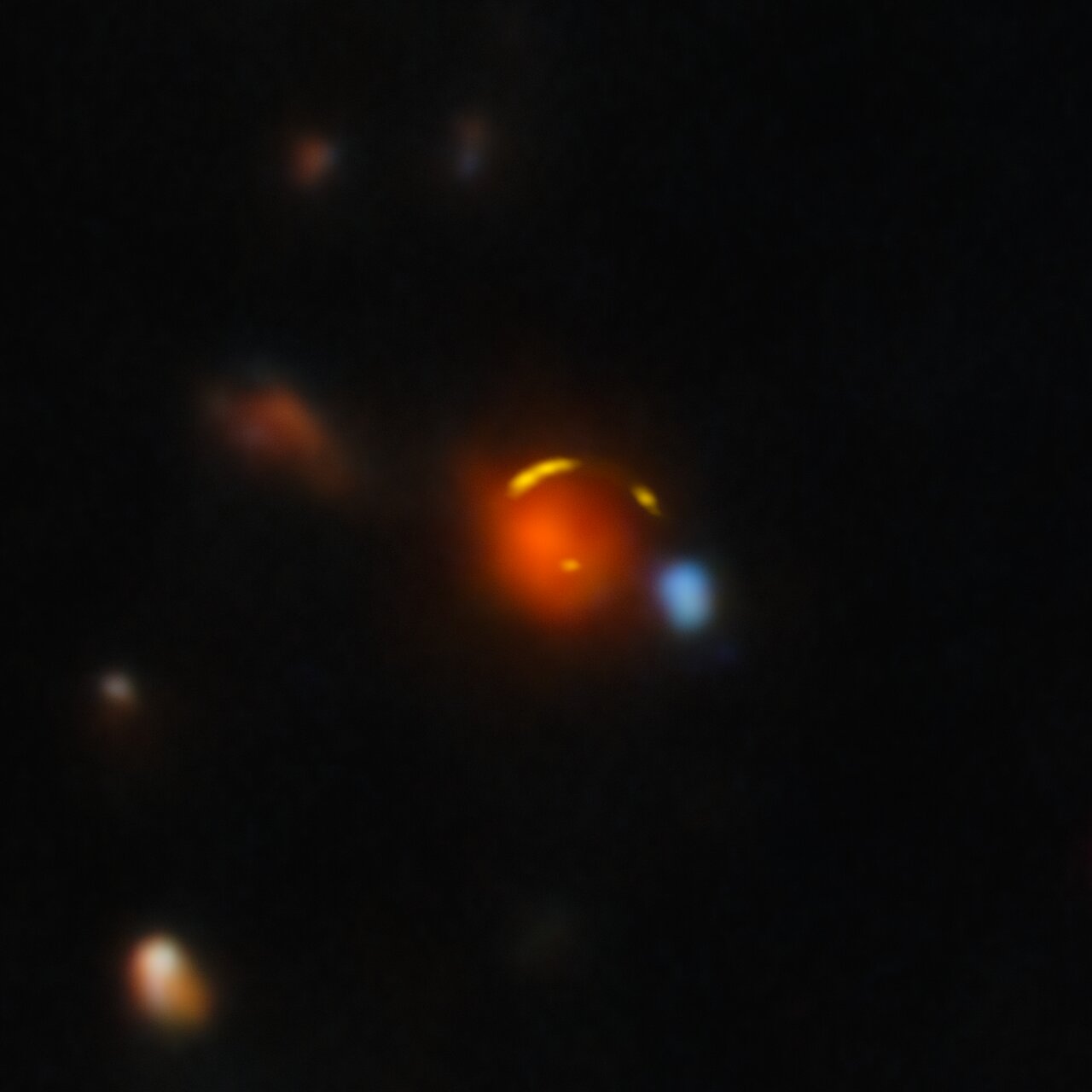
De’s team has also analyzed a previously discovered supergiant star in the more distant galaxy NGC 6946, 22 million light-years from Earth. They found that it, too, followed a similar pattern of brightness changes, suggesting it is another failed supernova.
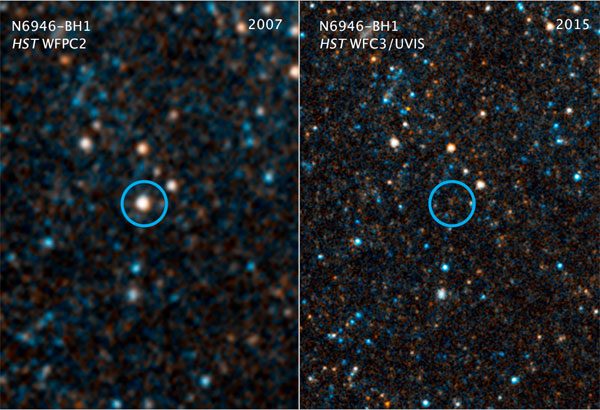
NASA / ESA / C. Kochanek (OSU)
“This is a fascinating discovery and a thorough analysis of a much sought-after event on our cosmological doorstep,” says Joseph Lyman (University of Warwick, UK), who was not involved in the research. “The interpretation as a failed supernova seems very promising.”
But while Lyman calls the find a “major milestone”, he adds that it is far from an open-and-shut case.
Other experts also urge caution. “This is an intriguing find, but I’m not yet convinced it really is a failed supernova and the death event of a massive star,” says Stephen Smartt (University of Oxford, UK), who was not involved in the research.
“It is somewhat of a contrived model to make the failed supernova and accretion onto a black hole work,” Smartt says. “It is plausible but not proven by any means.”
Smartt also points out that the mass of M31-2014-DS1 — 12 to 13 times that of the Sun— is lower than the theoretical threshold for stars that give rise to failed supernovae.
According to Smartt, we need more data, such as observations being taken with the James Webb Space Telescope. “Continued observations with JWST to see how this remnant evolves is essential, along with further radio monitoring to see if there are any signs of accretion onto the black hole,” he says.
So for now, perhaps, it remains a case of wait and see.
About Colin Stuart
Colin Stuart (@colinstuartspace) is an astronomy author and tutor. He also runs a free online astronomy club.



Comments
You must be logged in to post a comment.