 SUNSET:

 0
0New analysis reveals a tight relationship between two supernova remnants in the outer Milky Way.
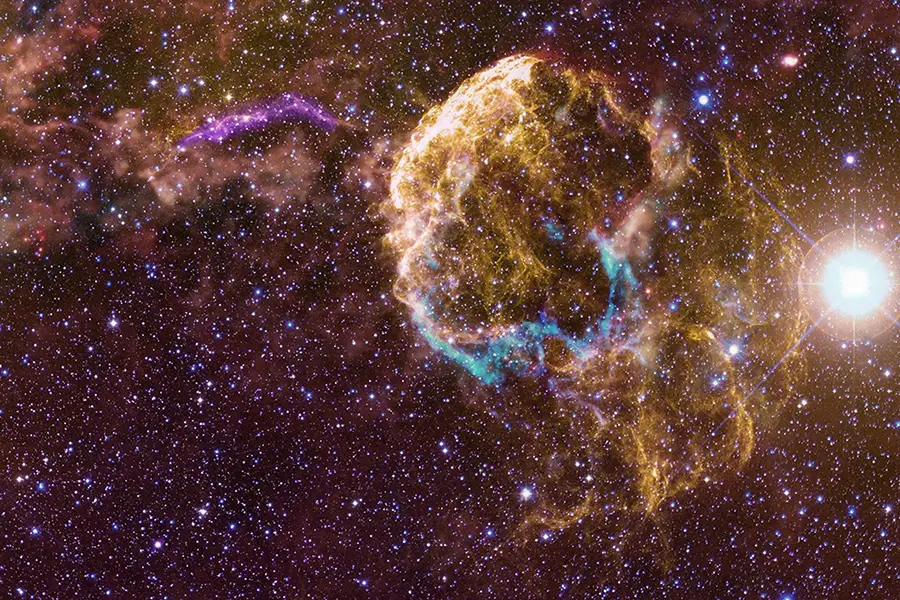
NASA GSFC and M. Michailidis et al. 2026; Optical: DSS; Infrared: NASA / WISE / JPL-Caltech / UCLA; Ultraviolet: NASA / Swift
Astronomers have identified the first known binary supernova remnant. According to a team led by Miltiadis Michailidis (Stanford University), IC 443 and G189.6+3.3 – two supernova remnants in Gemini, close to the star Propus (η Geminorum) – are siblings.
In a paper to be published in Nature Communications, the team argues that the massive progenitor stars of the two remnants once formed a close binary system.
The first star went supernova between 20,000 and 110,000 years ago. The explosion sent its companion star hurtling through space. Then, some 8,000 or 9,000 years ago, after racing at least 40 light-years away, this second star also detonated. Both supernovae left remnants behind — expanding gaseous clouds that emit high-energy radiation as they crash into their surroundings.
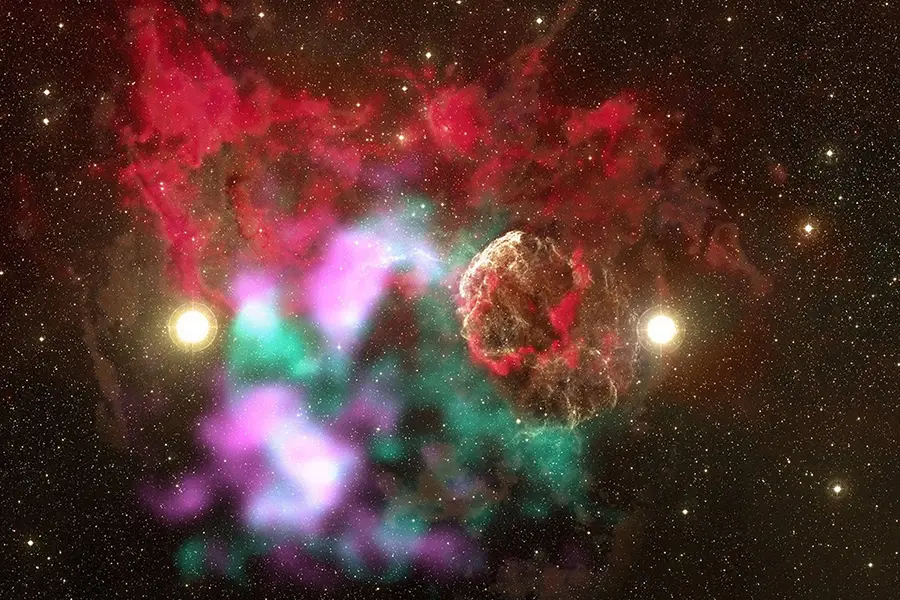
NASA GSFC and M. Michailidis et al. 2026; Radio, MWISP and ESA / Planck; infrared: NASA / WISE / JPL-Caltech / UCLA; Optical: DSS; Ultraviolet: NASA / Swift; X-ray: SRG / eROSITA; Gamma ray: NASA / DOE / Fermi LAT Collaboration
IC 443, also known as the Jellyfish Nebula, is the younger of the two remnants. It’s a remarkable object, not only because of its appearance at visible wavelengths but also because it’s so bright in high-energy gamma rays — as detected by NASA’s Fermi Gamma-ray Space Telescope back in 2013. The gamma rays result from protons, which fled the supernova and slammed into gas atoms of the neighboring interstellar cloud Sharpless 249 (or S249 for short).
The older and larger remnant, on the other hand, is hardly visible except at high-energy wavelengths. Known by its galactic coordinates as G189.6+3.3, it was first detected by the German X-ray telescope Röntgensatellit (ROSAT) in 1994.
One part of the nebula that is readily visible is a filament of hot gas to the immediate east of IC 443. Newer X-ray observations reveal that this filament is a shock wave, produced when the expanding shell of gas from the older supernova crashed into the S249 cloud. Moreover, analysis of Fermi observations over the past 16 years shows that G189.6+3.3 also glows in gamma rays, most likely due to the same process that generates the gamma-ray emission of IC 443.
Estimating the distance of a supernova remnant is hard, but the fact that both remnants are interacting with the same cloud of gas indicates they’re equally far away, probably some 6,000 light-years.
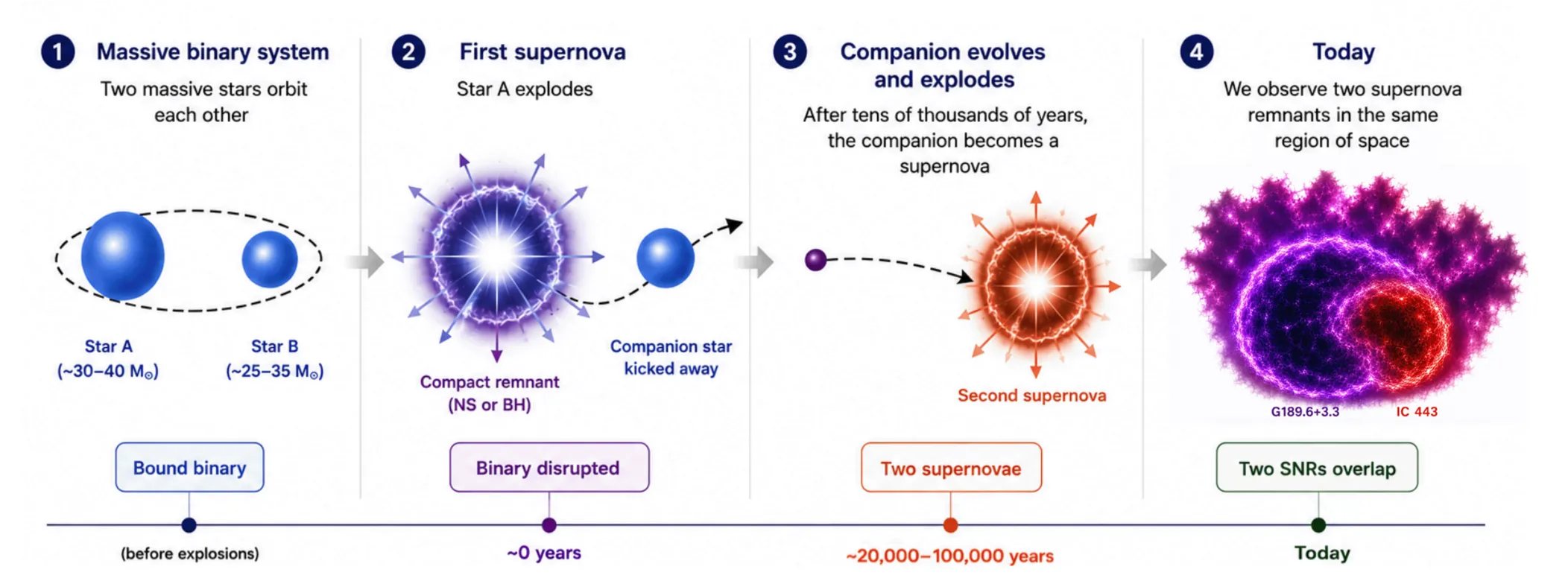
M. Michailidis et al. 2026
According to Michailidis, who presented the result last week at the 248th meeting of the American Astronomical Society in Pasadena, California, the chance of finding two unrelated supernova remnants in the same region of the sky by pure chance is less than 1%.
To check on the credibility of the proposed sibling scenario, Michailidis and his colleagues ran computer simulations of the evolution of 1 million different massive binary stars.
They found that twin supernova remnants with separations of a few dozen light-years and time delays of tens of thousands of years are readily produced when the progenitor stars are in a tight orbit.
“The evidence we’ve compiled […] paints a compelling picture of a dual supernova event,” according to Michailidis in a NASA press statement. “I think this is a really nice piece of work,” says supernova expert Danny Milisavljevic (Purdue University), who was not involved in the study. “The ‘sibling’ interpretation is compelling, and it’s encouraging that it builds on a picture that’s been developing for a few years, since X-ray data first suggested these two remnants might share a common origin.”
About Govert Schilling
Sky & Telescope Contributing Editor Govert Schilling lives in The Netherlands but loves to explore his home planet. In May 2022, Harvard University Press published The Elephant in the Universe: Our Hundred-Year Search for Dark Matter. His latest book is Target Earth - Meteorites, Asteroids, Comets, and Other Cosmic Intruders That Threaten Our Planet.



Comments
You must be logged in to post a comment.