 SUNSET:

 0
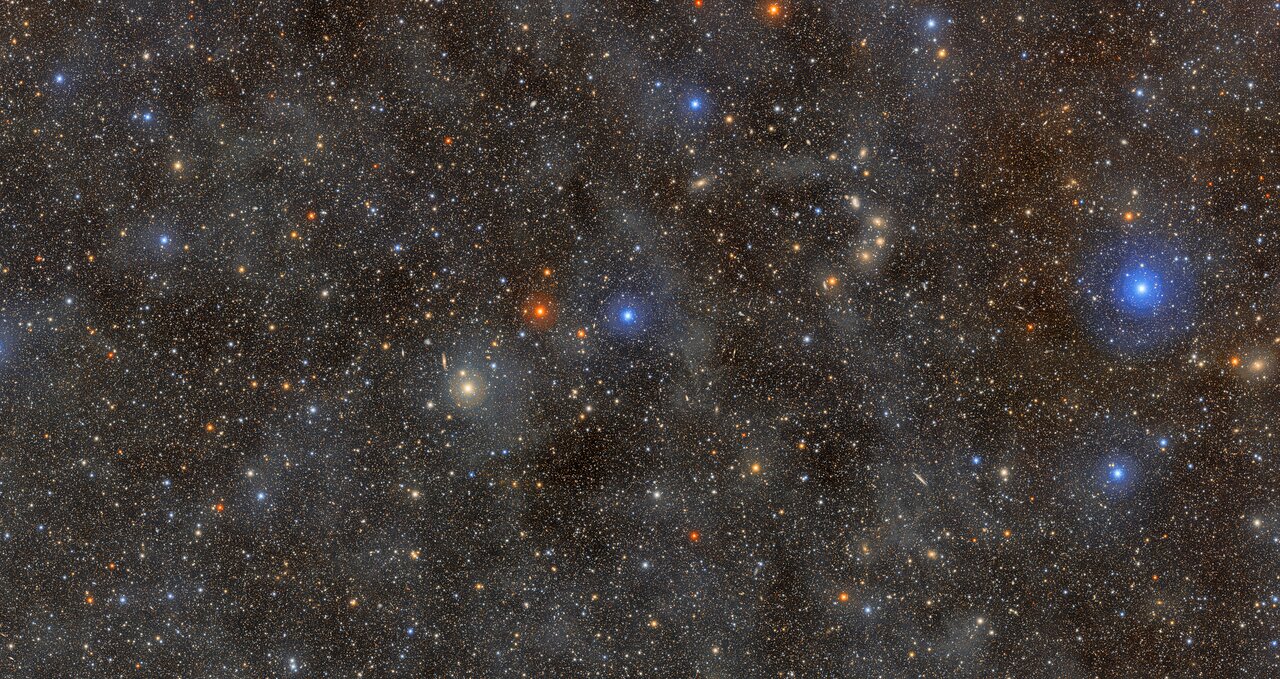
0A star-forming galaxy in the early universe might have sent a ghostly particle known as a neutrino crashing into the ice at Earth’s South Pole, after an 11 billion-year journey through space.
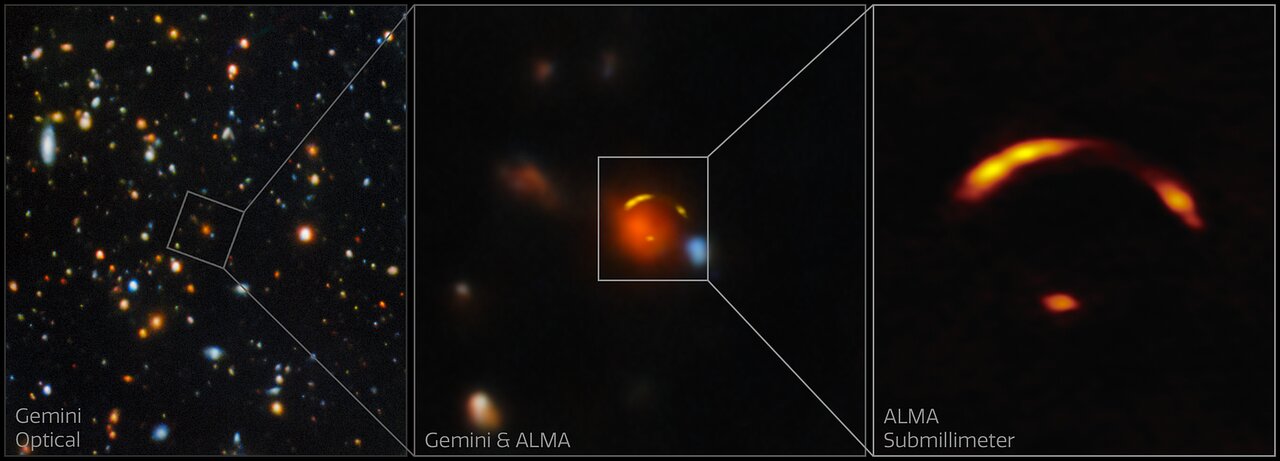
International Gemini Observatory / NOIRLab / NSF / AURA / ALMA (ESO / NAOJ / NRAO)
Astronomers say they’ve traced a high-energy neutrino back to a distant, dusty star-forming galaxy. If they’re right, supermassive black holes are not the only sources of these energetic but elusive particles.
Neutrinos – electrically neutral and almost massless elementary particles – hardly interact with other matter. So they’re hard to catch, despite their huge numbers. But rarely, a neutrino crashes into an atomic nucleus, producing a muon (a heavy electron). As the muon moves through a medium such as air, water, or ice, it causes a tiny burst of blue light known as Cherenkov radiation.
The 5,160 light-sensitive detectors of the IceCube neutrino observatory at the South Pole regularly observe these flashes from within a cubic kilometer of ice. From these data, astronomers can deduce the direction of origin of the original neutrino to within a few degrees.
On September 22, 2021, IceCube registered a neutrino (IC210922A) with an estimated energy of 750 tera-electronvolt (750 TeV) — more than 100 times the maximum energy generated in our largest particle accelerators. Analysis of IceCube’s data pinpointed the neutrino’s source, arriving from a point in northern Eridanus.
Although scientists have convincingly traced some previously detected high-energy neutrinos back to active galactic nuclei (massive black holes in the cores of distant galaxies), follow-up observations didn’t reveal any such counterpart to IC210922A in visible light or in X-rays.
However, in 2021 a team led by Taiwanese astronomers Yuji Urata (MITOS Science) and Kuiyun Huang (Chung Yuan Christian University) found a source of submillimeter radio waves in the same direction as the neutrino source, from data collected by the James Clerk Maxwell Telescope on Maunakea, Hawai’i.
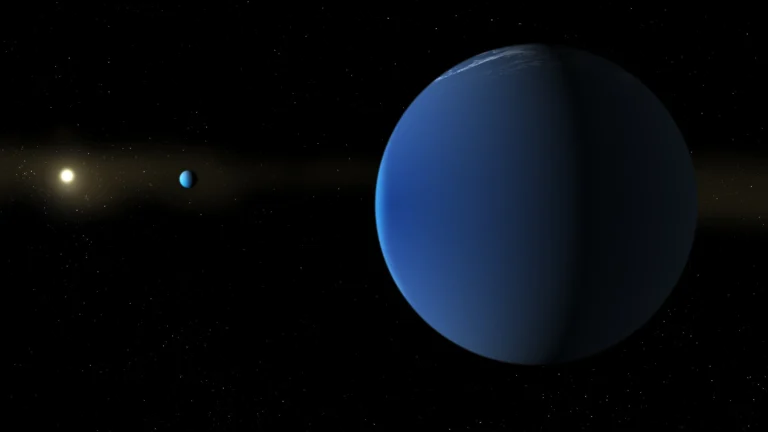
Now, in Nature Astronomy, the team presents detailed Atacama Large Millimeter/submillimeter Array (ALMA) observations of that submillimeter source. It turns out to be a gravitationally lensed, dusty, star-forming galaxy, magnified by the gravity of a nearer galaxy in the foreground. It’s so distant that its light takes 11 billion years to reach us.
The ALMA data indicate that the galaxy has a compact core, harboring huge amounts of gas in a region about 3,000 light-years across. According to the team of astronomers, this violent but obscured star-forming region is the likely source of IC210922A. They have nicknamed the galaxy “Shadow Blaster.”
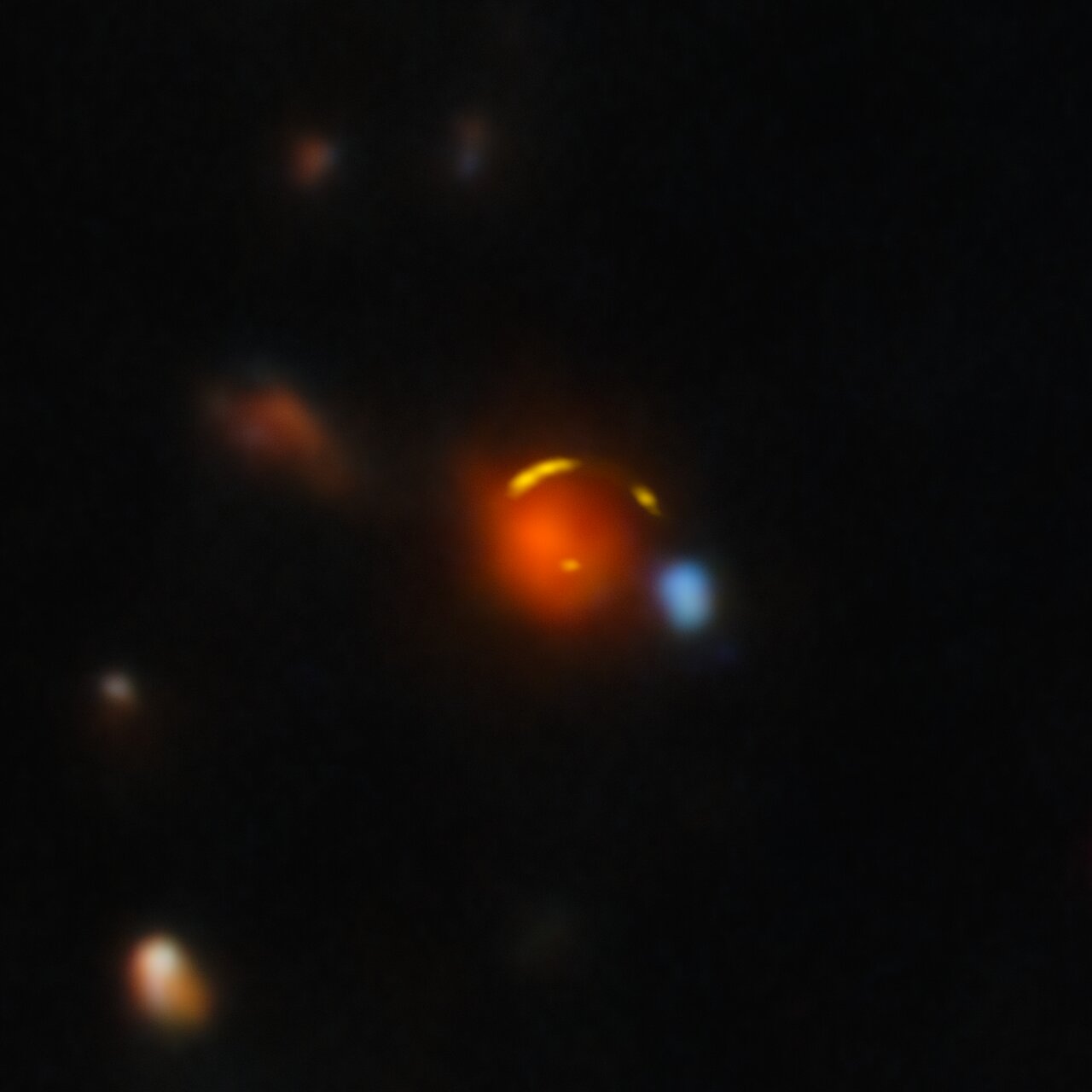
International Gemini Observatory / NOIRLab / NSF / AURA / ALMA (ESO / NAOJ / NRAO)
“I think the paper provides a good case” for this identification, says Jacco Vink (University of Amsterdam), who was not involved in the study.
Energetic charged particles produced by supernova explosions produce neutrinos when they collide with gas atoms, Vink explains. “A dusty star-forming galaxy is a very turbulent medium, so strong and tangled magnetic fields can keep charged particles in the galaxy for a long time,” says Vink. “The high density then makes it more likely that they collide, rather than escape.” But the non-charged high-energy neutrinos produced in the collisions do escape, and some of them eventually arrive on Earth.
Then again, the positional coincidence of the neutrino’s point of origin and the remote galaxy could be just that — a coincidence.
Although dusty star-forming galaxies are rare, the authors calculate there’s a less than 1% probability to find one lining up with the neutrino source by pure chance.
The paper presents “a hopeful sign that we have found a dusty star-forming galaxy counterpart to a neutrino event,” Vink says, “but only having many more of these dusty star-forming galaxy-neutrino alignments will clinch the case,”
Ralph Wijers (also at the University of Amsterdam) agrees. “To me, there is still a reasonable chance that the galaxy just happens to be an interesting object that lies within the error region but is unrelated,” he says. “It would be nice to find another one or few to make the case.”
If Shadow Blaster is indeed the source of IC210922A, Urata, Huang, and their colleagues estimate that up to 20% of all high-energy neutrinos in the universe may originate in similar galaxies, rather than in the violent environments around supermassive black holes.
About Govert Schilling
Sky & Telescope Contributing Editor Govert Schilling lives in The Netherlands but loves to explore his home planet. In May 2022, Harvard University Press published The Elephant in the Universe: Our Hundred-Year Search for Dark Matter. His latest book is Target Earth - Meteorites, Asteroids, Comets, and Other Cosmic Intruders That Threaten Our Planet.


Comments
You must be logged in to post a comment.