 SUNSET:

 0
0A deep spectrum of a mysterious “little red dot” reveals a supermassive black hole cocooned in gas so dense it’s opaque — but glowing in the infrared.
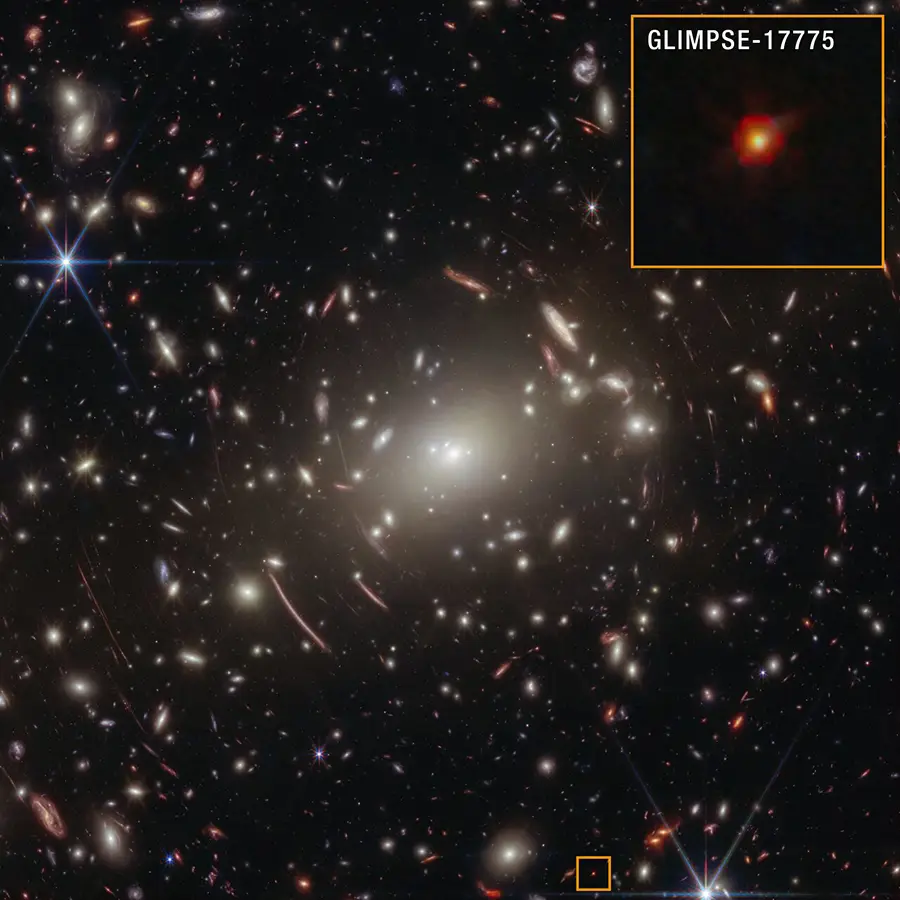
NASA / ESA / CSA / V. Kokorev (University of Texas at Austin) / A. Pagan (STScI)
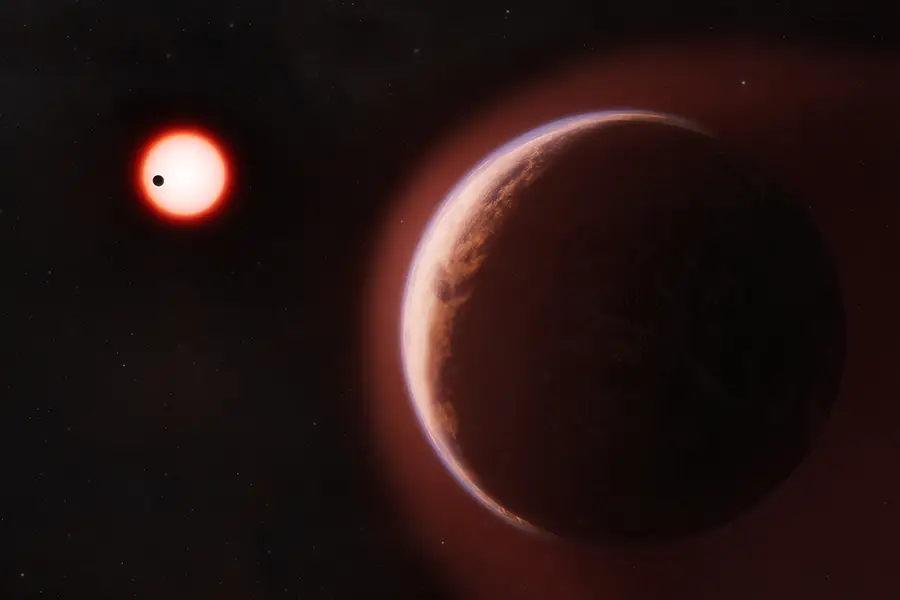
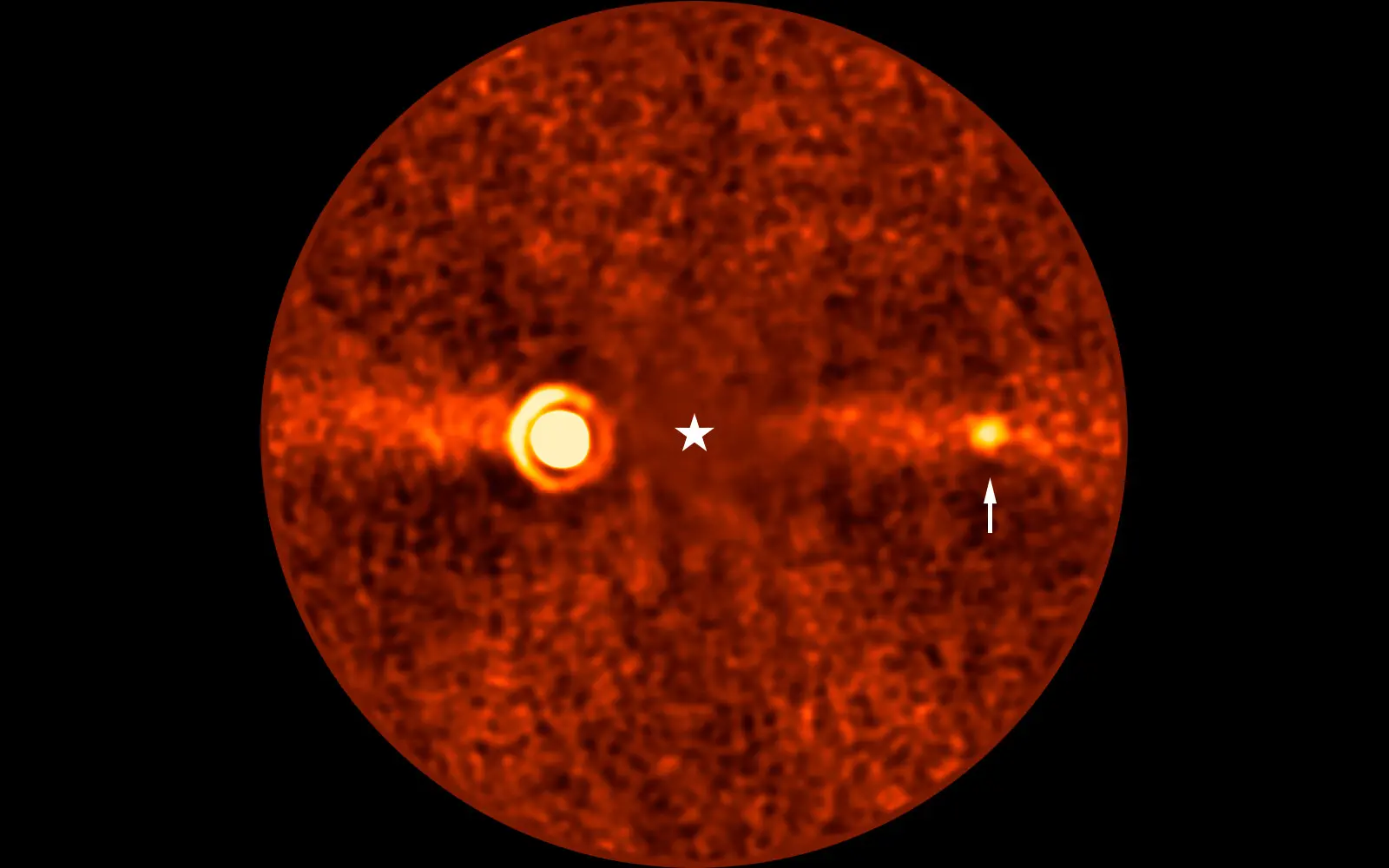
Astronomers using the Webb space telescope have observed a mysterious Little Red Dot (LRD) in unprecedented detail, providing some of the strongest evidence yet that these red-hued fuzzies in Webb images are supermassive black holes enveloped in dense cocoons of gas.
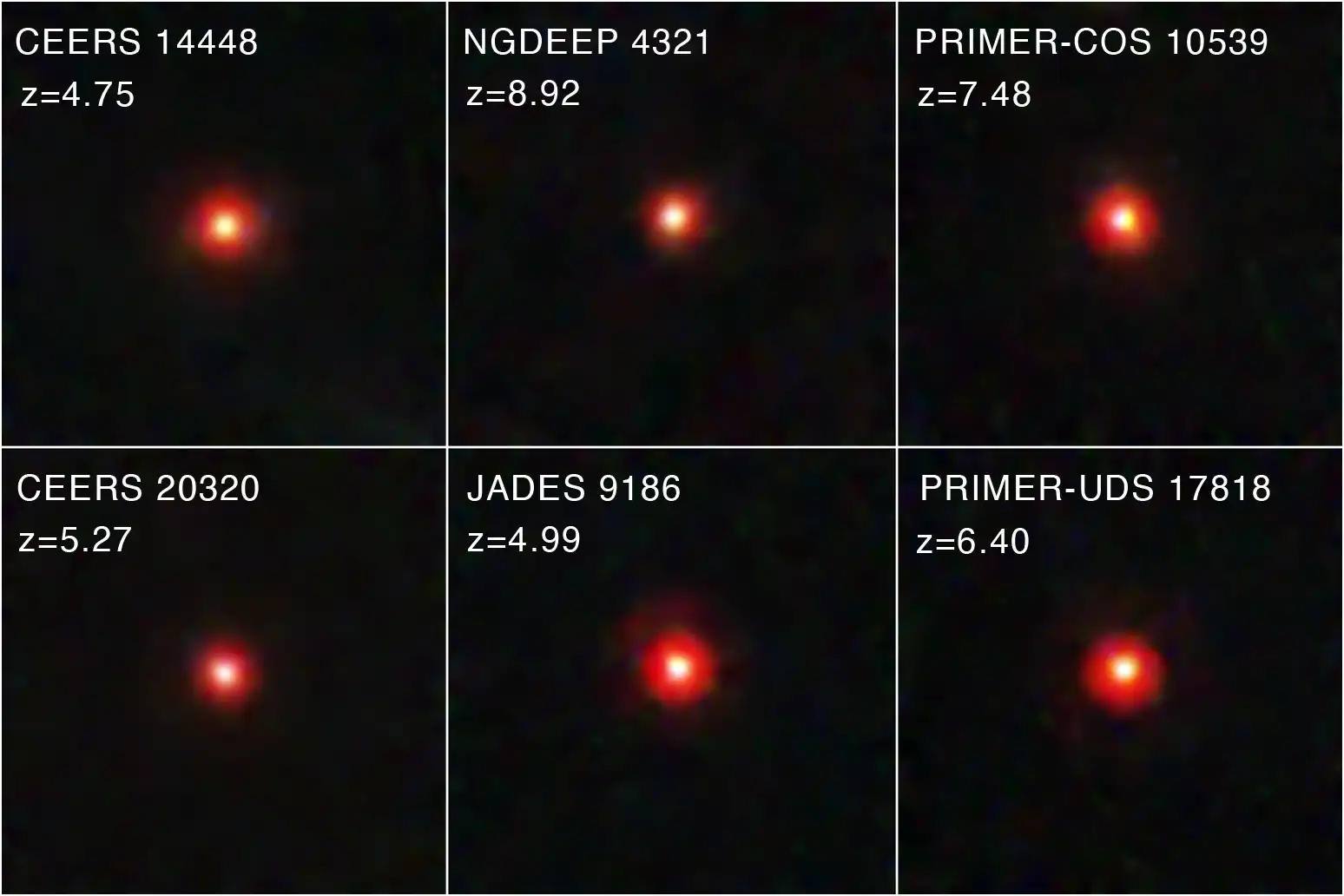
Soon after Webb’s launch, astronomers began spotting these mysterious objects in the early universe, several hundred million years after the Big Bang. The number of these Little Red Dots (LRDs) fell off drastically by the time the universe reached around 1.5 billion years old. Their nature was unclear: Were they galaxies bursting with star formation? Or were they dust-enshrouded supermassive black holes?
Now, astronomers may be closing in on an explanation, based on the deepest spectrum of an LRD captured so far. This LRD is called GLIMPSE-17775, and it exists some 1.8 billion years after the Big Bang. Its light is magnified by a foreground galaxy cluster, which acts as a gravitational lens and magnifies the more distant LRD. A team led by Vasily Kokorev (University of Texas at Austin) used Webb to take a 20-hour spectrum of GLIMPSE-17775, but the lensing effect boosted that to the equivalent of 80 hours’ worth of telescope time.
“When we saw the spectrum for the first time, it was like having all the pieces of a puzzle scattered on the floor,” Kokorev says. “We picked up each piece of the puzzle, measured the lines, and started combining the different pieces into a mosaic.” Their results are published in The Astrophysical Journal.
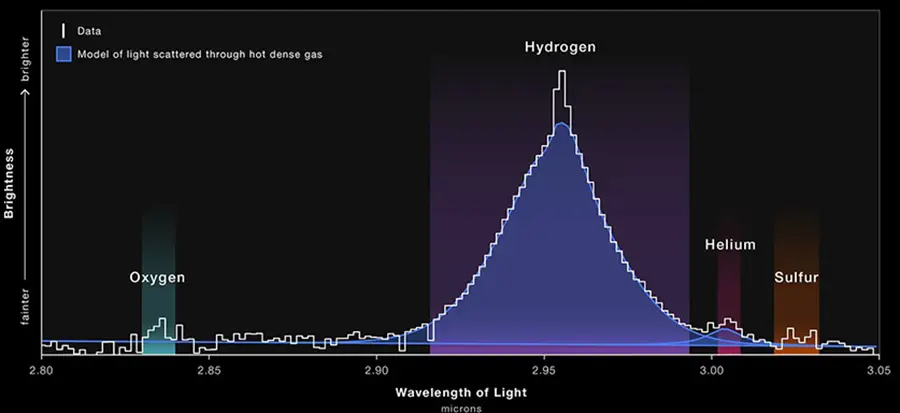
The team observed more than 40 features in the LRD’s spectrum. Several of the emission lines were thick, broadened in a way that suggests an effect known as electron scattering is at work. These lines indicate that a dense cocoon of gas surrounds the central source.
NASA / ESA / CSA / V. Kokorev (University of Texas at Austin) / A. Pagan (STScI)
The spectrum also contains strong features from ionized iron, oxygen and helium, all pointing to a powerful source of energy hidden within that cocoon.
Taken together, the observations are consistent with the picture of an actively feeding 5 million-solar-mass black hole surrounded by layers of gas so thick they are opaque. The gaseous cocoon absorbs much of the radiation produced near the black hole, reemitting it at the infrared wavelengths that Webb sees, creating the unusual red appearance that gives LRDs their name.
Webb and Hubble observations also suggest GLIMPSE-17775 is embedded within a substantial host galaxy, which helps resolve one puzzling feature of the spectrum: A characteristic dip in emitted light that is normally a signature of LRDs, called the Balmer break, is weaker than typically seen in such objects. But the surrounding galaxy could explain this, as stars radiate at bluer wavelengths, diluting the Balmer break.
One challenge for this interpretation is that the black hole appears to be guzzling gas at a rate almost twice the theoretical threshold, known as the Eddington limit.
"While such a scenario is plausible, it has not been shown in any self-consistent numerical simulation that follows the formation of black holes and their host galaxy," says Sadegh Khochfar (University of Edinburgh, UK), who was not involved in the research.
NASA / ESA / CSA / STScI / Dale Kocevski (Colby College)
"While these results are promising, I am looking forward to more observations of LRDs to see whether this picture indeed is confirmed," he says. "The main source of uncertainty is the gravitational lensing by the foreground galaxy cluster, as it requires a lensing model which comes with large uncertainty that could change the results."
The findings, if they pan out, are another piece of evidence suggesting that the supermassive black holes found at the center of almost all large galaxies today grew from “heavy seeds.” This scenario proposes that some black holes in the early universe formed in an already massive state, allowing them to rapidly grow into the supermassive black holes seen in LRDs.
Exactly how heavy black hole seeds form soon after the Big Bang is still debated.
"The main impact on heavy seed formation comes from the fact that many LRDs have been detected," says Khochfar. "If these are all indeed massive black holes, massive seed formation needs to be very efficient in the early universe."
About Colin Stuart
Colin Stuart (@colinstuartspace) is an astronomy author and tutor. He also runs a free online astronomy club.


Comments
You must be logged in to post a comment.