 SUNSET:

 0
0Astronomers have located the edge of the Milky Way’s star-forming disk for the first time, showing that star formation is focused within 40,000 light-years of our galactic center.

Stefan Payne-Wardenaar; Magellanic Clouds: Robert Gendler / ESO
Disk galaxies like the Milky Way form stars “inside-out” — starting from the center and working outwards through the disk. So, as a general rule, the farther out astronomers look, the younger the stars are.
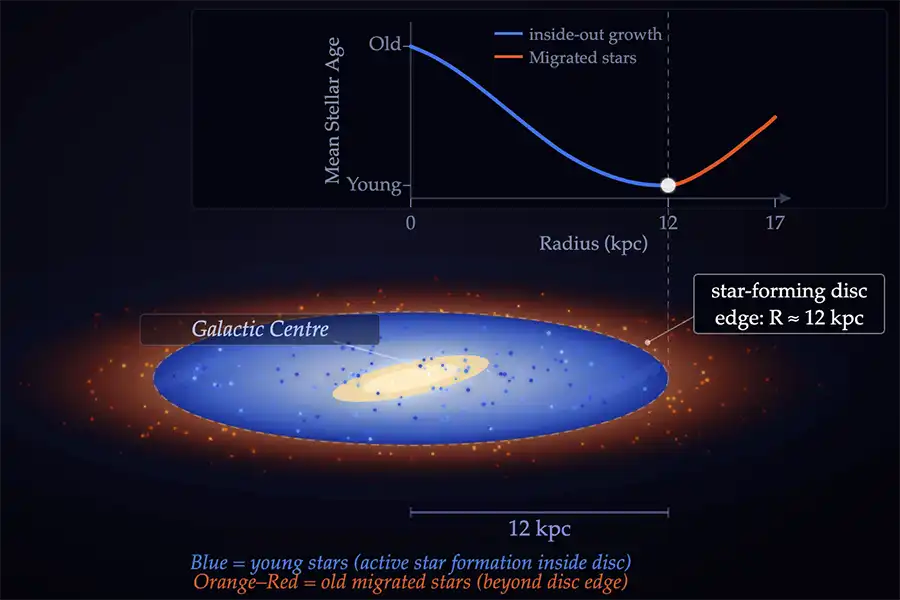
Now, research led by Karl Fiteni (then at University of Malta), carried out under the supervision of Joseph Caruana and Victor Debattista, has analyzed more than 100,000 giant stars. By coupling observations with advanced computer simulations, the astronomers show that this inside-out pattern reverses at between 35,000 and 40,000 light-years from the Milky Way’s center. Beyond this distance, the stars are older again.
Joseph Caruana et al. / Astronomy & Astrophysics 2026
The sudden switch-up creates a U-shaped age profile. The nadir of this curve marks a steep decline in star formation, and that marks the edge of the Milky Way’s star-forming disk. “The extent of the Milky Way’s star-forming disk has long been an open question in galactic archaeology,” Fiteni says. “By mapping how stellar ages change across the disc, we now have a clear, quantitative answer.”
The analysis involves data from the LAMOST and APOGEE spectroscopic surveys, as well as measurements from the European Space Agency’s Gaia satellite. Fiteni’s team focused on giant stars, whose ages can be estimated with relatively high precision. The results are published in Astronomy & Astrophysics.
The stars beyond this boundary probably weren’t formed in situ. But they didn’t come from infalling satellite galaxies either. Instead, they likely migrated outward over time. “A key point about the stars in the outer disk is that they are on close-to-circular orbits, meaning that they had to have formed in the disk,” says team member Victor Debattista (University of Lancashire, UK).
Like surfers carried to the shore, these stars were caught in the spiral waves of our swirling galaxy, which carried them outward and dumped them in the outer regions of the Milky Way. Naturally, it takes longer for them to travel farther, so the outermost stars are also the oldest. The outward migration is responsible for the uptick in stellar ages beyond the edge of the star-forming disk.
Similar U-shaped age profiles have been seen in simulated disk galaxies and inferred in observations of other galaxies beyond our own. So the Milky Way is not unusual but merely following a common pattern of disk evolution, with the newly identified boundary marking a transition that may be a generic feature of spiral galaxies.
It is currently unclear what stymies star formation beyond this boundary. It is possible that the gravity of the Milky Way’s central bar corrals gas at preferred radii. Or it could be due to the bend of the galaxy, which warps towards the edge, disrupting star formation in the outer reaches.
New and future instruments could help paint a clearer picture. They include the 4MOST spectroscopic instrument at the European Southern Observatory in Chile, which saw first light last October, and the WEAVE spectrograph, attached to the William Herschel Telescope at La Palma in the Canary Islands.
As this concerted effort improves our knowledge of galactic archaeology, it brings with it the hope of explaining the past and future of our Milky Way and other galaxies like it.
About Colin Stuart
Colin Stuart (@colinstuartspace) is an astronomy author and tutor. He also runs a free online astronomy club.






Comments
You must be logged in to post a comment.