 SUNSET:

 2
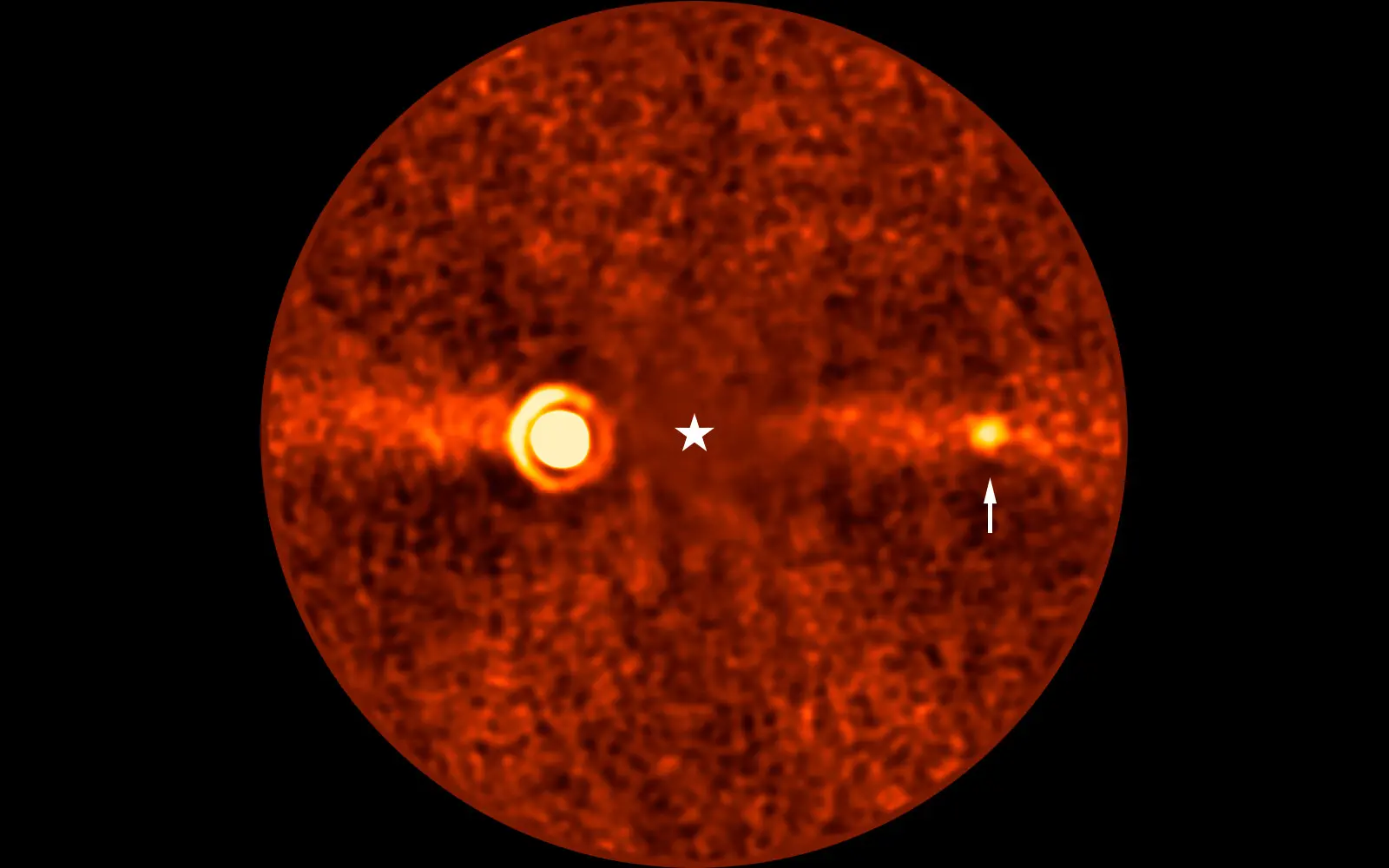
2With the Very Large Telescope in Chile, astronomers have spotted a planet forming around a star 430 light-years away.
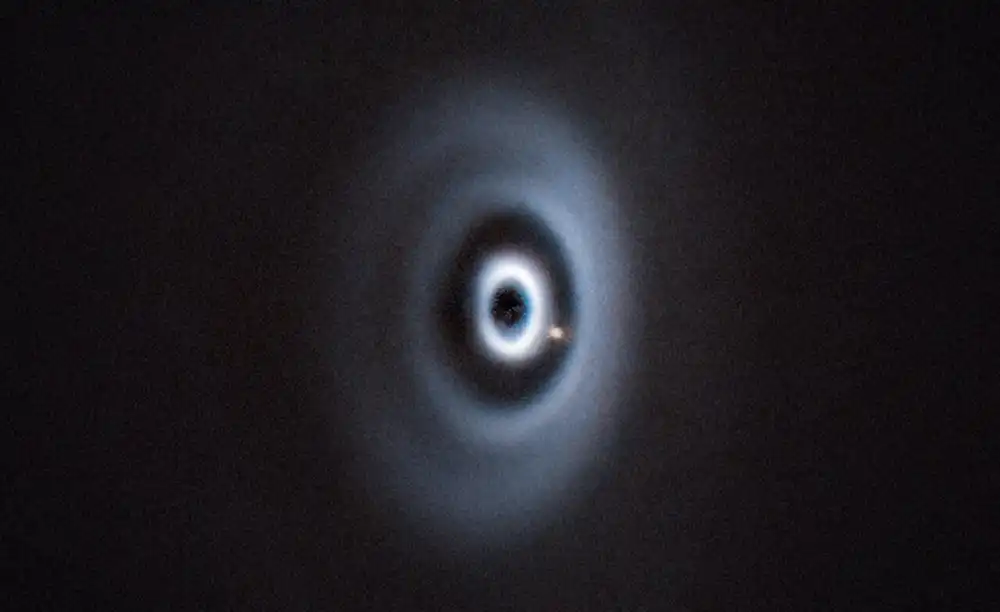
ESO / R. F. van Capelleveen et al.
For the first time ever, an international team of astronomers led by PhD student Richelle van Capelleveen (Leiden Observatory, The Netherlands) has directly imaged a baby planet orbiting in the gap it has itself cleared within the huge, multi-ringed protoplanetary disk of a young star. The 5-million-year-old star, TYC 5709-354-1, is 430 light-years away, in the outskirts of the Scorpius-Centaur association.
Astronomers have long theorized that newborn planets sweep out concentric gaps observed in many circumstellar disks. In 2018, astronomers detected a planet in the relatively empty central region of the disk of the young star PDS 70, but the new discovery is “the first detection of an embedded planet in a cleared gap,” according to van Capelleveen’s supervisor Matthew Kenworthy.
Multiple images obtained by the SPHERE instrument on the European Southern Observatory’s 8.2-meter Very Large Telescope in Chile, carried out over a period of 18 months, reveal the orbital motion of the planet, which is about five times as massive as Jupiter, the team reports in The Astrophysical Journal Letters.
A companion paper, by Laird Close (University of Arizona) and colleagues, describes observations with the 6.5-meter Magellan Telescope, also in Chile, that reveal hydrogen gas still accreting on the planet. “As soon as we took a picture, in the light of H-alpha [dark red light emitted by excited hydrogen], we found a beautiful accreting planet,” says Close in a press statement. “Our strong H-alpha detection proves it is a very rare example of a growing protoplanet.”
The planet, WISPIT-2b (named for the Wide-Separation Planets in Time survey that led to its discovery), orbits at 57 astronomical units (about 8.5 billion kilometers) from its parent star. According to coauthor Christian Ginski (University of Galway, Ireland), “This is strong direct observational evidence that the gas giants we have found on wide orbits around slightly older stars can indeed have formed further away from their host stars.”
Meanwhile, observations with the Large Binocular Telescope in Arizona have revealed a second and even more massive planet candidate in the system, within the bright inner ring of the protoplanetary disk. However, this planet does not appear on the near-infrared VLT image.
Van Capelleveen adds: “This system will likely be a benchmark for years to come.”
About Govert Schilling
Sky & Telescope Contributing Editor Govert Schilling lives in The Netherlands but loves to explore his home planet. In May 2022, Harvard University Press published The Elephant in the Universe: Our Hundred-Year Search for Dark Matter. His latest book is Target Earth - Meteorites, Asteroids, Comets, and Other Cosmic Intruders That Threaten Our Planet.



Comments
Daniel Crowe
August 30, 2025 at 7:28 pm
H-alpha is not emitted by ionized hydrogen: it's emitted when a neutral hydrogen atom goes from the second excited state (n = 3) to the first excited state (n = 2), where the ground state is n = 1.
You must be logged in to post a comment.
Monica Young
September 2, 2025 at 10:40 am
Thank you for the catch, I've corrected that error.
You must be logged in to post a comment.
You must be logged in to post a comment.