 SUNSET:

 0
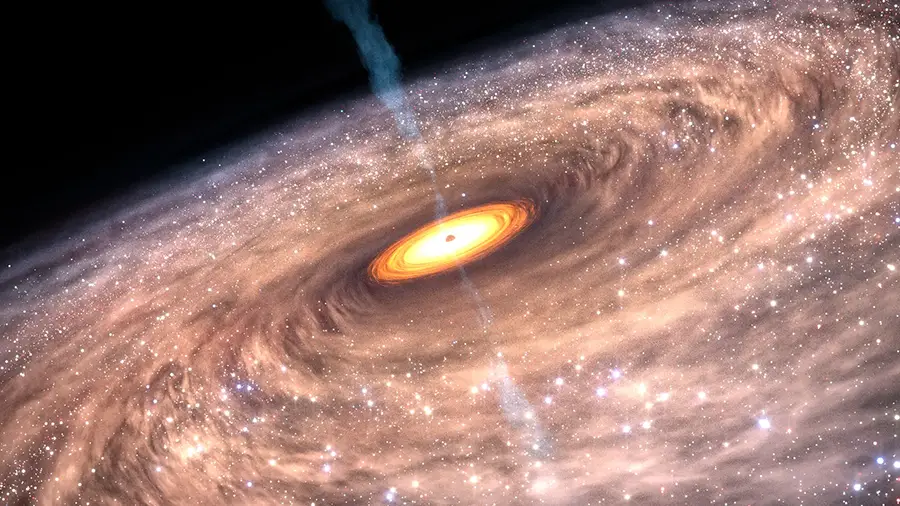
0Why is the gravitational-wave background — the hum made by supermassive black holes colliding across the universe — stronger than expected?
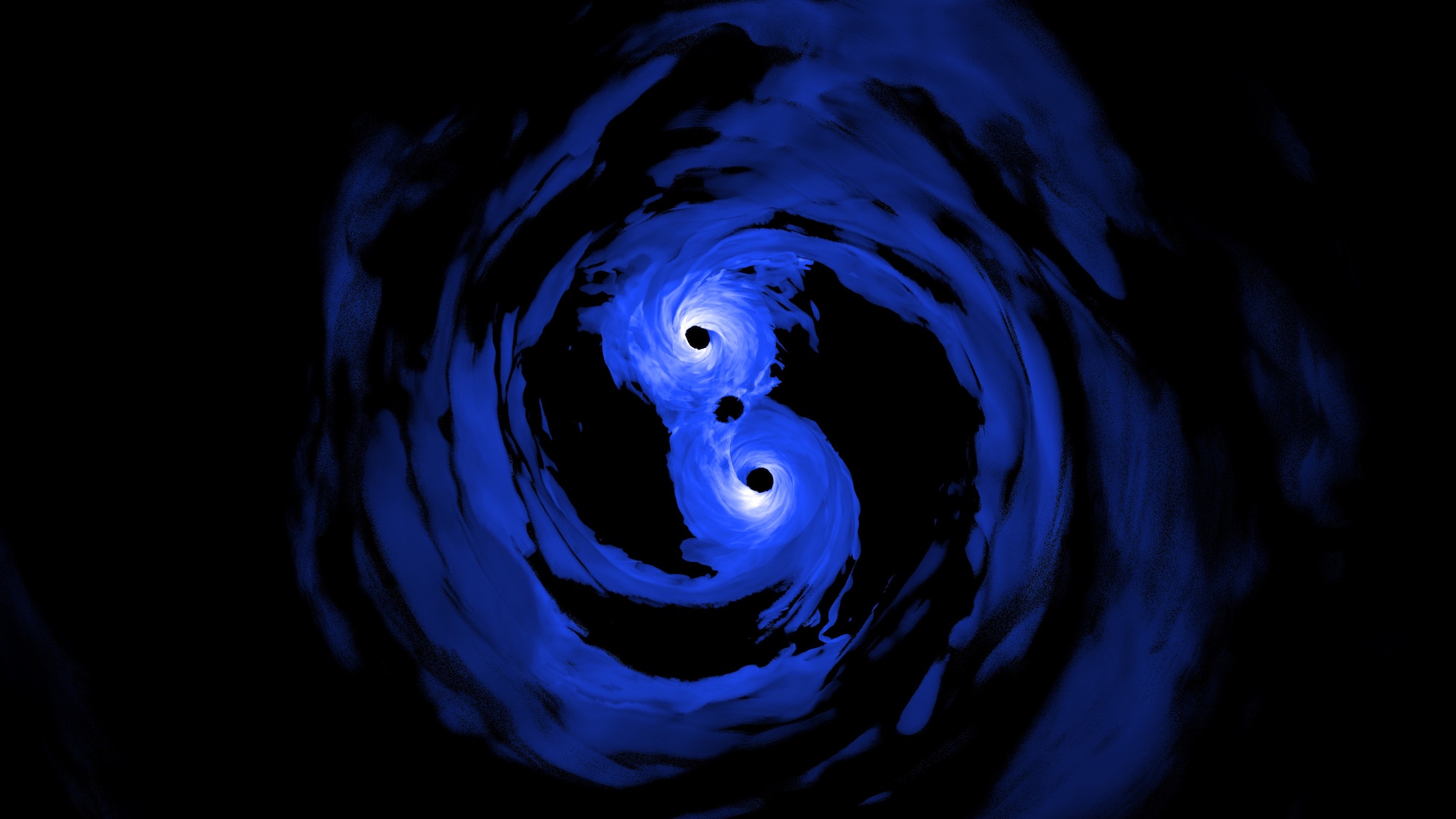
NASA's Goddard Space Flight Center / Scott Noble; simulation data, d'Ascoli et al. 2018
The gravitational wave background — the constant, low-frequency hum of colliding supermassive black holes across the universe — seems to have a larger amplitude than expected. Can preferential accretion explain why?
Larger than Expected
In 2023, researchers announced the discovery of compelling evidence for the gravitational wave background: a low-frequency, low-amplitude signal that is likely due to supermassive black hole binaries across the universe steadily trundling toward mergers. The amplitude of the background, however, is larger than expected for a population of merging supermassive black holes.
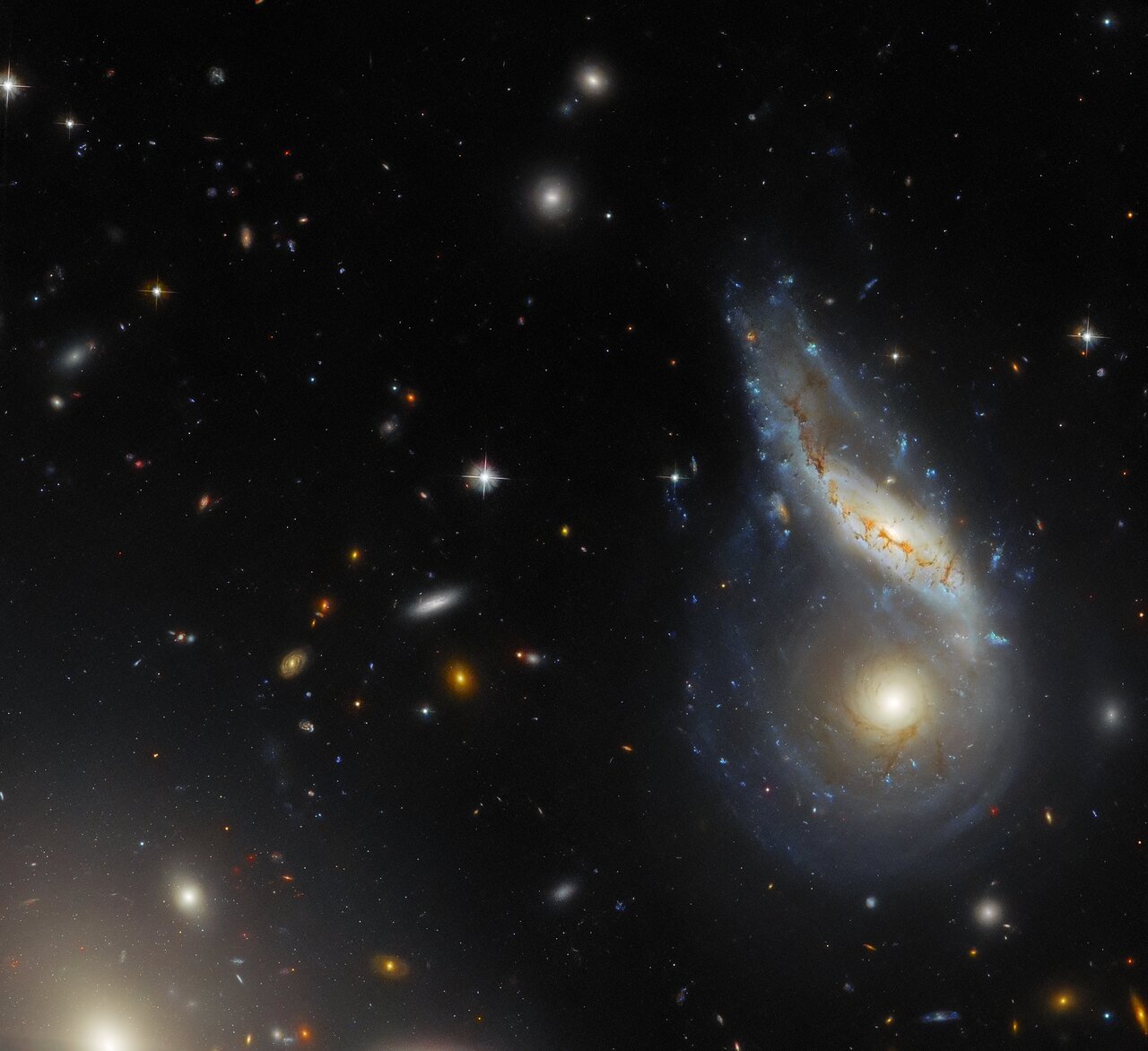
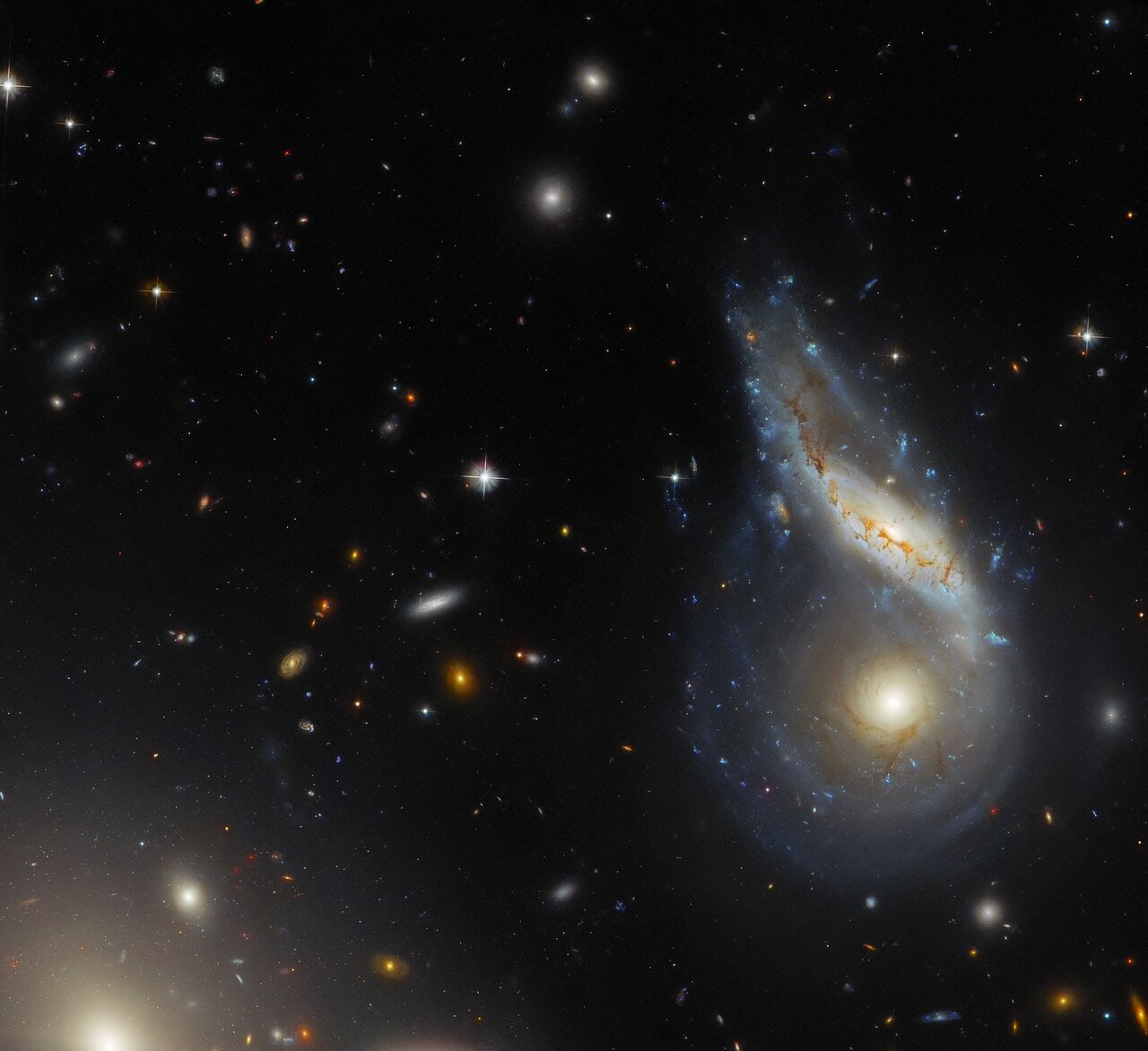
ESA / Hubble & NASA, J. Dalcanton, Dark Energy Survey /DOE / FNAL / DECam / CTIO / NOIRLab / NSF / AURA; Acknowledgement: L. Shatz; CC BY 4.0
Though some researchers have invoked new physics to explain this discrepancy, all that may be required is an adjustment to our understanding of the supermassive black hole binary population in our universe. In a recent research article, Julia Comerford (University of Colorado Boulder) and Joseph Simon (University of Colorado Boulder; Oregon State University) tackled one of the underlying assumptions about the masses of merging supermassive black holes.
Preferential Accretion Pathway
When supermassive black holes merge, the strength of the gravitational-wave signal depends on how similar the black holes were in mass: Merging equal-mass black holes produce stronger signals than mismatched black holes do. What if, Comerford and Simon proposed, the masses of merging supermassive black holes scattered across the universe are more similar than previously thought?
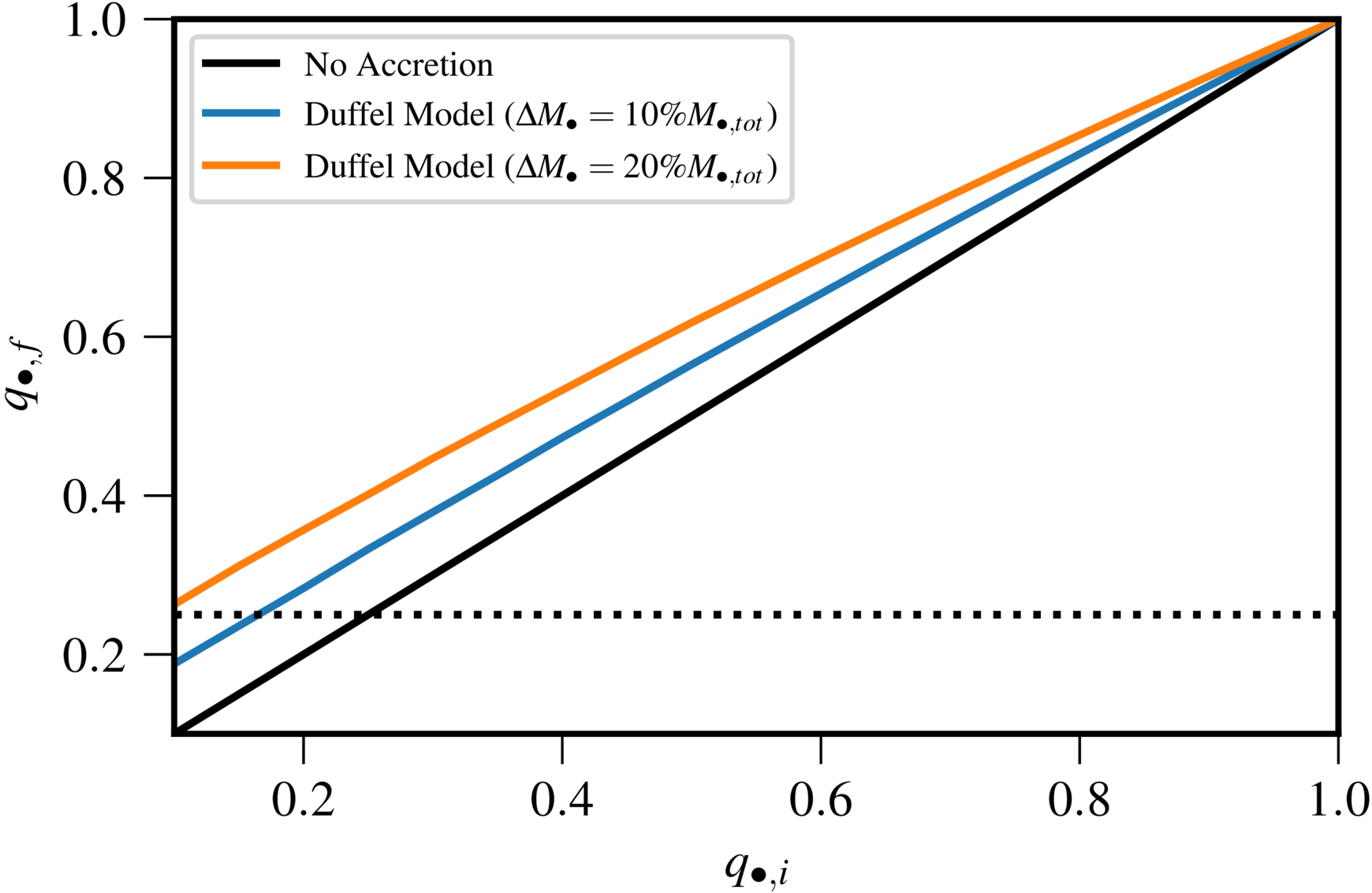
Observations and simulations of supermassive black holes within colliding galaxies appear to support this hypothesis. Rather than staying the same mass as they approach one another, as models tend to assume, supermassive black holes likely gather material from their surroundings and gain mass.
Comerford & Simon / Astrophysical Journal 2025
What’s more, it appears that the smaller of the two black holes tends to pack on more mass, meaning that the masses of the black holes grow more similar as they wind toward a merger. (This somewhat counterintuitive result arises because the smaller of the two black holes encounters more gas as it spirals inward.)
Boosting the Signal
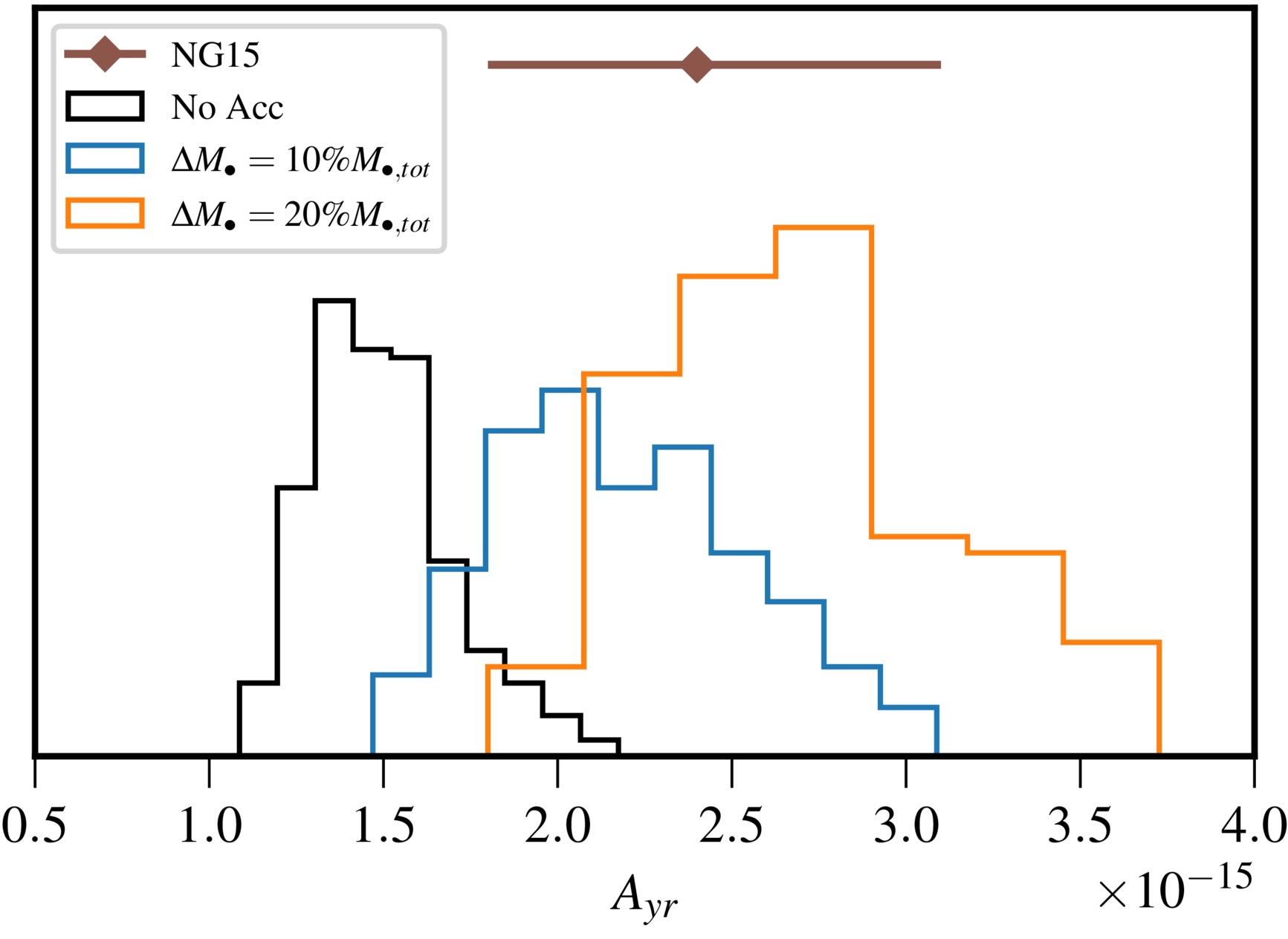
If accretion tends to even out the masses of the binary members, is the resulting increase in signal strength large enough to explain the observed amplitude of the gravitational wave background?
Adapted from Comerford & Simon / Astrophysical Journal 2025
Comerford and Simon modeled the gravitational-wave background that results when supermassive black hole binaries undergo preferential accretion onto the smaller black hole. Benchmarking their model with observations wherever possible, they found that just a 10% increase in the total mass of the merging black holes can raise the gravitational-wave background to the median observed value — easing the discrepancy without the need for speculative new physics.
The signal-boosting effect from preferential accretion may be especially important if the binary evolution timescale — the time it takes for black holes approaching a merger to reach a separation at which their gravitational waves become accessible to pulsar timing arrays — is longer than the estimated 1.8 billion years. At longer timescales, models without this accretion become entirely inconsistent with observations. Future research that examines the masses and accretion rates of supermassive black holes as they approach make their way toward a merger can provide further clues to the role of preferential accretion.
Citation
“Preferential Accretion onto the Secondary Black Hole Strengthens Gravitational-Wave Signals,” Julia M. Comerford and Joseph Simon 2025 ApJ 994 168. doi:10.3847/1538-4357/ae1133
This post originally appeared on AAS Nova, which features research highlights from the journals of the American Astronomical Society.




Comments
You must be logged in to post a comment.