 SUNSET:

 0
0New observations from the James Webb Space Telescope might have caught the signature of the universe’s first stars.
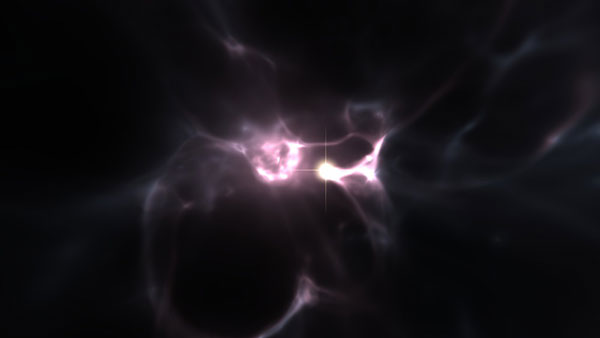
Abel Wise / Kaehler (KIPAC / SLAC)
Astronomers might have finally discovered the very first generation of stars. At most a few hundred million years after the Big Bang, the bright behemoths formed out of the primordial brew of hydrogen and helium that filled the newborn universe.
When they ended their short lives in titanic supernova explosions, these stars enriched interstellar space with the heavier atoms forged in their nuclear ovens. As a result, later generations of stars always contain a smattering of elements such as carbon and oxygen.
Using the sensitive Near-infrared Spectrograph on the James Webb Space Telescope, Roberto Maiolino (University of Cambridge, UK) and his colleagues now claim to have found this first generation of stars, termed Population III (or Pop III for short), in a diminutive proto-galaxy observed 400 million years after the Big Bang.
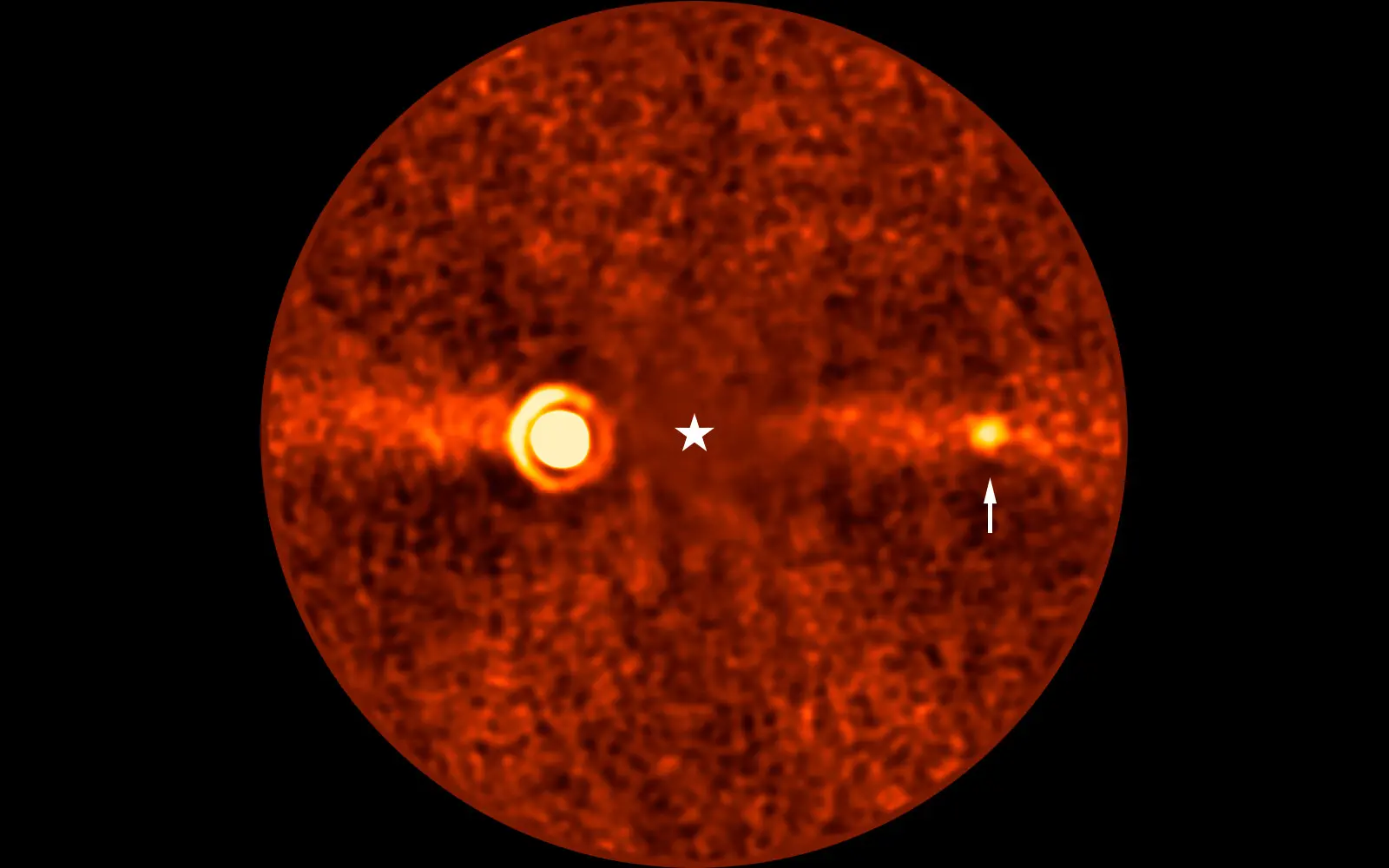
The small, irregular cloud of gas lies just some 10,000 light-years from the much brighter early galaxy GN-z11, probably within the larger galaxy's halo. The cloud appears to lack any heavy elements. Instead, JWST detected only the emission from ionized helium and excited hydrogen atoms (the latter is referred to as Balmer emission). The team has nicknamed the object Hebe, short for Helium Balmer Emitter. In Greek mythology, Hebe was the goddess of youth.
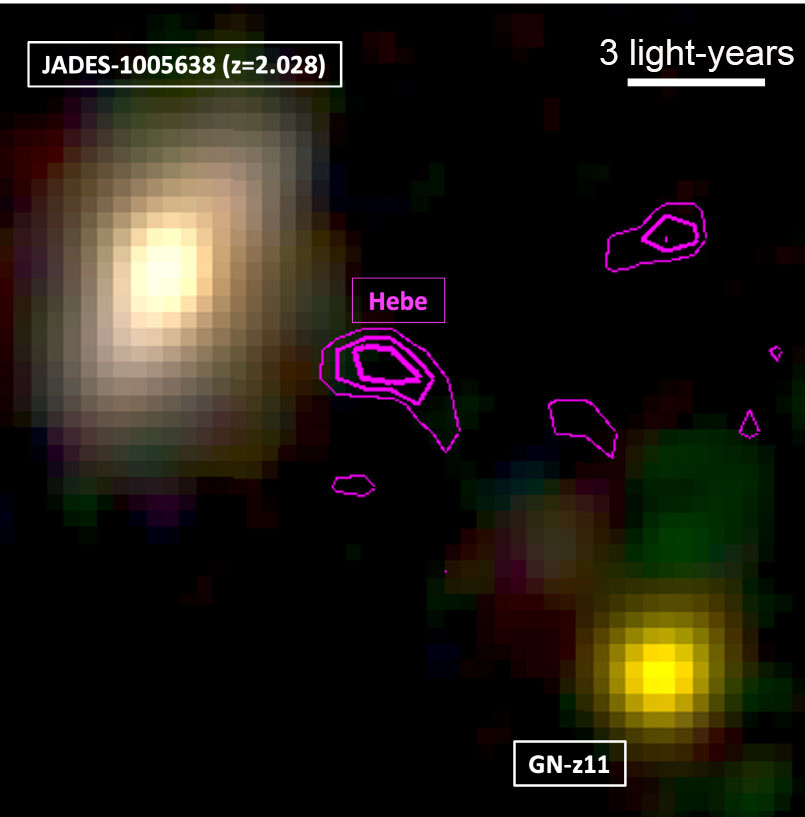
R. Maiolino et al. / arXiv/2603.20362
In three papers published on the astronomy arXiv preprint server (Paper 1, Paper 2, Paper 3), the astronomers argue that embedded hot, massive stars are the only viable candidates to have ionized helium in the surrounding gas.
Since Hebe doesn’t contain heavy elements, these stars must have formed from the same pristine material. “The only models consistent with the [observations] are those involving Pop III stars,” the researchers write.
Studying Pop III stars is important to understanding the early evolution and chemical enrichment of the universe as well as glimpsing the birth of the first black holes that are left behind when the massive stars go supernova.
So why can’t we see the stars themselves? As Maiolino explains, Pop III stars mainly produce extreme ultraviolet radiation. “We cannot [easily] observe such short wavelengths at high redshift, because of the absorption by the intergalactic medium,” he says. In other words, the intervening gas molecules around and in the distant galaxy absorb most of the ultraviolet photons, leaving few to travel all the way to telescopes at Earth.
Indeed, according to Simon Glover (University of Heidelberg, Germany), detecting stellar radiation with a broad range of short, high-energy wavelengths may require deeper imaging than is currently available.
Glover, who was not involved in the Hebe studies, says he was “interested, but skeptical” when he first heard about the team’s claim. “Because a direct detection of a Pop III-dominated system would be so important, it’s natural to demand a high standard of evidence,” he says.
Even after reading the papers, Glover is still not completely convinced. “I would say right now that the Pop III interpretation is probably the most plausible one, but I don’t think it’s completely settled,” he says. “There’s been quite a history in the field of apparently groundbreaking results not holding up when more data is gathered.”
But Maiolino and his colleagues are more confident, writing, “Hebe represents one of the most convincing pieces of evidence for Population III stars in the early universe.”
About Govert Schilling
Sky & Telescope Contributing Editor Govert Schilling lives in The Netherlands but loves to explore his home planet. In May 2022, Harvard University Press published The Elephant in the Universe: Our Hundred-Year Search for Dark Matter. His latest book is Target Earth - Meteorites, Asteroids, Comets, and Other Cosmic Intruders That Threaten Our Planet.




Comments
You must be logged in to post a comment.