 SUNSET:

 0
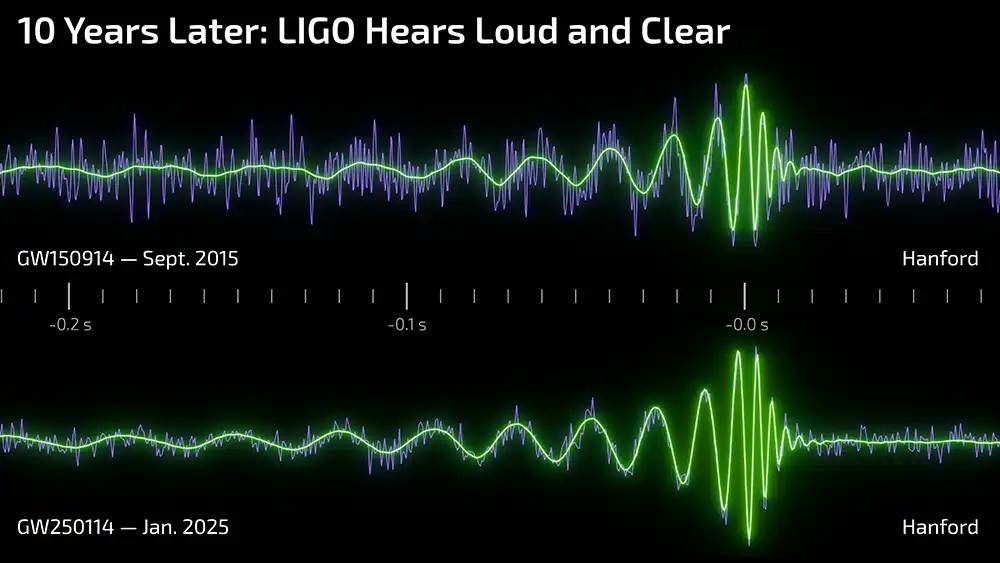
0The LIGO gravitational-wave detector celebrates its 10th birthday with the clearest signal yet from a pair of merging black holes.
LIGO / J. Tissino (GSSI) / R. Hurt (Caltech-IPAC)
Astronomers have used the Laser Interferometer Gravitational-wave Observatory (LIGO) to detect the clearest-ever gravitational-wave signal from colliding black holes. Released to coincide with the 10th anniversary of the first LIGO signal, these new measurements also confirm key predictions made by physicists Roy Kerr and Stephen Hawking.
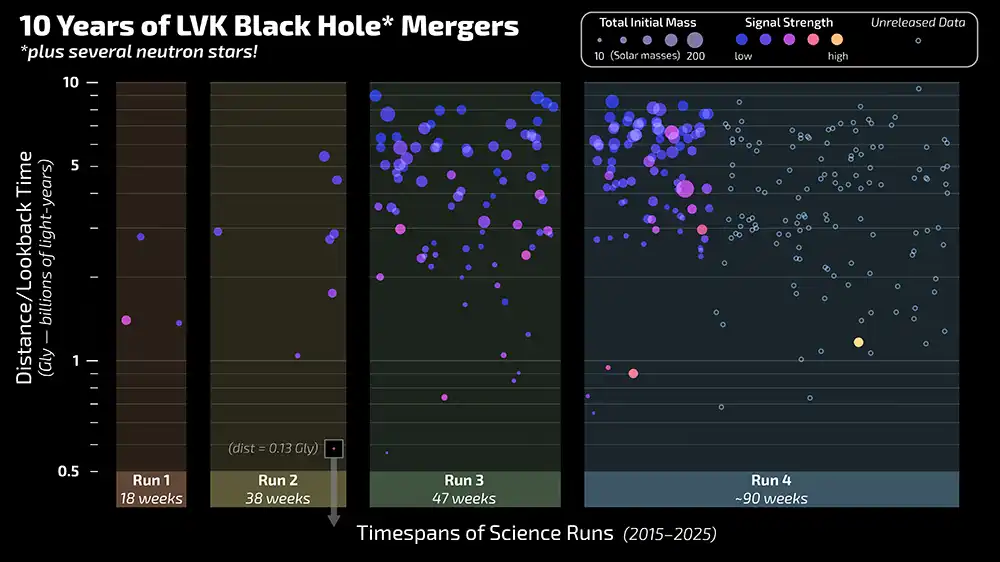
Gravitational waves are ripples in the very fabric of the universe itself. Predicted by Einstein in 1915, it took a full century to find them. Since the first discovery in 2015, the floodgates have opened — LIGO now observes a black hole merger every three days.
Much has changed over the last decade, with LIGO now four times as sensitive as it was then. Improvements have allowed astronomers to look at new mergers with sharper eyes. As an example of this enhanced sensitivity, the LIGO team investigated an event seen as part of LIGO’s fourth observing run, in January 2025. The signal is known as GW250114.
“This specific collision involved two black holes that looked pretty much identical to the first two we saw,” says team member Maximiliano Isi (Columbia University). “Intrinsically, the signal is equally loud, but our detectors are just so much more high-fidelity now.”
LIGO / Derek Davis (URI)
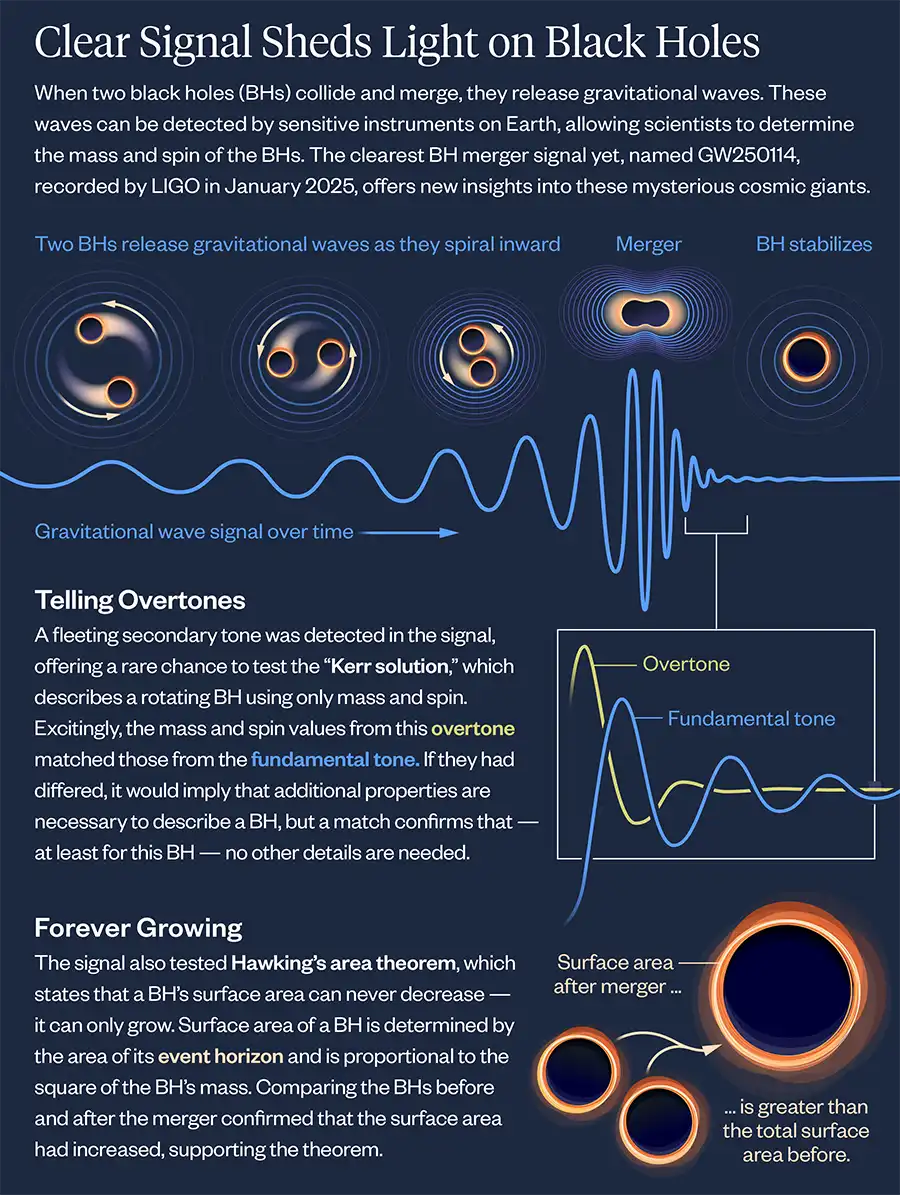
LIGO's increased sensitivity enabled researchers to measure a key property of the single black hole created by the merger: ringdown. “The ringdown is what happens when a black hole is perturbed, just as a bell rings when you strike it,” says team member Katerina Chatziioannou (Caltech). Except these oscillations are in space and time. By analyzing the ringdown, the team found that the mass and spin of the new black hole was consistent with the solutions to Einstein's equations that Roy Kerr found 60 years ago. Those results appear in Physical Review Letters.
“The observations suggest that Einstein was right, yet again,” says Nils Andersson (University of Southampton, UK), who was not involved in the research. “It is in many ways remarkable that his 100-year-old theory keeps passing ever more precise experimental tests.”
The team used the data to confirm that the total surface area of the black hole’s event horizon increased, in line with a prediction made by Stephen Hawking. The black hole itself is a singularity in space and time, but its mass determines the size of its event horizon — the sphere around the singularity from which nothing, not even light, can escape. Hawking’s rule, which states that the event horizon area can only increase, is often called the Second Law of Black Hole Mechanics, mirroring the Second Law of Thermodynamics that says entropy can only increase.
In the case of GW250114, the initial black holes had event horizons with a total surface area of 240,000 square kilometers (90,000 square miles, or roughly the size of Oregon). The area of the final black hole’s horizon was about 400,000 square kilometers (roughly the size of California).
Lucy Reading-Ikkanda / Simons Foundation
Hawking once telephoned Kip Thorne to ask him whether LIGO could help prove his second law. "If Hawking were alive, he would have reveled in seeing the area of the merged black holes increase," Thorne says.
Astronomers performed a similar test in 2021, using the initial signal from 2014, but they were only 95% sure that Hawking’s theorem held. Now, thanks to LIGO's increased sensitivity, that certainty has risen to 99.999%.
There should be more landmark observations to come, particularly when LIGO observations are combined with those of the Virgo and KAGRA detectors (which were both offline for GW250114).
LIGO / Caltech / MIT / R. Hurt (IPAC)
However, one area where the project has struggled is with mergers involving neutron stars.
There was one landmark event in 2017, when LIGO and Virgo spotted two neutron stars merging. That signal was among the first multi-messenger astronomical objects, with the detection of both light and gravitational waves. “It established that gamma-ray bursts originate from neutron star mergers, that they also create a large fraction of the heavy elements like gold and platinum in the universe, placed some constraints on matter at extreme densities and even tested the rate of expansion of the universe,” says Andersson. “But since then, we have only seen one much weaker event of this kind.”
If future neutron star observations provide anywhere near the level of detail as these recent black hole measurements, more cosmic mysteries are likely to be solved.
About Colin Stuart
Colin Stuart (@colinstuartspace) is an astronomy author and tutor. He also runs a free online astronomy club.



Comments
You must be logged in to post a comment.