 SUNSET:

 0
0
Da Ko
If you live in the Northern Hemisphere and want to see Comet ATLAS (C/2024 G3), get ready to put your back into it.
Southern Hemisphere observers have had their eye on the prize the past few weeks, during which time it has steadily brightened. Reports from the Comet Observation Database (COBS) peg it at around magnitude 0 as of Jan. 8th. Although visible in binoculars, Comet ATLAS has been a challenge to see with the naked-eye because of low altitude and twilight.
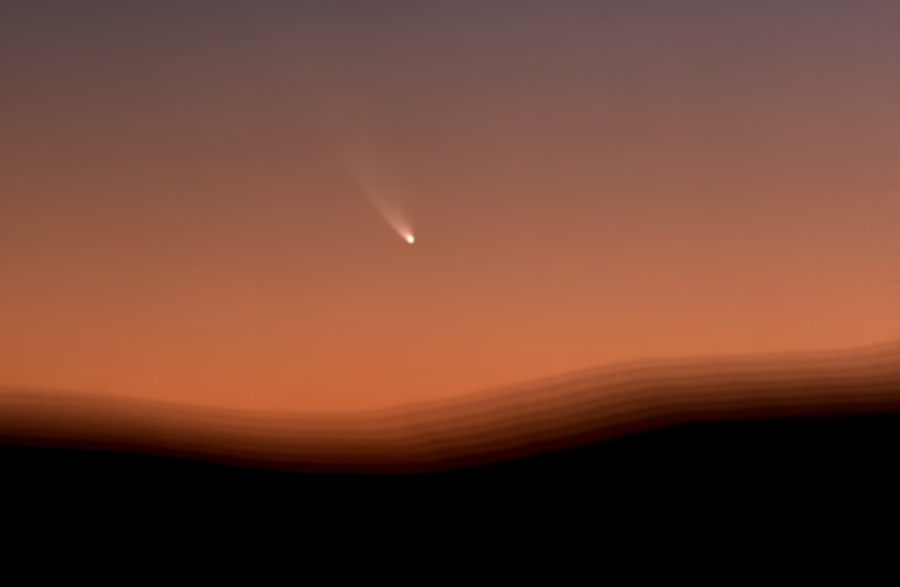
Da Ko of Zacatecas, Mexico, who took the beautiful image above, spotted it easily in binoculars. But it was not a naked-eye object despite being near first magnitude at the time. His experience parallels mine when I sought Comet Tsuchinshan-ATLAS (C/2023 A3) last fall at dawn. After several mornings of trying, I finally saw it in binoculars on October 1st, 45 minutes before sunrise. Comet T-A was then at magnitude 1.5 and stood 4° high when the Sun was about 8° below the horizon. Sky conditions were excellent with no clouds or haze. Despite a good effort, naked-eye was a no-go.
Stellarium with additions by Bob King
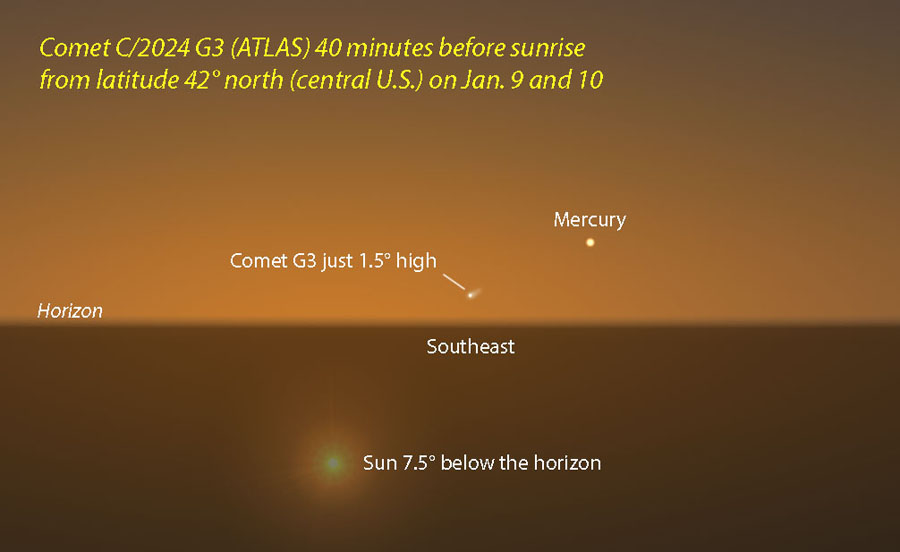
Northern hemisphere observers will get their best crack during the dawn half of its apparition January 9th and 10th, when C/2024 G3 may show in binoculars under ideal conditions low in the southeastern sky approximately 40 minutes before sunrise. Unfortunately, it will only hover between 2° and 2½° high for much of the country — about half of Comet Tsuchinshan-ATLAS's altitude that October morning. On the plus side, its brighter magnitude may compensate for its lower elevation.
Another approach that worked for me even when Comet C/2023 A3 wasn't visible in binoculars was to attach a telephoto lens (100mm - 200mm) and aim the camera at the comet's position. Using the live view feature I could easily spot it on the camera's backscreen, frame a scene and take a picture of the otherwise invisible object. Feels like magic. Give it a try.
Brightness-wise, Comet ATLAS will be a good match to Mercury (magnitude –0.3) in the coming mornings. If you can find the planet in binoculars, the comet will look like a bright, fuzzy dot with a short tail about 7° to its lower left (east). A recent outburst had some of us thinking it might shoot up into the high minus-magnitudes. That flutter of activity has since calmed, with the comet resuming its normal rise in brightness as it approaches perihelion on Jan. 13th.
Rob Kaufman
But make no mistake. C/2024 G3 will continue to brighten. Predictions call for it become as brilliant as Venus at perihelion on January 13th, when it passes just 5° and 0.09 a.u. from the Sun. For experienced and careful observers it may be possible to see it in the daytime sky using a solar-filtered telescope and then carefully offsetting it from the Sun. Some amateurs will also attempt to corral it with big binoculars by hiding the Sun behind a roofline, tree or power pole. Just be careful to NEVER let any direct sunlight enter your eyes or you'll risk damaging your vision.

Stellarium with additions by Bob King
After perihelion, Comet ATLAS swings into the evening sky and quickly distances itself from the Sun. Southern Hemisphere observers are once again favored. Though the comet is expected to fade fairly quickly it may return to view perhaps as early as Jan. 16th when its solar elongation expands to 11°. A few days after, it should wrest itself from the twilight glow and gain sufficient altitude to be easily accessible with binoculars. From then on, it will continue to fade but move into a dark sky.

Stellarium with additions by Bob King
Some Northern Hemisphere skywatchers may see it — with effort — extremely low in the southwestern sky from about January 15–18. From my latitude it won't climb high enough to see at dusk, but anyone with a phone or computer can watch the comet zip 'round the Sun in Solar and Heliospheric Observatory LASCO C3 coronagraph images from January 11-14. Good luck and clear skies!
About Bob King
I love the sky (day and night) and have been a skywatcher and amateur astronomer since childhood. I'm also a long-time member of the American Association of Variable Star Observers (AAVSO) and Astronomical League. I pen the Astro Bob blog and have written four books: Night Sky with the Naked Eye (2016); Wonders of the Night Sky You Must See Before You Die (2018) and Urban Legends from Space (2019) and Magnificent Aurora, published in 2024. The universe invites us on an adventure every single night. To accept the invitation, we only need look up.




Comments
You must be logged in to post a comment.