 SUNSET:

 1
1New data hint that dark energy is weakening over time. If true, it means that our most trusted cosmological models may be wrong.

DESI Collaboration / DOE / KPNO / NOIRLab / NSF / AURA / R. Proctor
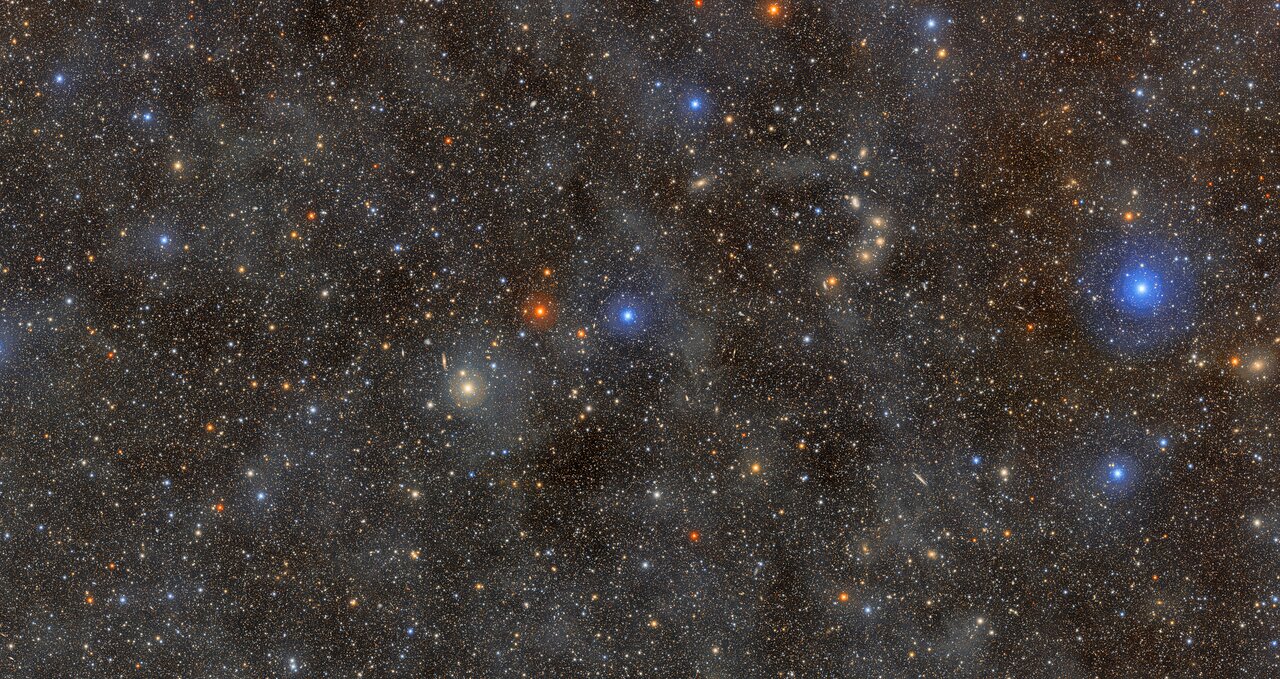
By constructing the largest 3D map of the universe so far, astronomers behind the Dark Energy Spectroscopic Instrument (DESI) have found hints that dark energy is weakening. If true, it means that dark energy is not a constant — and that our most trusted cosmological models may be wrong.
The astronomical world was turned upside down in 1998 when astronomers revealed that the universe’s expansion rate appears to be accelerating. Astronomers usually put this down to a shadowy entity known as dark energy, which acts as a sort of anti-gravity. Crucially, its strength is traditionally thought to be constant and is often associated with the cosmological constant (Λ) that Einstein tried to weed out from his equations of relativity.
In the early universe, with everything huddled close together, gravity was able to trump dark energy. Then, as space expanded, the gravitational attraction between galaxies and their halos of dark matter waned. But while that attraction weakens with distance, a constant dark energy would continue to exert the same repulsive force. So, some 5 billion years ago, the pull of gravity dipped below the might of dark energy and the expansion of the universe began to accelerate away.
Now, new data from DESI suggests the acceleration itself may be slowing. Located at the Kitt Peak National Observatory in Arizona, DESI is an incredibly powerful instrument capable of observing 5,000 galaxies simultaneously. This new data release saw astronomers analyze three years of observations, covering more than 14 million galaxies and quasars. The team's results are published in flurry of papers posted on the astronomy arXiv preprint server.

DESI Collaboration / DOE / KPNO / NOIRLab / NSF / AURA / C. Lamman
On its own, the new DESI data is completely consistent with our standard cosmological models, including the cosmological constant. It’s only when the data are combined with other observations that things get interesting. Add in observations of the cosmic microwave background (the afterglow of the Big Bang), gravitational lensing, and distant supernovae, and suddenly the neatest way to tie all those data points together is to assume dark energy is not constant after all, but is now weakening.
“What we are seeing is deeply intriguing,” says DESI co-spokesperson Alexie Leauthaud-Harnett (University of California, Santa Cruz). “It is exciting to think that we may be on the cusp of a major discovery about dark energy and the fundamental nature of our universe.”
This isn’t the first hint from DESI that our leading cosmological model has issues. The project’s first results, released in 2024, already showed subtle hints that dark energy may be dynamic instead of constant. And just-released results at the American Physical Society’s Global Physics Summit in California from the similarly named but independent Dark Energy Survey (DES) likewise point to a repulsive force that changes over time.
However, it’s still far from an open-and-shut case. “The significance of the claim that dark energy is dynamic is still low,” says Andy Taylor (Royal Observatory Edinburgh, UK), who was not involved in the research. “It is still possible the disagreement is a statistical fluke, or there may still be some bias in the data causing the results.”
That said, if future data further firms up these findings, it would be a remarkable breakthrough. “It would be a hugely significant result, worthy of a Nobel prize on its own,” Taylor says. Henk Hoekstra (Leiden University, The Netherlands), also not involved in the research, agrees. “If these findings can be confirmed, this would be truly revolutionary — arguably a bigger discovery than the accelerating expansion,” he says.
If dark energy’s potency were to continue to grow, a “Big Rip” could tear all structure in the universe apart in around 22 billion years’ time. In light of these new results, that now seems a little less likely. “Whatever the nature of dark energy is, it will shape the future of our universe,” says DESI Director Michael Levi (Lawrence Berkeley National Lab). “It’s pretty remarkable that we can look up at the sky with our telescopes and try to answer one of the biggest questions that humanity has ever asked.”
About Colin Stuart
Colin Stuart (@colinstuartspace) is an astronomy author and tutor. He also runs a free online astronomy club.


Comments
Michael
March 26, 2025 at 9:58 am
Very informative article. Thanks for the links.
You must be logged in to post a comment.
You must be logged in to post a comment.