 SUNSET:

 1
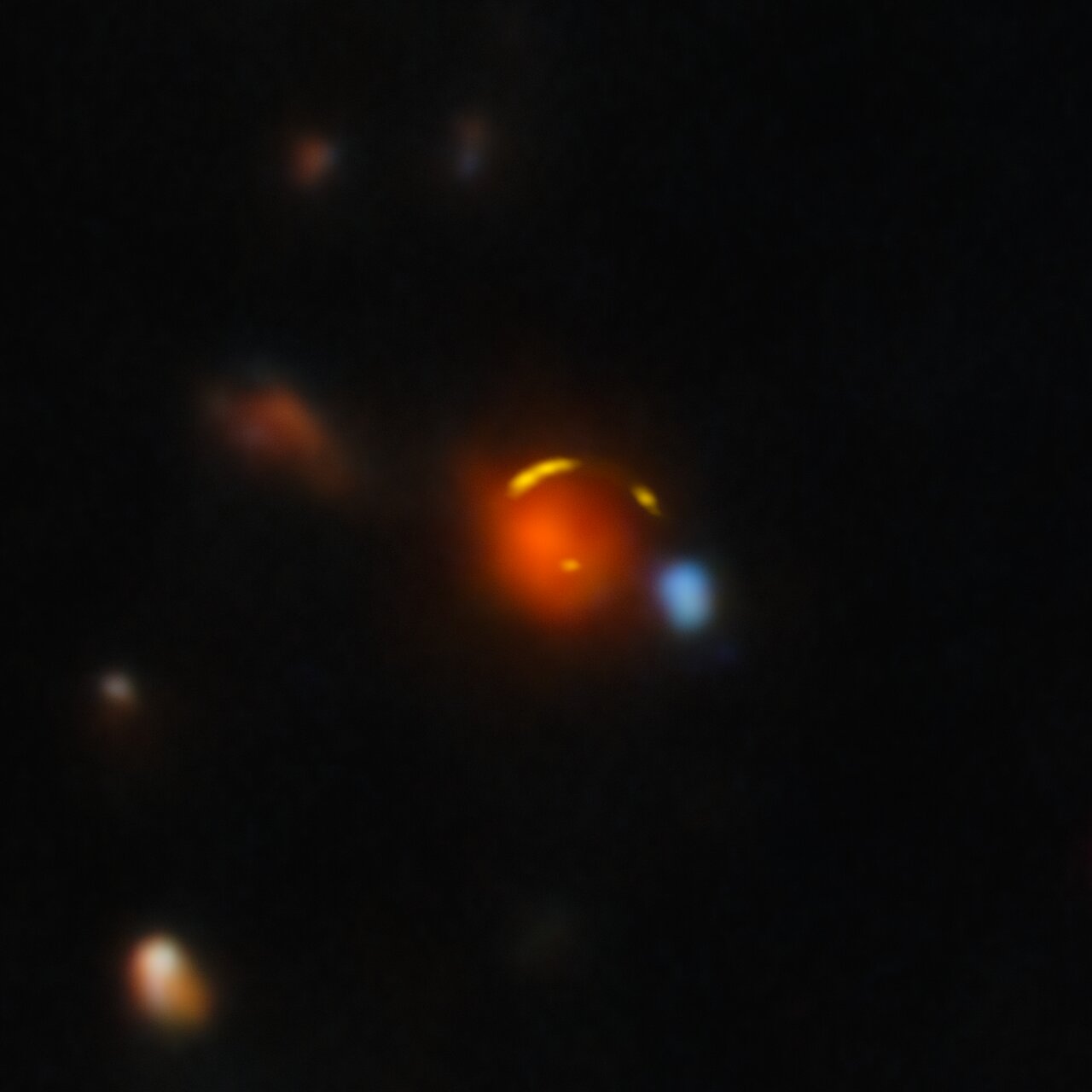
1Astronomers are trying to determine if they’ve witnessed a complex stellar explosion or a relatively ordinary supernova.
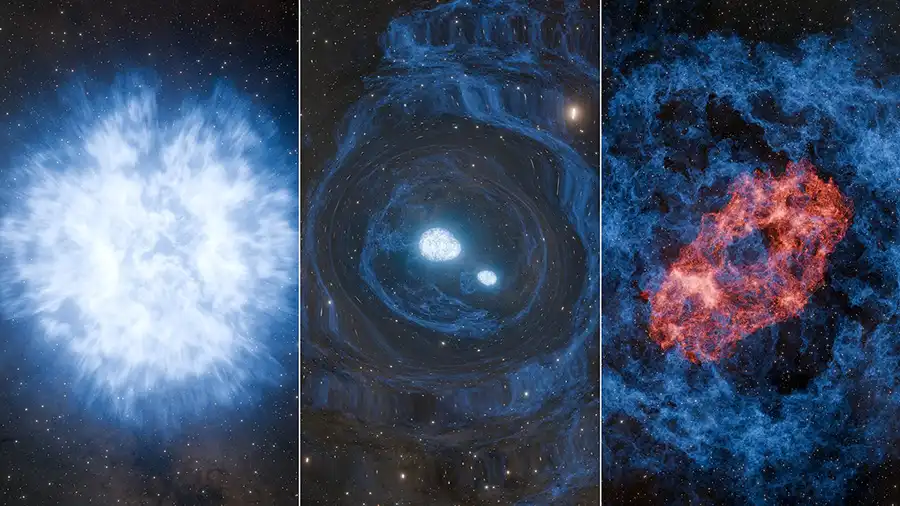
Caltech / K. Miller and R. Hurt (IPAC)
Astronomers may have spotted their first superkilonova — a star that’s exploded not once, but twice.
When massive stars die, they detonate in a celestial fireworks display known as a supernova. Often this leaves behind a neutron star — a dense, city-sized kernel. A spoonful of its material weighs more than everyone on Earth put together. When two neutron stars collide, they produce a different spectacular show: a kilonova.
Astronomers currently spot multiple supernovae every day, but they’ve only ever seen one confirmed kilonova. That was in 2017, when gravitational waves from the cataclysm washed up on Earth at the same time as multiple telescopes were bathed in the light of the explosion.
Then, on August 18, 2025, both detectors of the Laser Interferometer Gravitational-wave Observatory (LIGO) in the U.S. and the Virgo detector in Europe, picked up a new gravitational wave signal.
"The eruption looked just like the first kilonova in 2017," says Mansi Kasliwal (Caltech). A dozen telescopes around the world swung into action, training their mirrors on the patch of sky the gravitational waves had travelled from.
The Zwicky Transient Facility (ZTF) was the first to pinpoint a rapidly fading object 1.3 billion light-years away. Astronomers would eventually name it AT2025ulz. It glowed red, the result of heavy elements such as gold blocking light at the blue end of the visible spectrum. This is exactly how the 2017 kilonova appeared.
Then something curious occurred. Days after the initial blast, AT2025ulz began to brighten, turn blue and show hydrogen in its spectra. These are all calling cards of a supernova, not a kilonova. “Some astronomers lost interest,” says Kasliwal. “Not us.”
The gravitational waves contained a tantalizing clue: one of the merging objects seemed to have a mass lower than our own Sun. If true, this would be a breakthrough discovery.
Neutron stars usually have masses between 1.2 and 3 Suns, but theorists have speculated that “sub-solar” neutron stars could exist. Perhaps a heavier neutron star spins so rapidly that it fractures into two lighter ones. Alternatively, a star could go supernova, creating a disk of material that then collapses into a tiny neutron star.
“If these ‘forbidden’ stars pair up and merge by emitting gravitational waves, it is possible that such an event would be accompanied by a supernova rather than be seen as a bare kilonova,” says Brian Metzger (Columbia University).
In a paper published in the December 20th Astrophysical Journal Letters, a team led by Kasliwal and Metzger speculates that this is what may have happened with AT2025ulz. The team is keen to stress, however, that more evidence is needed to firm up the claim.
Matt Nicholl (Queen's University Belfast, UK), who was not involved in the research, isn’t convinced. “In my opinion, AT2025ulz looks most likely to be a normal supernova that exploded by chance at around the right time and in the right region of the sky.” In other words, AT2025ul and the gravitational-wave signal were two completely separate events.
James Gillanders (University of Oxford, UK), who was also not involved in the research, is equally skeptical. “The data recorded in the first few days do resemble that of a kilonova, but this behavior is a known property of Type IIb supernovae,” Gillander says.
“If [AT2025ulz] were discovered and observed in absence of the gravitational-wave signal, I suspect no one would interpret it as a superkilonova,” he says. Like Nicholl, Gillanders believes the gravitational-wave signal is unrelated.
If it is even a signal at all. “There is only a 29% probability that the signal is real, while there is a 71% chance that it is some glitch or noise signal,” Gillanders says.
Taken together, these counterpoints cast significant doubt over whether astronomers have really discovered a superkilonova — and highlight some of the difficulties in understanding stellar explosions. However, if further work clears the doubt, the find could be one for the history books.
About Colin Stuart
Colin Stuart (@colinstuartspace) is an astronomy author and tutor. He also runs a free online astronomy club.



Comments
Warren-Odom
December 26, 2025 at 5:59 pm
Color me curious -- why is there only a 29% chance the gravitational wave detection is "real?" It would be nice if the article explained that, at least a bit.
You must be logged in to post a comment.
You must be logged in to post a comment.