 SUNSET:

 4
4NASA’s spacecraft to Jupiter’s icy moon Europa will explore the little world’s potential habitability.

NASA / JPL
NASA will soon launch the largest spacecraft it has ever sent to another planet. Europa Clipper, measuring 3 meters (10 feet) long and carrying 3 tons of fuel, is set for departure for Jupiter, via Mars, on Thursday, October 10th, at 12:30 EDT. Its mission: Explore Europa to investigate its habitability.
When the mission was originally selected, Congress directed NASA to launch it on the Space Launch System, a rocket that didn’t yet exist and still isn’t in service. Privately, mission scientists feared that NASA was building a spacecraft that would be too big for any actual launch vehicle. Fortunately, the agency made sure that Europa Clipper had a backup plan.
That backup plan is an expendable Falcon Heavy: Three Falcons are basically strapped to each other, and they’ll use all their fuel to carry the spacecraft aloft, reserving none for return and reuse. In fact, SpaceX has stripped the three rockets to their essentials, removing hardware related to return and landing, to give Europa Clipper every last bit of oomph it can. Fun fact: The two side boosters are the ones that launched the Psyche mission in 2023.
Those tweaks to the rocket gave the mission more breathing room in their launch period, which originally closed October 30th, but now extends through November 6th. (This is welcome news in hurricane season.)

Emily Lakdawalla
Progress reports on Europa Clipper’s road to launch, including the latest information on launch dates, can be found on the Europa Clipper mission blog: blogs.nasa.gov/europaclipper.
The launch will take Europa Clipper on a direct-to-Mars trajectory. A very direct one: it’ll fly by Mars only four months later, between February 28th and March 4th, depending on launch date. Typical Mars-bound craft take longer to get there because they need to arrive at a low enough speed to enter into Mars orbit.
The spacecraft will return to Earth for a second gravity-assist maneuver between December 2 and 7, 2026, which will send it on to intercept Jupiter on April 11, 2030. The Mars-Earth gravity assist means Europa Clipper will never have to travel closer to the Sun than Earth, in contrast to the Venus-Earth trajectories taken by Galileo and Cassini.
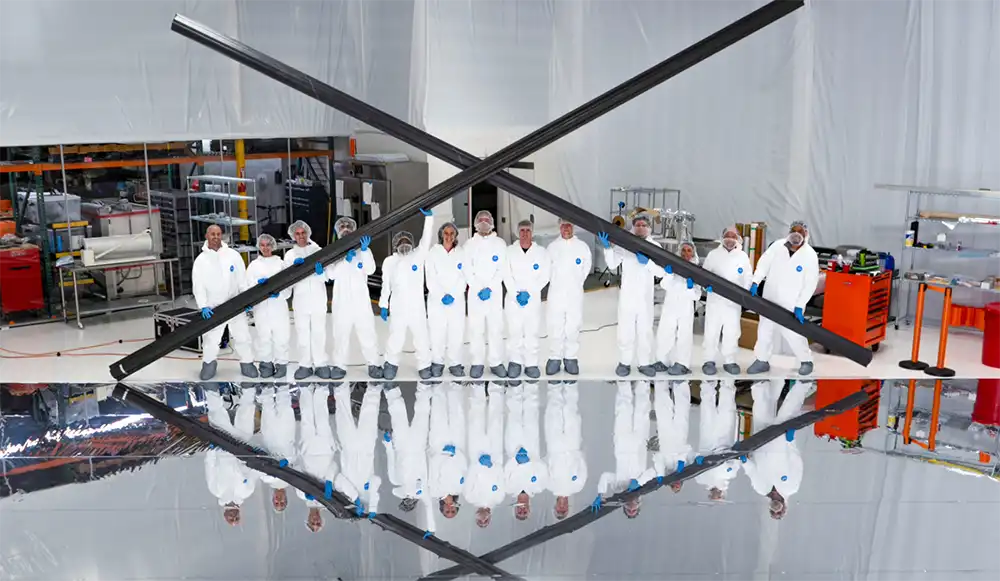
Unlike its predecessors, Europa Clipper is solar-powered, carrying twin arrays that span 30 meters. They are so large and heavy that they can’t support their own weight on Earth and are accordion-folded for launch. They’ll deploy within hours of lift-off.
Other items will also be coming out after launch, such as the long magnetometer boom that will deploy from the main spacecraft body as well as two pairs of radar antennae that will extend from the midpoints of each solar array. Deployment of the boom and antennae should be complete within the first month.

NASA / JPL / University of Arizona
On the day Europa Clipper arrives at its destination, capture, begins with a final gravity-assist flyby of Ganymede 12 hours before the Jupiter orbit insertion rocket burn. The Ganymede flyby will slow the spacecraft so Jupiter’s gravity can capture it. A six-hour burn of the main engines will shed enough velocity to arrive in the hoped-for initial orbit.
Then it’s onward to a four-year mission to study Europa via 49 flybys of the icy moon, plus seven flybys of Ganymede and nine of Callisto. Ganymede will feature prominently in the mission’s end, too: After the mission and any extensions, Europa Clipper will prevent contamination of Europa (attempt no landings there!) by crashing into Ganymede.
Juno, currently exploring Jupiter, is not expected to survive until Europa Clipper’s arrival. But the spacecraft won’t be alone for long: ESA’s Juice orbiter will join it there in July 2031. There is some overlap between the science teams of the two missions, and discussion has already begun about joint observations.

J. Grebmeier / Oceanography 2022
Europa Clipper’s instruments are designed to answer questions about the thickness of the moon’s icy crust and ocean interior, and whether and where there are pockets of liquid water within the ice. They’ll investigate the composition of the ocean, crust, atmosphere, and space environment around Europa, determining how salty the ocean is, whether liquid from the ocean works its way up to the surface or if surface material can be recycled into the ocean. And they’ll study the surface geomorphology to illuminate the stories that the landforms can tell about past and present activity, including searching for plumes like those on Enceladus.
News, updates, and feature stories about the Europa Clipper mission are available at science.nasa.gov/mission/europa-clipper/newsroom.
It's a mission focused intently on whether life could now exist within Europa’s ocean, and what environments exist that could support life. Importantly, though, it’s not a mission designed to actually search for life. This distinction is the same one that’s been carefully drawn around NASA’s Mars rover missions, too.
If you search for life, and you don’t find it, your mission has failed. But if you already know that the conditions for life exist, as we do for Europa and Mars (and Enceladus), you can succeed in a mission designed to learn specifically what those conditions are, how they came to be, how stable they are, and whether they’re likely common or special. That’s Europa Clipper’s plan. Cross your fingers for a nominal liftoff on October 10th!
About Emily Lakdawalla
Sky & Telescope contributing editor Emily Lakdawalla is a freelance planetary scientist, space artist, and author of The Design and Engineering of Curiosity: How the Mars Rover Performs Its Job. Find her on Bluesky at elakdawalla.bsky.social and explore her space-inspired, ultra-nerdy art and jewelry on Etsy.



Comments
Personatech
October 3, 2024 at 6:25 pm
My wife and I are hoping to see this launch (my first!) Given the recent SpaceX hold on Falcon 9 launches, is the October 10 launch date still on? How can I get up-to-date information about this.
You must be logged in to post a comment.
Monica Young
October 4, 2024 at 11:01 am
One place to check is https://spaceflightnow.com/launch-schedule/. Perhaps other readers can offer other sites (or Twitter/X feeds) to check.
You must be logged in to post a comment.
Tom Hoffelder
October 6, 2024 at 11:47 am
https://europa.nasa.gov/news/newsletter-signup/
https://science.nasa.gov/mission/europa-clipper/
The second link shows it still scheduled for the 10th. I have been wondering about the Falcon 9 failures also. There have been three in the last three months of the second stage. I believe the Falcon Heavy uses the same second stage.
You must be logged in to post a comment.
Nathan
October 7, 2024 at 2:05 pm
Given that there is now a category 5 hurricane headed towards Florida, NASA delayed the launch indefinitely. However, given the conditional ungrounding (due to no landing attempt) they should be go for launch whenever NASA and SpaceX deem it safe. The forecast is showing conditions good for no earlier than October 15, depending on hurricane impacts.
You must be logged in to post a comment.
You must be logged in to post a comment.