 SUNSET:

 3
3Little-known Norma, a small constellation in the southern sky, contains several stellar and deep-sky delights.
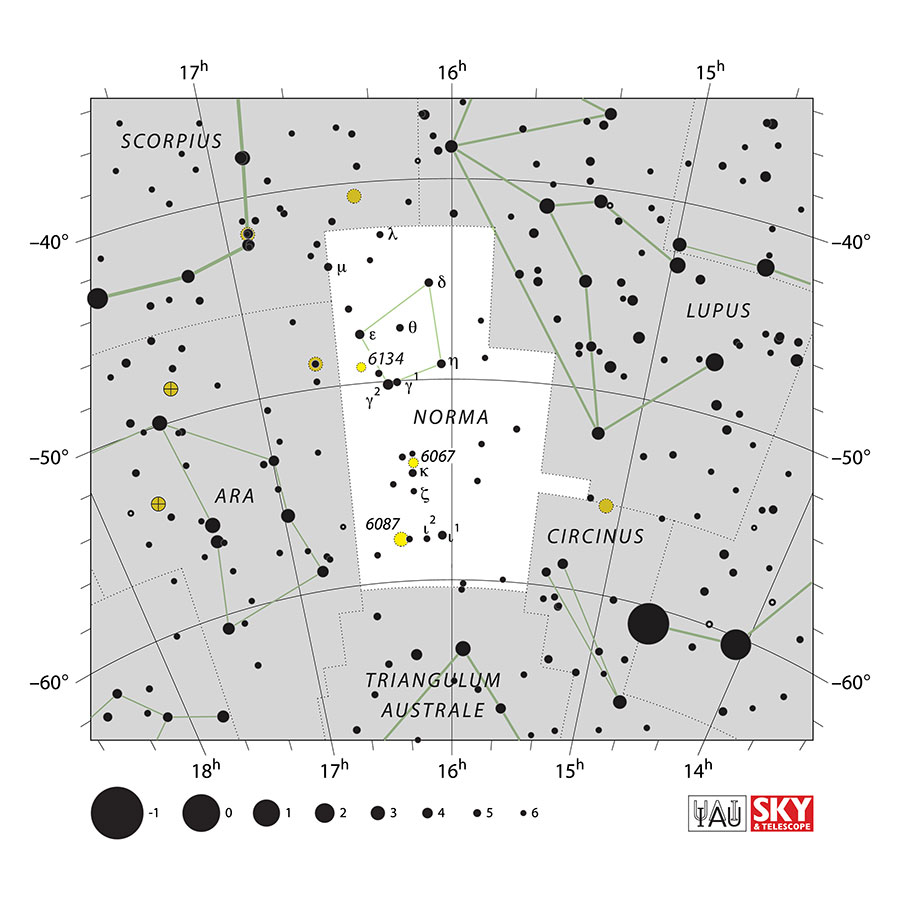
IAU / Sky & Telescope (Roger Sinnott & Rick Fienberg)
Our target constellation this month is Norma, which extends from declination –42° to –61° and spans about an hour of right ascension — one of the smallest of the 88 constellations. Yet, positioned as it is on the Milky Way, it holds several starry sights.
Norma is one of 14 constellations created by French astronomer Nicolas-Louis de Lacaille in the mid-1750s. He had spent two years studying the southern sky from the Cape of Good Hope on the southern tip of Africa. Thirteen of those constellations represent technologies or devices that had become important in the development of human society at the time. Norma represents a carpenter’s square or ruler, with the name deriving from the Latin word for “right angle.”
Norma is one of those constellations whose list of Bayer star designations — in which Alpha, Beta, and so on denote stars’ relative brightness — has become a bit messed up due to historical changes to its borders. In Norma’s case, there are no Alpha and Beta stars, because a boundary change saw them end up in Scorpius instead, where they were renamed N and H Scorpii. This change left Norma with no stars brighter than fourth-magnitude Gamma2 Normae (γ2 Nor), a yellow giant twice as massive as the Sun and about 130 light-years away. About ½° west and much more distant (around 1,500 light-years from Earth) is fifth-magnitude Gamma1 Normae (γ1 Nor), a yellow supergiant of about 6½ solar masses.
Fernando Menezes
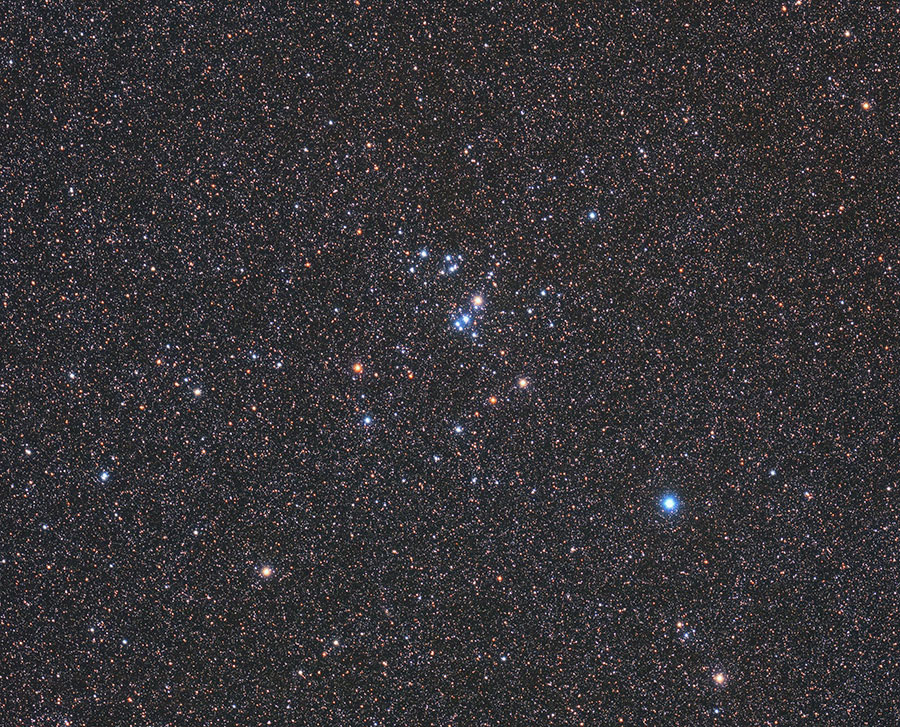
Our first stop on our deep-sky tour this month is NGC 6087, also known as Caldwell 89.. This open cluster has a combined magnitude of around 5.4 and contains more than three dozen stars. To find it, draw a line between Eta Normae and Kappa (κ) Normae and continue straight on southwards for another half of the Eta-Kappa distance. In my light-polluted sky, 8×56 binoculars reveal a handful of stars, while a 4-inch-or-larger telescope shows a wider scattering of stellar points. Two lines of stars on opposite sides of the cluster angle in toward each in a “V” shape, which, combined with other cluster members, leads some observers to describe the overall arrangement as a compact “W”.
Within NGC 6087 is one of the most well-known of Norma’s star systems: S Normae, the brightest member of the cluster and one of the most well-known star systems in Normae. It’s a Cepheid variable binary (with possibly other companions too) whose primary star’s brightness ranges between magnitudes 6.1 and 6.8 over 9½ days. Some 65 times wider than the Sun, it’s more than 6 times as massive and roughly 3,000 times more luminous. Our Sun really is a lightweight in comparison, isn’t it?
Fernando Menezes
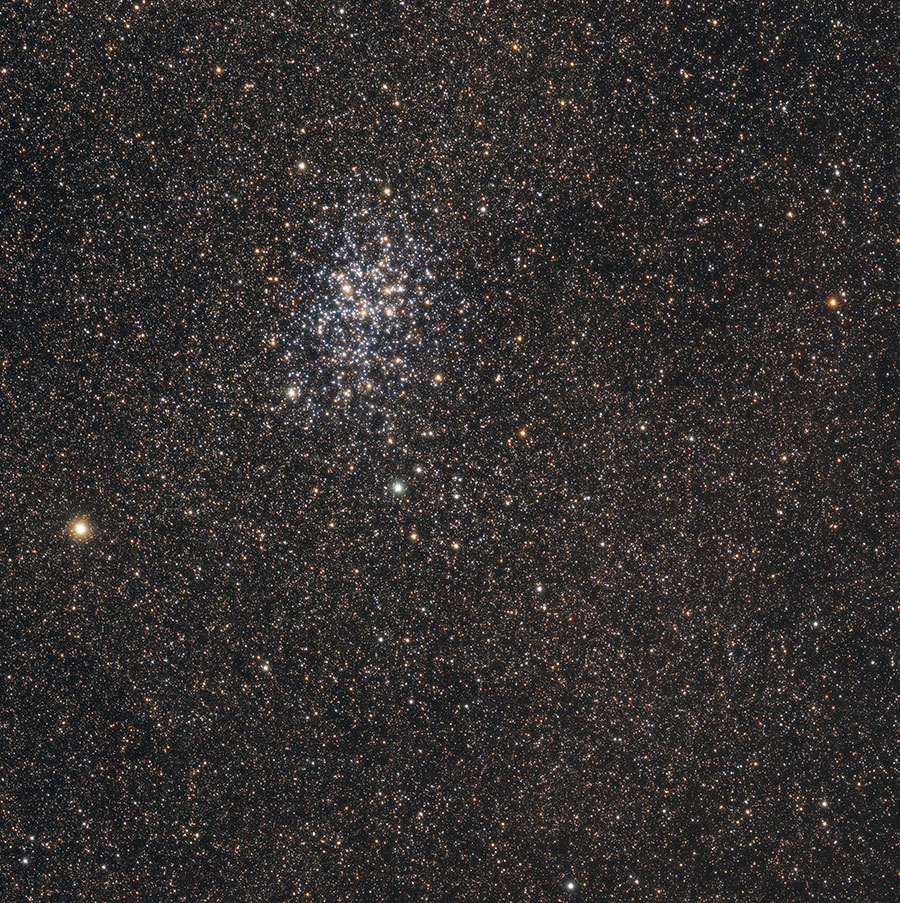
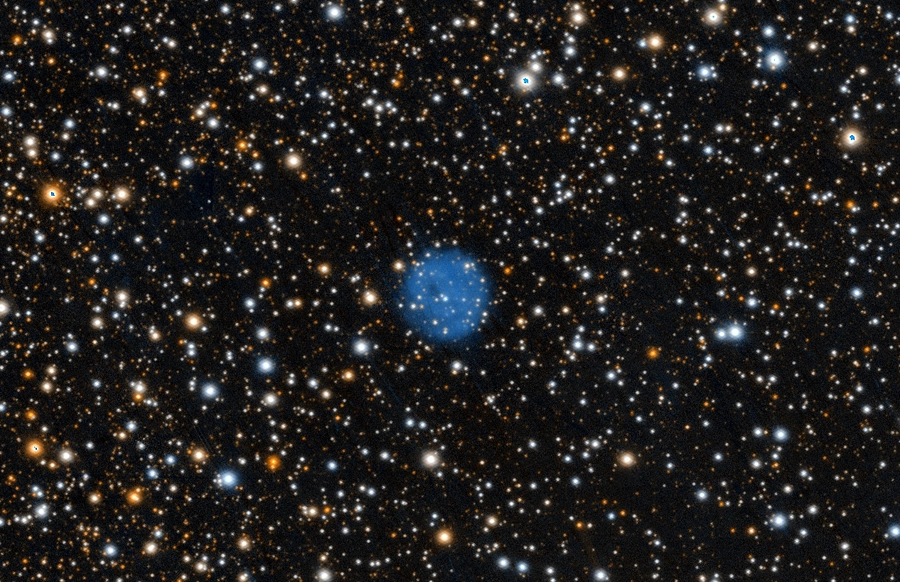
Another of Norma’s open clusters is NGC 6067, easily found by heading back to Kappa Nor and going just 25 arcminutes toward the north. With a combined magnitude of 5.6, those with good eyesight and dark skies should be able to make it out as a dim spot of fuzz.
The cluster was discovered by James Dunlop in 1827, who described it as “a pretty large cluster of small stars of mixed magnitudes, about 12 arcminutes diameter; the stars are considerably congregated towards the centre . . .”, while John Herschel opined its “a most superbly rich and large cluster.”
Remember, though, these observers were using reasonably large telescopes at the time (with 9-inch and 18-inch apertures, respectively). A 4-inch scope shows a concentration of 12th-magnitude stars with a raggedly defined edge, although a few observers have noted a passing resemblance to a globular cluster.

DECaPS / Legacy Surveys / D. Lang (Perimeter Institute) / NERSC / CC BY 4.0
Our final Norma object is another Dunlop discovery, NGC 6134, located 1½° northeast of Gamma2 Nor and 1½° south of Epsilon Nor. This small but attractive 7.2-magnitude open cluster is visible with a 6-inch telescope and appears as a loose agglomeration of 11th-magnitude-and-fainter stars.
Norma has about another half dozen other small open clusters, but their faintness and the busyness of the background Milky Way makes them somewhat harder to spot with small instruments. You won’t find any prominent galaxies, either, as the Milky Way blocks them out. But don’t let that put you off — before you leave this constellation, take a sweep through it with binoculars or a small telescope with a wide-angle eyepiece. You’ll find some splendid views of the southern starfields, packed with myriad sparkling stellar gems.



Comments
Andrew James
July 16, 2024 at 7:09 pm
The 2nd Paragraph misses a few details that need more elaboration...
Norma was first known in the French language as ‘Niveau’, being the carpenter’s instrument that checks that the ground in horizontally level, either as, a spirit level or water level. (In French the name niveau usually refers to the height in metres above sea level.)
This whole area was once confused with its earlier associated name for the more southern constellation of Triangulum Australe (TrA), Triangulum Austral was first given in Jean Fortin’s “Atlas Céleste.” Afterwards this was likely changed by French astronomers into the differently named ‘l'Équerre et la Règle’ (The Square and the Rule) or just ‘L’Equerre’ (The Square). For the Germans this becomes ‘Lineal’ and ‘Wintelmaafs’ (or sometimes ‘Winkelmaafs’) - literally meaning the ‘Ruler and Quadrant.’ Italians name it ‘Riga e Squadra’, while in the adopted English, the name Norma is from the Latin, whose full name of Norma et Regula. It means ‘The Carpenter’s Square and Ruler.’ In Bode’s ‘Uranometria’ maps first name it as Norma et Regula.
It is likely reason why Normal was axed was because it would've lay near the boundary of the ecliptic, where the Moon would occasionally fall. This northern boundary would've been at -29.5° declination and between 16h and 16h 30m RA (Epoch 1875). To solve this, it was better to put the area into Scorpius. (This is not the only culling. The nearby constellation Libra had once been the scorpion’s left claw - hacked off to make the famous twelve constellations of the zodiac.)
Note: According to Richard Allen in “Star Names : Their Lore and Meaning” (1899), it is also known as Quadra Euclidis, meaning ‘Euclid’s Square’ − in direct homage to the Greek geometer. During the 19th Century, this adopted name was openly discouraged, mostly, as some interpreted the word ‘Quadra’ to mean literally quadrant − which is plainly wrong and unjustified.
You must be logged in to post a comment.
Erwin-Miller
July 21, 2024 at 4:32 pm
Correction 6134 is 1 1/2 degrees south of Epsilon Nor not Eta Nor. This might have a few "newbie" amateurs scratching their heads. I really hate that term newbie.
You must be logged in to post a comment.
Monica Young
July 22, 2024 at 12:40 pm
Good catch! I've updated the text.
You must be logged in to post a comment.
You must be logged in to post a comment.