 SUNSET:

 9
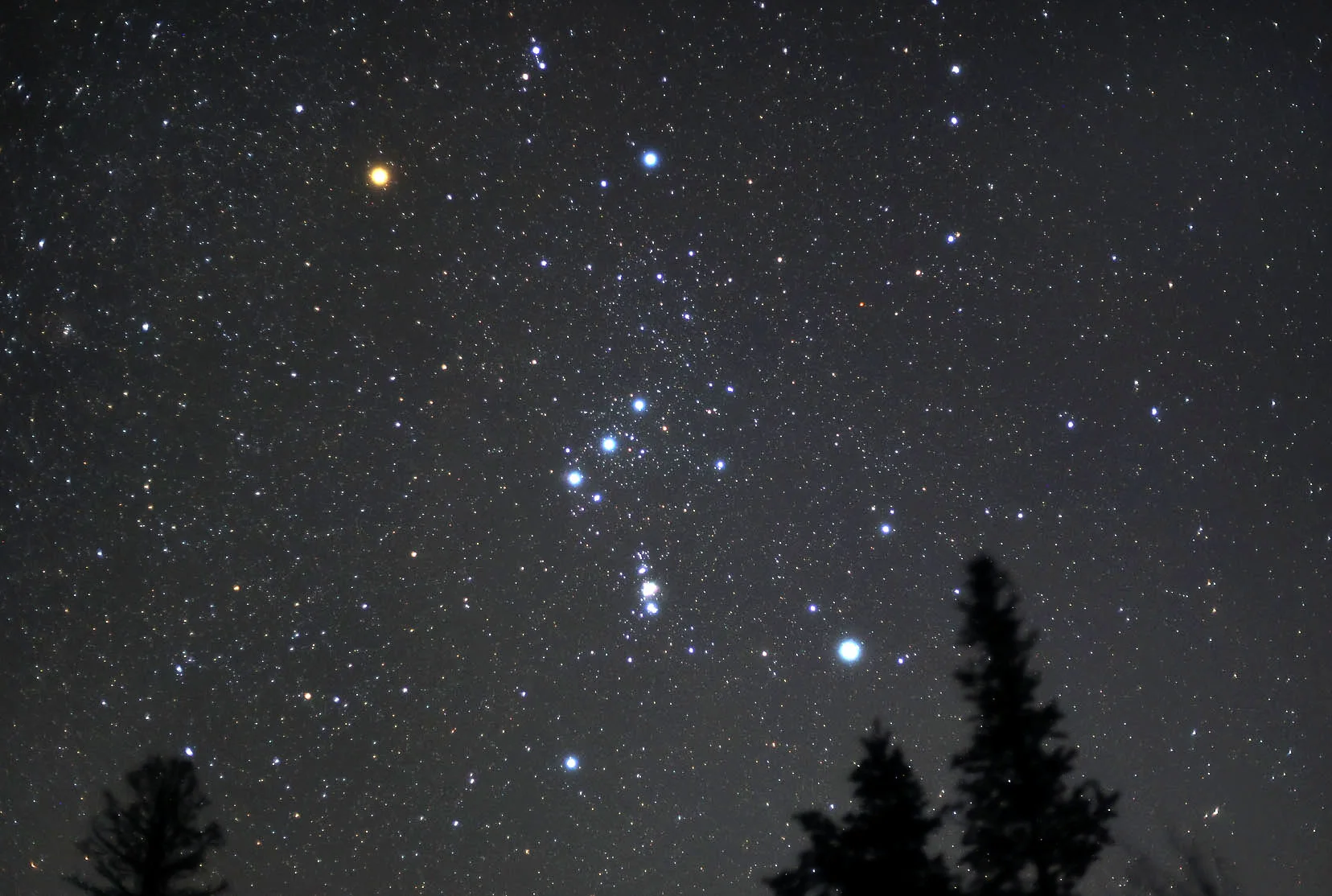
9Waves of recent star formation have made Orion winter’s most scintillating constellation. You can see how it all came to be.
Bob King
Some constellations have all the luck. Orion not only has one of the most recognizable forms, including its signature Belt, but it contains two of the top 10 brightest nighttime stars (Rigel and Betelgeuse), three 2nd-magnitude stars and M42, the Orion Nebula, one of the brightest and most important star-forming regions in the galaxy. No wonder it sparkles on winter nights.
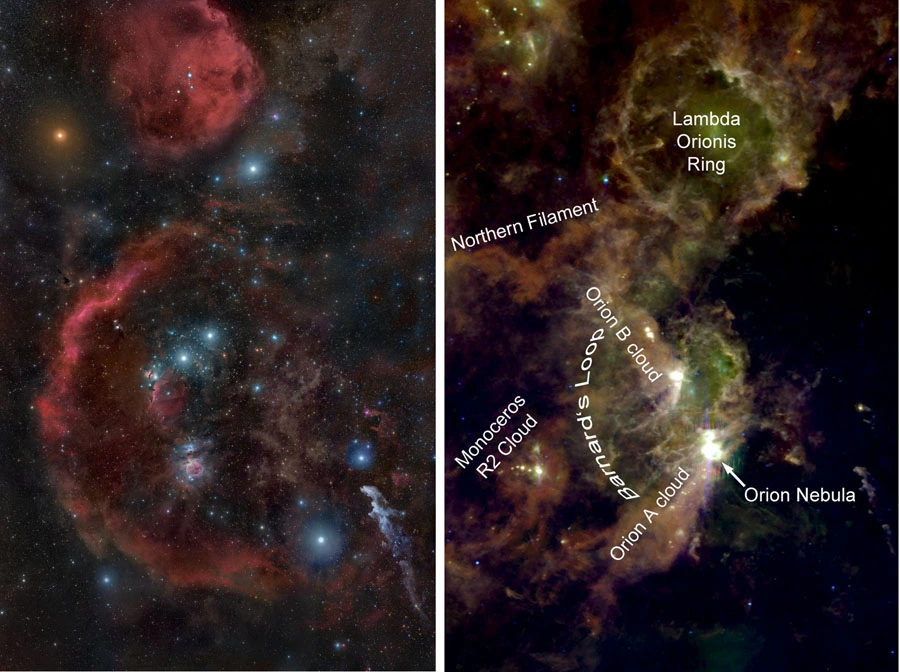
Giving birth to new suns is what Orion is all about. The celestial Hunter is home to the lavish Orion Molecular Cloud (OMC), an enormous star-forming region hundreds of light-years across located about 1,500 light-years from Earth that enrobes the constellation. Within it you'll find Orion's Belt, the Orion Nebula complex, Barnard's Loop, and stellar spawn tucked into every nook and cranny. Stars within the OMC range in age from less than a million to 12 million years.
Left: Rogelio Bernal Andreo. Right: IRIS, Dame, et al, 2001, Meli thev
That's incredibly young compared to our 4.5-billion-year-old Sun, which is currently enjoying a productive middle age. If the Sun were 50 years old, the most ancient OMC stars would be cherubic babes barely two months young. That's why so many of the Cloud's hot, massive O- and B-type stars are still shining, including Betelgeuse. Massive stars live fast and die young as they rapidly consume their nuclear fuel. Although Betelgeuse is only about 10 million years old it's already hobbling toward old age and supernova-hood.
OB oh my!
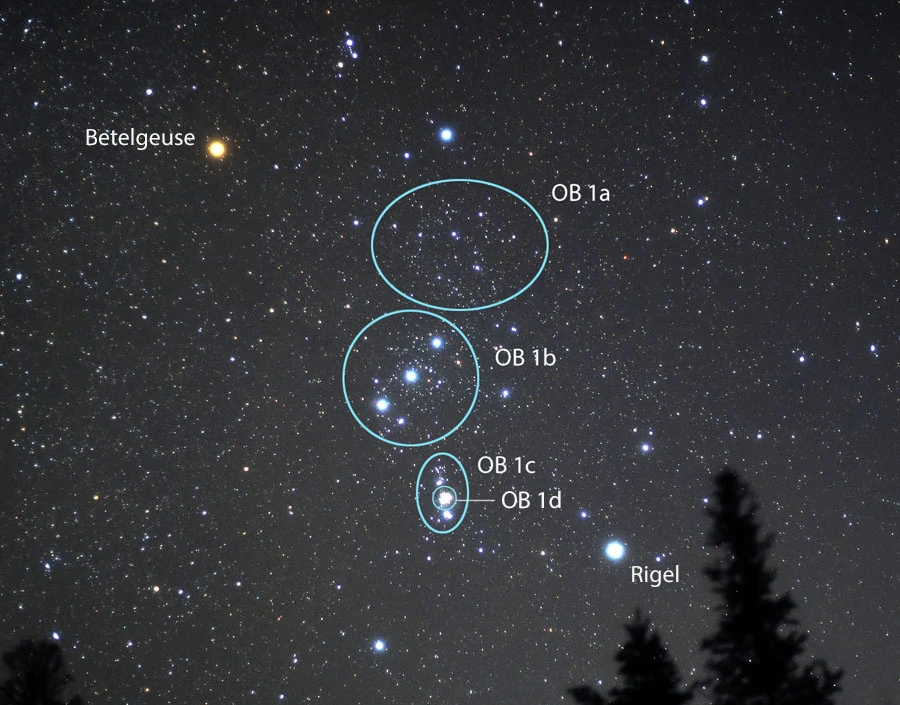
Orion stands apart from many constellations because most of its stars are related instead of random, line-of-sight alignments. Like crashing waves that deposit shells on a beach, successive swells of star formation within the OMC have rippled across Orion and left countless stars in their wake, which astronomers call OB associations. The name comes from massive, blue O and B stars that visually dominate the groups, but associations also contain thousands of smaller stars like our Sun. Unlike star clusters, which are gravitationally bound, OB associations are loose, free-to-roam, low-density collections of stars. Nonetheless, their members are all related because they share the same birthday (give or take) and have similar chemical compositions and motions.
Bob King
OB associations litter the disk of the Milky Way Galaxy. You'll find them from Cassiopeia to Centaurus. The Orion OB 1 association encompasses much of central Orion and is further subdivided into four subgroups based on age. All are easily accessible either with the unaided eye, binoculars, and telescopes of all sizes. You're probably long familiar with Orion OB1b, which includes the three Belt stars, but let's meet them all. The data below is primarily sourced from Stellar Stories by Jim Kaler, professor emeritus of astronomy at the University of Illinois.
- OB 1a — Stars north and west of Orion's Belt (1,100 light-years away and ~10–12 million years old)
- OB 1b — Orion's Belt and surroundings (1,550 light-years and ~2–8 million years)
- OB 1c — Orion's Sword (1,650 light-years and ~2–6 million years)
- OB 1d — Orion Nebula and Trapezium (1,500 light-years and less than a million years)
Star powder
I've had several excellent opportunities recently to observe Orion from a dark sky. All four associations were visible without optical aid. Obviously, the bright Belt stars and Sword required the least effort. But the many limit-of-vision stars that swaddled the Belt trio gave the region a powdery, fuzzy appearance reminiscent of a rich star cluster viewed through a telescope. I particularly enjoyed seeing Orion OB 1a, which had a similar grainy texture. The two associations overlap into peppered starlight that competes in bounty with the band of the neighboring Milky Way. Use averted vision to fully experience this "star powder" effect.
Michael Boyle
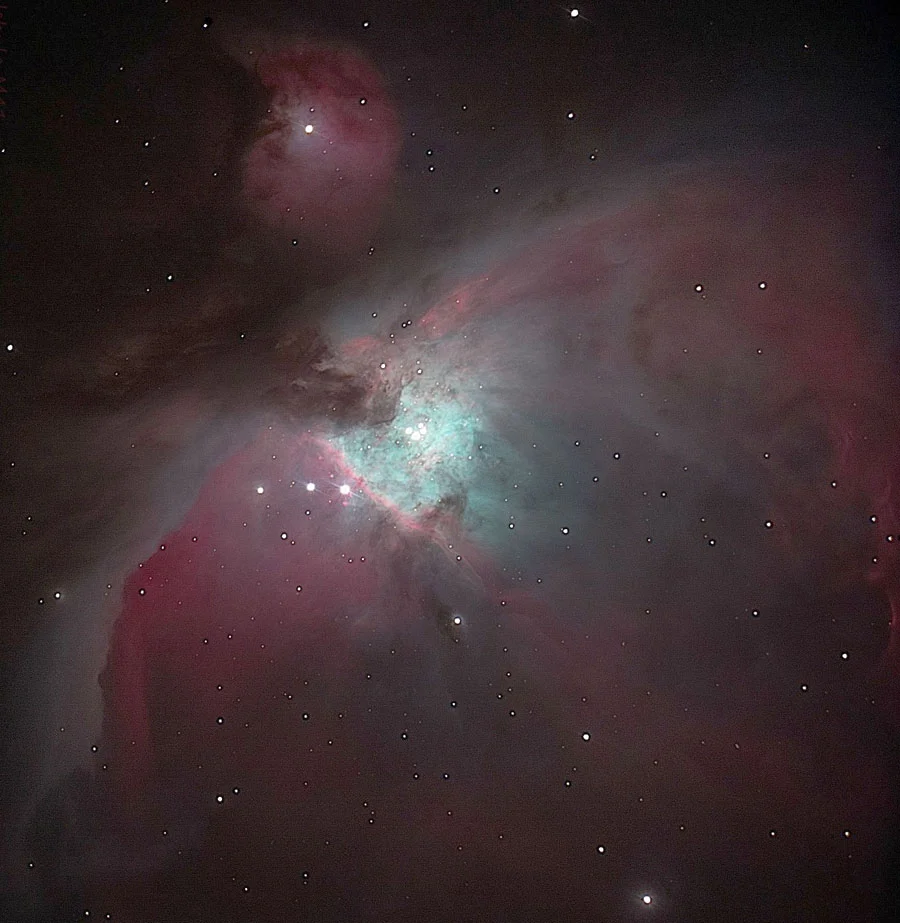
Of course, binoculars really dress up the scene. Orion OB 1a looks like a loose star cluster in my 10×50s; the Belt is richer yet! My favorite feature in Orion OB 1b is the lazy, stellar "S" that loops between Alnilam, the central star, and Mintaka, the western star. Binoculars also make the perfect instrument for OB 1c, better known as Orion's Sword. Within this vertical pendant of stellar gems, you'll find OB 1d, the Orion Nebula. Most people can tell it looks a little fuzzy, hinting at its non-stellar nature, but 50-mm binoculars paired with a dark sky clearly show the nebula's 1° extent and nodding-flower shape.
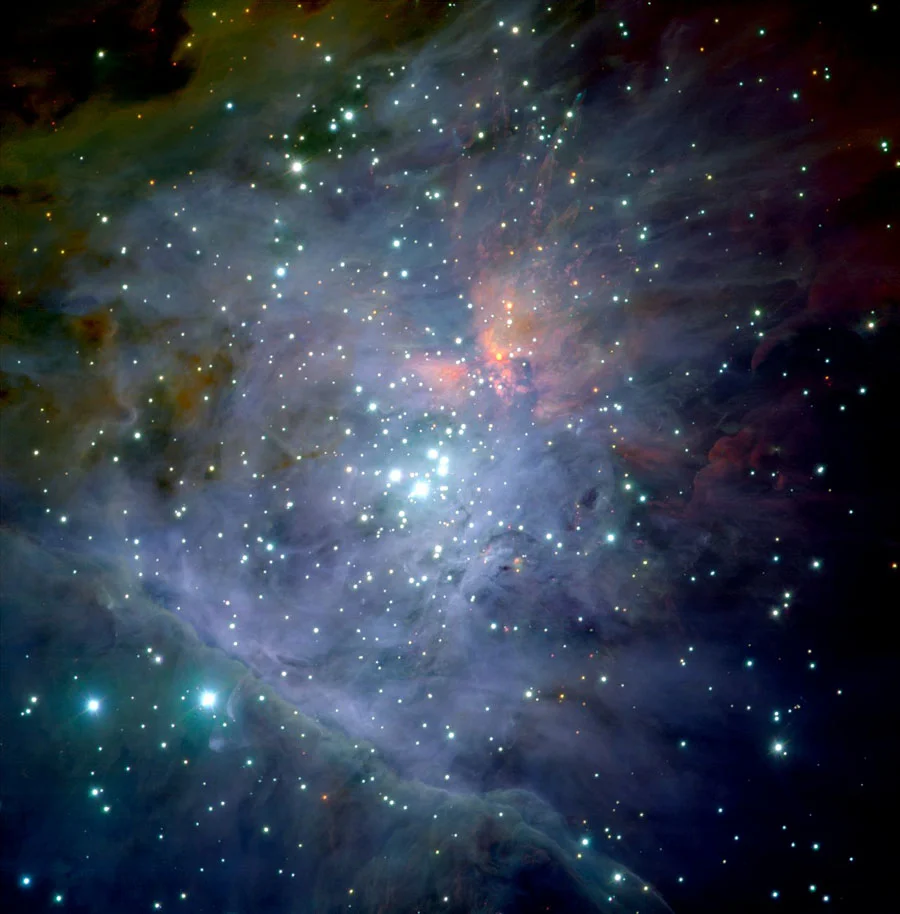
ESO / M. McCaughrean et al. (AIP)
Through a telescope the nebula is a revelation. The fearsome O and B giants that comprise the Trapezium excite webby billows of nebulosity to luminesce in pale shades of lime and watermelon. While I usually start at low magnification to take in the big picture, if the seeing is good, I step it up to 245× with a 100° apparent-field-of-view eyepiece. The combination allows for full immersion in the nebula, exactly where I want to be.
Now, at the darkest time of year, when subzero nights are the norm, seeing the transformation of stardust into starlight warms me on the inside and nurses a connection made long ago in childhood, when I first invited the terror and majesty of the universe into my life. During this holiday season, may you drink from the same cup.
About Bob King
I love the sky (day and night) and have been a skywatcher and amateur astronomer since childhood. I'm also a long-time member of the American Association of Variable Star Observers (AAVSO) and Astronomical League. I pen the Astro Bob blog and have written four books: Night Sky with the Naked Eye (2016); Wonders of the Night Sky You Must See Before You Die (2018) and Urban Legends from Space (2019) and Magnificent Aurora, published in 2024. The universe invites us on an adventure every single night. To accept the invitation, we only need look up.




Comments
Joe
December 22, 2025 at 8:33 pm
Great article as always, Bob!
You must be logged in to post a comment.
Bob KingPost Author
December 23, 2025 at 5:57 pm
Dear Anthony,
I really appreciate that. Thank you. I hope you have starry holiday season with an opportunity to enjoy Orion and the waxing evening crescent. Good omens for year's end!
You must be logged in to post a comment.
Anthony Barreiro
December 22, 2025 at 9:15 pm
"Like crashing waves that deposit shells on a beach, successive swells of star formation within the OMC have rippled across Orion and left countless stars in their wake ... ." That is a vivid simile!
Thanks! Best wishes for happy holidays and a good new year.
You must be logged in to post a comment.
Jen Willis
December 26, 2025 at 4:35 pm
Great article, Bob! I've shared it with my father, and I imagine we will be discussing at length as we do astronomy together over FaceTime. I've long been a winter stargazing enthusiast, and Orion (and its many wonders) is an easy favorite.
You must be logged in to post a comment.
Bob KingPost Author
December 30, 2025 at 11:01 pm
Hi Jen,
Thank you! Glad you did. I'm a big fan of your column by the way 🙂
You must be logged in to post a comment.
namrats66
December 26, 2025 at 10:11 pm
I very much enjoyed the info on the OMC. The visual vs infrared images are incredible to view. Thank you!
You must be logged in to post a comment.
Bob KingPost Author
December 30, 2025 at 11:02 pm
namrats66,
Glad to hear it and thank you for saying! I wish you many clear nights for exploration.
You must be logged in to post a comment.
[email protected]
December 30, 2025 at 10:48 pm
Harv Hurley
December 30-2025
Hi Bob, another great article. Several years ago I purchased a pair of Celestron SkyMaster 20x80 Binoculars. Absolutely one of the best purchases of my life. I started out with 7x35’s and then onto 10x50’s, but the 20x80’s are incredible. Living in eastern Ohio probably has some of the worst weather for observing, but in a moments notice I can walk out with my 20x80’s on a mono-stick and become immersed in things I could never see with my bare eyes. Orion into Monoceros and on down int Canis Major has always been one my favorite areas of the sky. Thanks for the expanded views! Till next month, enjoy!
You must be logged in to post a comment.
Bob KingPost Author
December 30, 2025 at 11:04 pm
Harv,
Wow, 20x80x are about perfect for getting the most out of the multifaceted OMC. Canis Major into Puppis also a favorite of mine — so many clusters!
You must be logged in to post a comment.
You must be logged in to post a comment.