 SUNSET:


How Young Galaxies Grow
A pair of recent studies sheds light on some of the universe’s earliest galaxies and how they grow.

Three Black Holes May Merge in Nearby Galaxy
New observations of a galactic crash site show that there are not just two but three supermassive black holes on the verge of union. Two of them are only 650 light-years apart, the closest pair known.

Exotic Messenger Probes a Galaxy’s Outer Reaches
Astronomers made use of a fast radio burst, a 40-microsecond flash at radio wavelengths, to evaluate the state of the nearly undetectable gas around an intervening galaxy.

"Invisible" Galaxies Found in the Young Universe
Astronomers have discovered galaxies that have escaped detection until now, uncovering a missing link in galaxy evolution.

Peer Deep Within the Large Magellanic Cloud
A team of amateurs reveals the Large Magellanic Cloud, a galactic neighbor, in an exceedingly deep, high-resolution mosaic.

Why Are Two Ghost Galaxies Missing Dark Matter?
Ultra-diffuse galaxies are usually dark matter-rich. But astronomers have discovered two of these galaxies that lack dark matter altogether.

Tracing the Cigar Galaxy's Superwind
NASA’s SOFIA airborne observatory has returned a striking far-infrared view of the Cigar Galaxy and its “galactic superwind.”

Radio Survey Maps Hundreds of Thousands of New Galaxies
The LOFAR survey, based in The Netherlands, has released a bonanza of new sources. And with only 2% of the sky covered so far, this is only the beginning.

NASA to Explore Early Universe, Origins of Life with SPHEREX
The SPHEREX mission will create multiple surveys of the near-infrared sky that will reveal the origins of life and perhaps the universe itself.

New Study Pushes Back Milky Way’s Dust-up with Andromeda
By tracing stars in other galaxies, the Gaia satellite has helped astronomers understand the relative motions of the Milky Way's galactic siblings.

Evidence Mounts for a Magellanic Collision
Astronomers have suspected for some time that the Large and Small Magellanic Clouds collided in the recent past. The Gaia space telescope provides striking new evidence for a head-on collision.

Ancient Merger Wreckage in the Milky Way
Mounting evidence indicates that our galaxy smashed up another smaller galaxy roughly 10 billion years ago.

How to Turn Off a Galaxy’s Star Formation
New observations by the Atacama Large Millimeter/submillimeter Array (ALMA) provide a close look at a galaxy that may be in the process of shutting down its star formation.

The Magellanic Clouds Might Once Have Been a Trio
The Milky Way's two largest companion galaxies may have once been a threesome — but new data from the Gaia satellite leaves the satellites' history an open question.
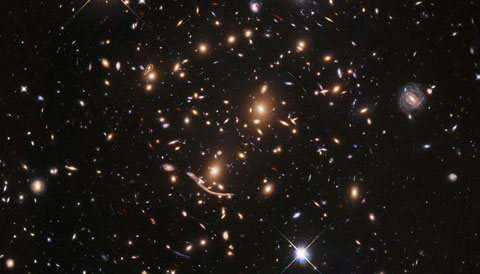
60-Second Astro News: Starbirth, Stardeath, and the Evolution of Galaxies
Starbirth and stardeath light up a nearby galaxy while faraway galaxies twist and bend in these new images from NASA's Hubble and Chandra space observatories.

Andromeda Collided with Galactic Sibling Billions of Years Ago
A new study says our neighbor galaxy’s big stellar halo and stellar evolution are due to a major collision that ended 2 billion years ago.

Disentangling the History of the Magellanic Clouds
The Magellanic Clouds — two nearby dwarf galaxies easily visible to the naked eye in the southern hemisphere — are key to understanding the dynamics and evolution of the Local Group of galaxies. Can an in-depth look at these galaxies’ outer regions help us make sense of their complicated interaction history?

Do Big Black Holes Wander the Galaxy?
New simulation work suggests that galaxies like the Milky Way could be home to a dozen supermassive black holes.

14 Galaxies Might Become Universe’s Most Massive Structure
At least 14 galaxies are swarming in the early universe, forming a protocluster with the mass of 10 trillion Suns. It might become one of the most massive structures in the universe.
Globular Clusters Shine in a Galaxy Lacking Dark Matter
You may have seen recent news about NGC 1052–DF2, a galaxy that was discovered to have little or no dark matter. Now, a new study explores what NGC 1052–DF2 does have: an enigmatic population of unusually large and luminous globular clusters.
