 SUNSET:

 11
11The space science community is deeply concerned after recent reports that NASA’s budget would be halved.
NASA
The prospect that NASA’s space science budget could face major cuts is prompting worried feedback. Those wake-up alarms are being sounded due to an Office of Management and Budget (OMB) draft budget called a “passback” to the space agency.
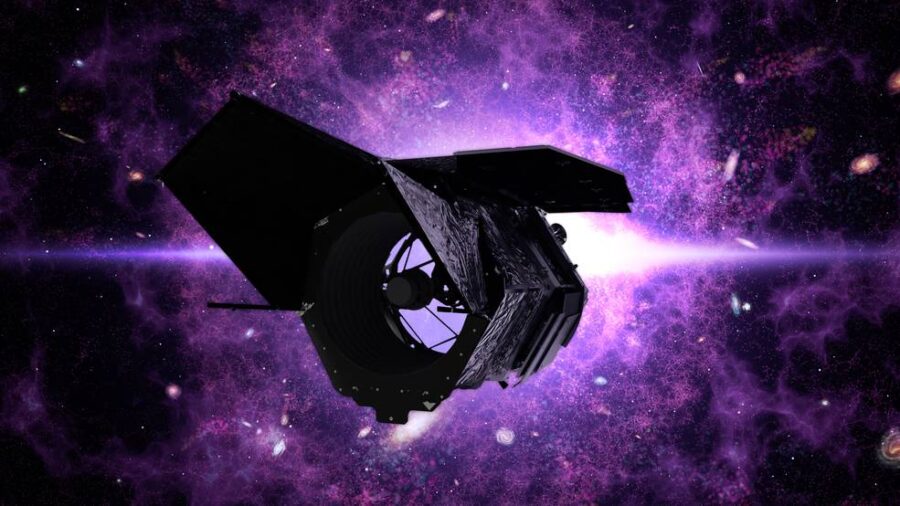
The OMB passback reportedly axes a number of projects, such as the Nancy Grace Roman Space Telescope, the DAVINCI mission to Venus, and the space agency’s Mars Sample Return mission. It may also close down NASA’s Goddard Space Flight Center in Maryland, which employs about 10,000 people.
Reaction to that news from the space science community has been swift.
The American Astronomical Society (AAS) stated that it is “gravely concerned” about the reported deep cuts to NASA science funding for Fiscal Year 2026. If left unchallenged, the nearly 50% cut to the NASA Science Mission Directorate “would be catastrophic to our nation’s leadership in the space sciences, damaging a broad range of research areas that are unlikely to be supported by the private sector,” the AAS said in a statement.
Similarly, the public space advocacy group, the National Space Society has urged Congress to take a “strategic approach” in hammering out NASA’s Science Mission Directorate budget. “While budgetary discipline is necessary, drastic cuts to space science funding would undermine America’s leadership in space exploration and jeopardize the burgeoning space-based economy,” contends the group.
Adding their voice of worry is the Planetary Society, which represents some 2 million space enthusiasts. That group warns of a “dark age” for space science under reported NASA budget cuts. This budget would “eviscerate space science research,” they caution, urging Congress to quickly reject such cuts and restore funding for NASA’s Science Mission Directorate.
Uncharted Territory
As a space policy expert tells Sky & Telescope: “This is all uncharted territory. Whether Congress decides to exert its constitutional powers and responsibilities instead of abdicating to the White House is unknown. There may be a red line when Congress will finally push back, but so far Trump is controlling everything and that means Russell Vought is in charge of the budget and that means science overall — not just at NASA — is in big trouble.”
Backed by President Trump, Russell Vought is now the confirmed OMB Director; he was also the key author of Project 2025, a conservative blueprint that called for a dramatic downsizing of the federal bureaucracy.
Still, given the growing outbreak of angst from many concerned about the would-be NASA budget slashes, there’s also recognition of a quip often tied to Mark Twain, the American writer and humorist, that “the reports of my death are greatly exaggerated.”
Force Multiplier for Science

NASA / Bill Ingalls
Even as alarms are sounding about NASA’s proposed budget cuts, mix in for good measure nominated NASA Administrator Jared Isaacman. As a billionaire high-tech CEO, he is no stranger to space; he was a self-financed commander of two private orbital missions led by SpaceX.
At his April 9th confirmation hearing, he testified before the Senate Committee on Commerce, Science, and Transportation that NASA could “absolutely” undertake missions to the Moon and to Mars, as well as run more scientific missions. In expressing support for NASA’s science programs, he said NASA is a “force multiplier for science.”
“We will leverage NASA’s scientific talent and capabilities to enable academic institutions and industry to increase the rate of world-changing discoveries,” Isaacman testified. “We will launch more telescopes, more probes, more rovers, and endeavor to better understand our planet and the universe beyond.”
Isaacman said that he supported the Trump administration’s plans for a “golden age of science and discovery.”
“If I’m confirmed, I absolutely am going to roll up my sleeves and get in the trenches with the best and brightest and figure out where we have our program challenges, what’s impeding progress, clear those obstacles and get back to delivering on the mission,” Isaacman said. “If we can do that, then we’re going to get the inspirational side of NASA going, we’re going to get the STEM [Science, Technology, Engineering, Math] side growing, and the next generation is going to grow up and want to reach even farther.”
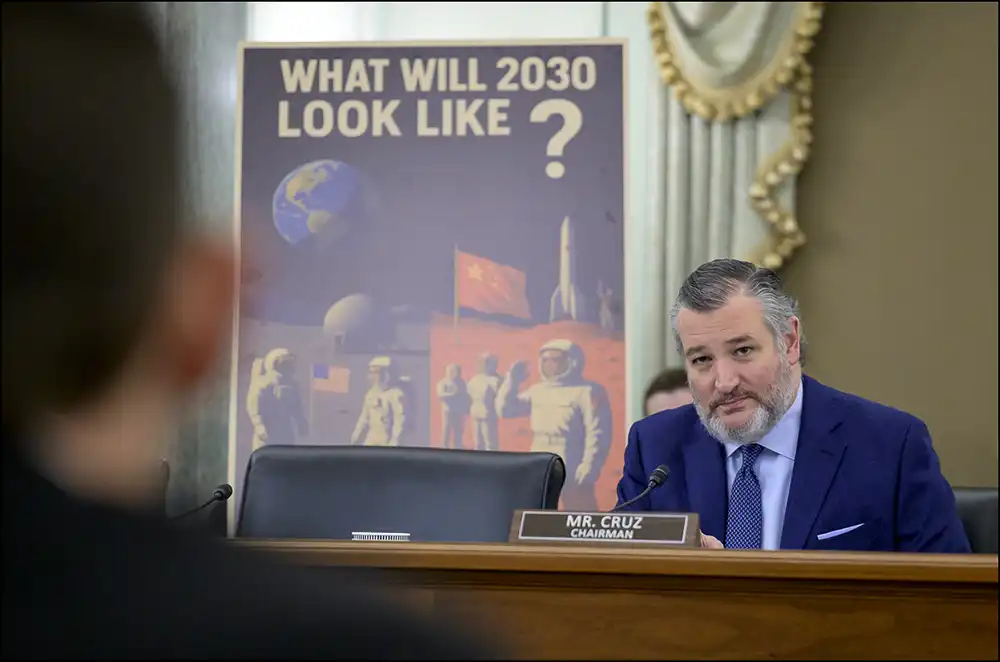
Chairman of the Senate Committee on Commerce, Science, and Transportation, Ted Cruz (R-Texas), voiced the view that the next space race is already here.
“The Artemis missions and the entire Moon-to-Mars program, which have enjoyed consistent bipartisan support, serve as the stepping stone to landing American astronauts on Mars,” Cruz said in a statement.
NASA / Bill Ingalls
“We must stay the course,” Cruz added. “An extreme shift in priorities at this stage would almost certainly mean a Red Moon — ceding ground to China for generations to come. I am hard pressed to think of a more catastrophic mistake we could make in space than saying to Communist China, ‘The Moon is yours. America will not lead.’
Going Out of Business Phase?
While the politicians talk, scientists are considering their options. “This is a unique time,” said Bruce Jakosky, a senior research scientist and professor emeritus at the Laboratory for Atmospheric and Space Physics at the University of Colorado Boulder. A 50% cut to NASA science “puts us into essentially a going out of business phase,” he says, “because that’s what would happen.”
Jakosky says he senses that the budgetary chaos and swirl of uncertainty is spurring the next generation of space scientists to question career paths and to begin looking for jobs elsewhere.
Everything is up in the air, Jakosky adds. “Even if Congress restores the cuts into the budget, that doesn’t mean the money will be spent there.”
Moreover, he continues, “even if President Trump decided to turn it around tomorrow, a tremendous amount of damage has been done. People are leaving and other countries are starting to poach our scientists. If people leave, it’s going to take at least a generation to get that experience back.”
Wanted: Bipartisan Support
Also dismayed by the situation is Scott Hubbard, a former NASA Ames Center Director, now at the Department of Aeronautics and Astronautics at Stanford University.
“I’ve never seen anything this dramatic,” says Hubbard. He reiterated that the OMB passback still involves what’s called the “reclama” from NASA. That’s a space agency response that then bounces back to OMB. Out of that process comes President Trump’s budget request, he said, and the fight then begins on Capitol Hill, one that could spur significant bipartisan support for changing the cuts.
“I have never seen anything this radical across an entire discipline, an entire field of studies like all of space science,” Hubbard says. “If this budget were to become reality, it would be devastating. It would be abandoning U.S. leadership in space science for decades. You can’t turn this stuff off and on like a faucet.”
As for what’s ahead, it’s all sausage-making — political style, Hubbard concluded.
Agencies submit their budget requests to OMB; the passback is OMB’s decision on what the White House will send to Congress. Agencies can negotiate with OMB and even appeal directly to the President, although the latter is viewed as a rare event.
Ultimately, the White House sends the proposal to Congress, which under the Constitution has the “Power of the Purse” to determine through the appropriations process how taxpayer money is spent.
The next major shoe to drop is the White House budget request, due in May. Once revealed, the Congress will start to deal with the details. The budgetary outcome for NASA is, quite literally, a to-be-determined matter of time and space.








Comments
Anthony Barreiro
April 17, 2025 at 11:39 pm
The most prudent strategy would be for NASA to name every mission after Donald J. Trump, and invite him to push the button to launch the rocket, like Kim Jong Un does in North Korea.
You must be logged in to post a comment.
Andrew James
April 18, 2025 at 9:06 pm
Nope. Most prudent strategy would be for NASA to launch Donald J Trump and Musk, and Nancy Pelosi to push the button to launch that rocket!
They should put a 'B' in front of OMB, because that's what these individuals are trying to do.
For me, it is Elon Musk who would greatly benefit by cutting NASA's budget. This would make taxpayers money instead of going into the government, put that money into the pockets of the billionaires and their space related endeavours that they want to profit by. It is just another step in corporatism of everything just for the benefit of the sycophants.
The current US administration seems to have no desire to pursue goals that will benefit humanity. All they see is a self-centred country, whose collaborations, shared contributions and pretend the rest of us can be used and abused for the sake of one country's nationalism. Destruction of international trade by imposing tariffs on everything outside and banning products or pharmaceuticals from specific countries, it's just the beginning. The destruction of trust in such a few months means that the rest of the world are starting to realise that the US could no longer be trusted, and they will instead work together and build their own prosperity and discard cooperating with the US - all on principle. e.g. In Australia, discarding your space network facilities, your spy facilities, and troops occupying northern Australia.
You must be logged in to post a comment.
Bruce Kamiat
April 20, 2025 at 1:51 am
Yes, Musk and his SpaceX will be the major (perhaps the only) beneficiaries of this. Musk is the champion when it comes to conflicts of interest.
You must be logged in to post a comment.
Bruce Kamiat
April 20, 2025 at 1:47 am
Exactly! On target with that one—no joke!
You must be logged in to post a comment.
crk112
April 20, 2025 at 11:09 am
NASA had their chance and instead they chose DEI. Too bad, they'd probably have already been to Mars and back otherwise.
You must be logged in to post a comment.
Paul Vondra
April 20, 2025 at 6:22 pm
You are saying that NASA brought this upon themselves when they decided that White males were not the only ones eminently qualified to work there? How gross! May I remind you that 'Diversity, Equity & Inclusion' is simply English for 'E Pluribus Unum.'
You must be logged in to post a comment.
Anthony Barreiro
April 22, 2025 at 12:19 am
NASA missions have been to Mars (although not back yet, hopefully we will have a sample return mission), also to Mercury, Venus, the asteroid belt, Jupiter, Saturn, Uranus, Neptune, Pluto, and beyond. NASA has launched and operated the biggest space telescopes. NASA has gone farther and accomplished more than all other space programs combined.
You must be logged in to post a comment.
Enrico the Great
April 30, 2025 at 5:06 pm
Yes indeed---but ESA is also a great agency---Cassini was a joint NASA-ESA project.
JAXA and ISRO also have some interesting missions.
Would like to see more nations get into space explorations.
You must be logged in to post a comment.
Enrico the Great
April 30, 2025 at 1:28 pm
AHH-----The messiness of Democracy.
Budgets, Politics. SHOCKED, SHOCKED that politics is happening here.
Add in IGNORANT media---ALL media, legacy, New Media, Left, Right AND Center, all provide inadequate information on space exploration---both manned and unmanned. Even science media isn't off the hook. Scientific American is a shadow of its former self. Ditto for National Geographic, Astronomy AND even our beloved Sky and Telescope---although since AAS took over it has started to improve. But---the general public is badly served by 99.9% of ALL media out there. Entire missions are ignored. I have seen precious little reporting on the Juno mission for instance. We DO see exaggerated headlines and clickbait on our phones---"science" reporting in the "Gee Whiz" style---or as I call it "Cheez-Wiz" science, accompanied by the same photos---photos in enhanced colors, taken at every wavelength except the visual---and NOT ALWAYS IDENTIFIED AS SUCH. All this contributes to public apathy. Frankly we all did a better job of communicating the wonders of science and especially space science and astronomy back in the day---from about 1950 to 1969. We in the USA and other Nations have accomplished much SINCE 1969, but the public hardly knows about it. ----- and What is it with the giggle factor? Why do jounalists and anchors, when they do the all too rare space or astronomy related story, almost invariably BREAK OUT INTO GIGGLING? I first noticed it back in the 197os or early 1980s with Tom Snyder when he did Eyewitness News on WABC in New York City. But--they ALL do if, we just did a better job of informing people---public opiniion would be very pro-Space.
You must be logged in to post a comment.
Andrew James
May 1, 2025 at 8:14 pm
Word salad. Does this comment mean anything? Oh I forgot. It's all the media fault.
You must be logged in to post a comment.
Enrico the Great
May 2, 2025 at 1:16 pm
"Does this comment mean anything?"
But of course---to anyone with reading comprehension abilities above those of an average graduate of a mediocre kindergarten.
Now---that we have gotten the unpleasantries out of the way--Please tell me how media are doing a good job of science reporting for the general public?
You must be logged in to post a comment.
You must be logged in to post a comment.