 SUNSET:

 0
0Gravitational-wave astronomers have identified ripples in spacetime from the coalescence of a neutron star with what’s likely one of the smallest black holes ever found.
When massive stars die in supernovae, their imploded cores can become neutron stars or — if they’re big enough — black holes. Neutron stars top out at around 2½ solar masses; black holes file in beyond that.
But starting in the late 1990s, observers noticed a gap between the heaviest neutron stars and the lightest black holes, the latter of which tended to weigh in with at least 5 Suns. Subsequent theoretical work suggested it’s difficult for stars to make black holes of only a few solar masses.
Astronomers have found a handful of objects in this putative gap, thanks to effects on companion stars or collisions with other objects in gravitational-wave events. The gap’s severity remains debated. One of the hopes for gravitational-wave detectors is that they’ll help us determine just how empty this gap really is.
To that end, scientists with the LIGO-Virgo-KAGRA (LVK) collaboration have now found another object in the breach.
On May 29, 2023, only five days after beginning the collaboration’s fourth observing run, the LIGO Livingston detector in Louisiana wiggled as gravitational waves passed through it. Unfortunately the network’s other three detectors were either offline at the time or not sensitive enough to pick up the signal. Nevertheless, by analyzing the data with three independent algorithms, researchers succeeded in detecting the event, dubbed GW230529.
Based on careful analysis of the signal, the event was the inspiral and merger of two objects: a smaller one with a mass between 1.2 and 2 Suns, and a larger one between 2.5 and 4.5 Suns.
The smaller one is almost certainly a neutron star, based on its mass. The larger one is most likely a black hole, the scientists conclude in the August 1st Astrophysical Journal Letters, although they cannot completely rule out that it’s an overly massive neutron star.
The LVK Collaboration has found objects in the low-mass gap before, but in those cases it was the smaller of the two thingamajigs that collided. This is the first merger detected in which the primary object lies in the gap.
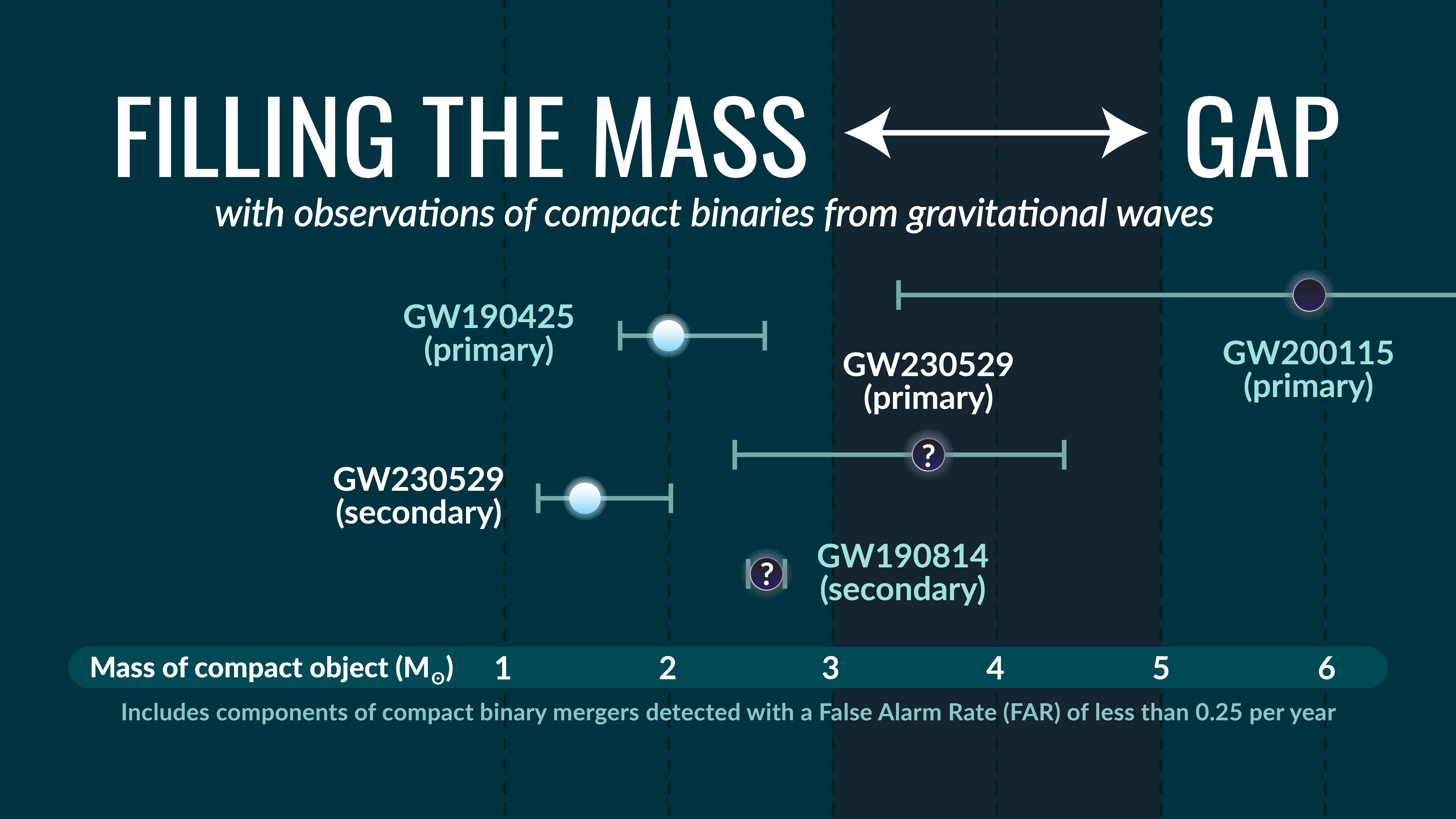
S. Galaudage / Observatoire de la Côte d’Azur
GW230529 adds to evidence that the low-mass gap isn’t empty, after all. But on its own, it doesn’t answer astronomers’ questions. Scenarios that could make a black hole this small are certainly possible — for example, excess material could have fallen back onto the star’s core after the supernova, overwhelming what would have otherwise been a neutron star and collapsing it into a black hole. But we can’t tell what made GW230529’s (probable) black hole.
When small black holes merge with neutron stars, the black hole can tear the neutron star up before swallowing it, instead of gulping the neutron star down whole (as bigger black holes do). This shredding would create a big swirl of glowing material that astronomers could see with professional telescopes before the black hole slurped it up.
This disruption might have happened with GW230529, but there’s too much uncertainty in the binary system’s parameters to say for certain. And with only one detector catching the event, astronomers couldn’t pinpoint a location in the sky and go look.
GW230529 is only one of 81 events detected during the first half of the fourth observing run (O4). The second half began in April 2024 and will continue until June 2025. By the run’s end, researchers predict the number of discoveries will top 200. These will join the roughly 100 already found in previous observing runs, either by the LVK collaboration or by independent teams trawling the data.
Reference: A. G. Abac et al. “Observation of Gravitational Waves from the Coalescence of a 2.5–4.5 M⊙ Compact Object and a Neutron Star.” Astrophysical Journal Letters. August 1, 2024.
About Camille M. Carlisle
Science Editor Camille M. Carlisle handles science features for Sky & Telescope. She specializes in black holes, Mars, and whatever she happens to be writing about at the time. Frolic with her through the delights of black holes in her blog, The Black Hole Files.



Comments
You must be logged in to post a comment.