 SUNSET:

 7
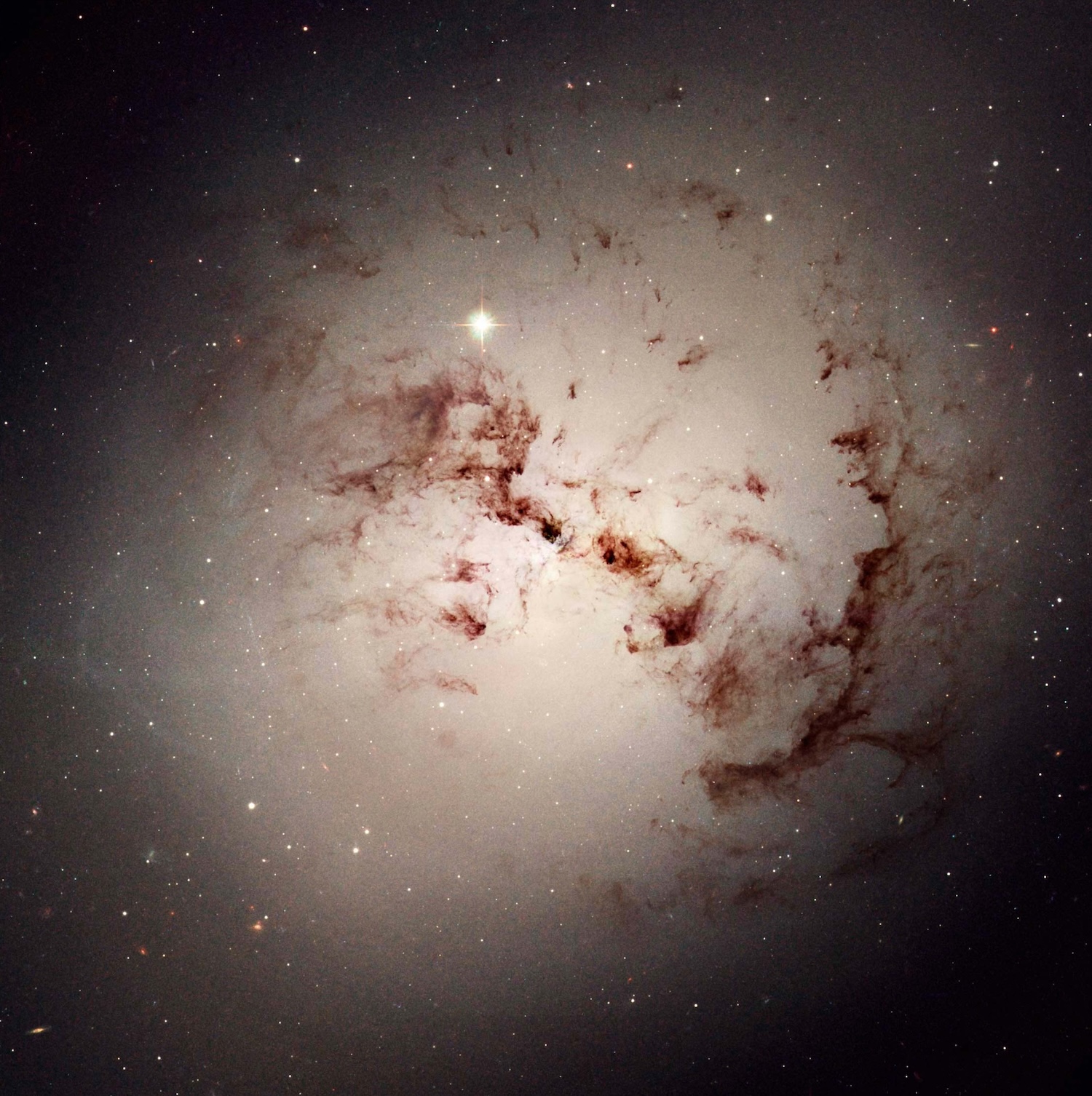
7The distance to the Coma galaxy cluster highlights a discrepancy between different measurements of the universe’s current expansion rate.

NASA / ESA / the Hubble Heritage Team (STScI / AURA); acknowledgment: D. Carter (Liverpool John Moores University) and the Coma HST ACS Treasury Team
In 1925, Edwin Hubble discovered that the Milky Way was just one among millions of galaxies in an ever-expanding universe, shattering long-held beliefs in cosmology. Now, 100 years later, astronomers are uncovering key discrepancies in the universe’s rate of expansion through measurements of the distance to one of our closest intergalactic neighbors — the Coma galaxy cluster.
The rate of the universe’s expansion is known as the Hubble constant, named for the astronomer who discovered it. But the universe is not simply expanding; its expansion is also accelerating. Astronomers have built a cosmological model of the universe that accounts for the rate of expansion at different points in time.
Measurements of the early universe align with the values predicted by astronomers, obtained by studying the cosmic microwave background radiation, or the remnant glow left over by the Big Bang. However, when astronomers compare the Hubble constant predicted by the distant universe with the rate of expansion obtained from measuring nearby objects, their measurements do not align — a phenomenon known as the Hubble tension.
Precise measurements to the Coma Cluster have now exacerbated this discrepancy, in new findings presented at the 245th meeting of the American Astronomical Society (AAS) in National Harbor, Maryland. “With this [result], the Hubble tension is now a Hubble crisis,” said Daniel Scolnic (Duke University) at an AAS press conference. He is the lead author on the study published in The Astrophysical Journal Letters,. “[The Hubble tension] is saying, to some respect, that our model of cosmology might be broken,” he added.
Rungs on a Ladder
Around 321 million light-years away, the Coma Cluster is a large, rich cluster of more than 1,000 galaxies. As one of the closest galaxy groupings to our own Local Group, astronomers have measured the distance to Coma many times in different ways.
Astronomers can use various techniques to measure distances on different scales, linking successive measurements to each other like the rungs of a ladder. These techniques often rely on standard candles, such as the white dwarf explosions of Type Ia supernovae. Astronomers know the intrinsic brightness these events actually have and can then gauge their distance by observing their apparent brightness in the sky. It’s like viewing a column of lanterns stretching out into the night — the farther lanterns appear successively dimmer. Precisely measuring distances is one way by which astronomers determine the universe’s expansion rate.
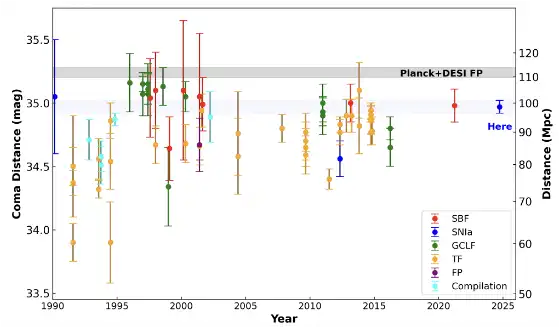
Scolnic’s team used 13 Type Ia supernovae to calculate the distance to the Coma Cluster. By linking the observations to distant galaxy data from the Dark Energy Spectroscopic Instrument, the team arrived at a distance to Coma of around 321 million light-years. That distance in turn corresponds to a Hubble constant between 74.3 and 78.7 kms/s/Mpc. For comparison, the standard model of cosmology instead predicts a Hubble constant of 67.4 km/s/Mpc, with an associated Coma Cluster distance of 365 million light-years.
The paper also incorporates many past distance measurements to the Coma Cluster, some computed “blind” to the problem of the Hubble tension. For all of these measurements, no one has ever come close to the distance that the standard cosmological model predicts. “We are in high tension . . . with the prediction of the standard model of cosmology,” Scolnic said.
D. Scolnic
A Hubble Crisis
New measurements, such as this one of the Coma Cluster distance, have shown that local measurements do not align with what astronomers expect based on measurements from the early universe.
“When people measure nearby objects, they are just closer than the standard model would predict,” Scolnic said. “Objects in the mirror are closer than they appear.”
The findings underscore the importance of a consistent distance ladder, which could demonstrate the source of the tension. “The problem comes from the disagreement between two very different classes of calibrators,” said Daniel Eisenstein (Harvard University), who was not involved in the study. Cepheid variable stars are used to calibrate nearby distances on the distance ladder, while the “well-predicted travel of sound waves in the first 400,000 years after the Big Bang” is used to measure far distances.
“If the second set is correct, then we likely will have found some intriguing bias in the measurement of the nearby calibrators,” Eisenstein said. “But if the first set is correct, then it seems that our understanding of the early universe will need some substantial change, which would be quite important for cosmology. The jury is still out!”
Further measurements may clarify these issues, according to Adam Riess (Johns Hopkins University), a coauthor on Scolnic’s study. A different kind of cosmological model could also resolve the Hubble tension, though astronomers remain far from a definitive solution. “Unfortunately there are too many options to provide a simple answer,” said Riess. He cites exotic dark energy, a new species of neutrino, primordial magnetic fields, and a decaying electron as a few possible ideas.
Ultimately, the measurement has thrown this cosmological crisis into greater relief. “This study has moved the Hubble tension closer to our backyard,” Riess said, “and demonstrates that it was already baked into measurements that preceded the recognition of the tension.”
Fresh evidence has emerged to demonstrate the Hubble tension — only a new model of cosmology or further measurements across space and time could solve this cosmological mystery.
About Arielle Frommer
Arielle Frommer has been writing for Sky & Telescope since April 2024. She covers news stories ranging from newly-discovered exoplanets to local astronomy events. She is a recent graduate of Harvard University, where she obtained her bachelor's degree in Astrophysics and Physics and researched massive star formation and exoplanets. Arielle is currently studying extrasolar atmospheres at Leiden Observatory in the Netherlands. In her free time, she enjoys hiking, crocheting, drinking coffee, and reading and writing fiction.



Comments
Fire-Starter James
January 24, 2025 at 7:05 pm
V(r) = c × tanh(Hr/c) relieves the "tension" in Hubble's Law. I don't know for sure why nobody will even try it out. (I suspect there's no grant money in it.) It's derived from the equation:
f(a+b) = (f(a)+f(b)) / (1 - (f(a)*f(b)) / c^2) )^.5
which applies relativistic addition of velocities to Hubble's Law. Something I worked out in '81
The problem is bad assumptions.
#1 Hubble's Law is linear. That is, if object B is x times farther away than object A, then it is receding x times faster than B.
Which leads us to:
#2 The universe is finite in space, time, mass, and every way else. Even if it is infinite, there's that "red limit" of exceeding the speed of light (??!) that cuts us off in our own little bubble. Remote parts of the universe are causally disconnected.
Which leads us to:
#3 An expanding universe must be increasing in size and decreasing in density, and must be embedded in at least a 4-dimensional space.
#4 There must be some sort of force or principle that overcomes gravity to cause the expansion.
So here we go:
Point #1. Hubble's Law is a hyperbolic tangent function multiplied by the speed of light. In the light of relativity, this is the assumption we should have started with.
Point #2. We can infer the universe is infinite in every way, and completely causally connected. No "red limit"; no need to break the speed of light.
Point #3. An infinite universe doesn't need an extra dimension to "expand into". That's an assumption we don't have to make. We can still have a "Big Bang" scenario, but it starts infinity time ago, with an infinite super dense universe. Not infinitesimal, but infinite. The age and size of the universe is always infinity.
Point #4. The distribution of infinite gravity sources cause the universal gravity field to be generally close to zero, rather like being near the center of a planet, where the gravity is zero. There is still an apparent "red limit", but all of the infinite universe appears compressed into that finite space. It looks less like a place where galaxies fade beyond view, and more like an event horizon shielded by a neutronium wall, which all the remote supermassive galaxies are getting compressed into at nearly the speed of light. We never see the matter pass through the event horizon to nowhere, because of the time dilation approaching infinity.
In other words, it looks like the entire infinite universe is inside an inside-out black hole, with it's event horizon at the "red limit" distance.
We've been mapping our infinite and completely observable universe into the finite "red limit" space. That's only one step for for a mathematician. Now we're confusing the map with the territory. So when we measure time relative to the "big bang", we're getting the dates wrong. We need to put our zero time back to the present, use negative years like we used to, and adjust to fit the hyperbolic tangent function.
You must be logged in to post a comment.
Fire-Starter James
January 24, 2025 at 7:24 pm
PS Don't forget to apply Lorentz contraction to the redshift measured distance. That might reconcile the brightness issue.
You must be logged in to post a comment.
Andrew James
January 28, 2025 at 2:26 am
Wow! This makes absolutely no sense at all.
I mean: "Hubble's Law is a hyperbolic tangent function multiplied by the speed of light."?!?
V(r) = c × tanh(Hr/c)??
What utter nonsense. Let's be clear as daylight. By standard definition, Hubble's Law is not associated with a hyperbolic tangent function.
Worst. "We've been mapping our infinite and completely observable universe into the finite "red limit" space." or "The age and size of the universe is always infinity." Who else says it is infinite anyway? Where is the observational evidence for this?
Zero evidence means zero validity!
Yet, according to you: "We need to put our zero time back to the present, use negative years like we used to, and adjust to fit the hyperbolic tangent function." Giggle.
Han Solo was dead-right. "Who is more foolish. The fool all the fool that follows him."
You must be logged in to post a comment.
Andrew James
January 28, 2025 at 3:09 pm
Error: Han Solo was dead-right. "Who is more foolish? The fool OR the fool that follows him."
You must be logged in to post a comment.
Martian-Bachelor
January 28, 2025 at 9:00 pm
In the final graph the caption says "(shown here in terms of the cluster’s magnitude, or mag)".
This is not correct. The vertical axis on the left is the distance modulus (m-M), not the cluster's magnitude. 321 million ly distance corresponds to m-M = 34.97. Basically, things are dimmer in the Coma Cluster by 35 mags compared to if they were only 10 parsecs away.
You must be logged in to post a comment.
Brian of DRAA
January 30, 2025 at 10:00 am
Pardon me if I’m not excited. It seems the interpertation of the graph is a mess:
- The blue measurement isn’t very different than the previous globular cluster luminosity function (GCLF, the green measurements), which is what is being used here (I think).
- The prior stated value is a SBF measurement (surface brightness function, from 2021) and it is the same value. Truthfully I don’t understand why this newest measurement is different from prior results, nor the significance of this one measurement?
- Note the “precision” of the “way wrong” TF measurements (Tully-Fisher method). Will this new measurement succumb to later measurements?
I'm perplexed by how measuring the distance to a near galaxy cluster can be "proof or falsification" of the lambda-CDM-Inflationary Big Bang model:
- Does the Coma Cluster's mag value skew all DESI measurements and make the universe younger?
- Does this measurement defy the BAO (baryonic acoustic oscillations) spacing between the galaxy clusters?
FYI found the most significant comment to be “Further measurements may clarify these issues”. Between DESI and Webb we should have a reasonable path of Hubble expansion going back in time (DESI) and going forward from the CMB (JWST) with a ~5 billion year gap in between. I’ll hold out for more data.
Please comment if you can assist or I've stated an error,
Clear skies, Brian
You must be logged in to post a comment.
Martian-Bachelor
February 5, 2025 at 5:59 pm
I think those are all things worth bringing up.
I doubt the fate of the standard model hinges on one cluster, so it's maybe playing up this one measure too much.
You must be logged in to post a comment.
You must be logged in to post a comment.