 SUNSET:

 6
6A new nova for early risers plus three fun observing projects for the week ahead.

Stellarium with additions by Bob King
We have a new "star" in the night sky. In truth, it's been there for billions of years, but it only first revealed itself a little more than a week ago. Nova Sagittarii 2025 no. 3 was independently discovered on March 23–24 by the Russian New Milky Way (NMW) Survey and Japanese amateur Tadashi Kojima at a right ascension of 18h 02′ and declination of –33° 11′. Both parties caught the star around magnitude 13; two days later it had brightened to 10.5. Despite its southerly declination, the nova stands more than 10° above the horizon before the start of dawn, making it an attainable target even for observers in the northern U.S.

Courtesy of the AAVSO
Clouds have thwarted my attempts to see it, but most estimates posted to the AAVSO peg it at magnitude 10.7 on April 1st. Not long after its discovery, the star received the official designation V7993 Sagittarii, making it the 7,993rd variable star to be discovered in Sagittarius. Although novae can appear anywhere in the sky, they're far more common within the star-dense band of the Milky Way, and especially in Sagittarius where we face toward the galactic center. In fact, this is the third nova discovered so far this year in the constellation.
NASA's Goddard Space Flight Center Conceptual Image Lab
In last week's post, I described novae, recurrent novae, and dwarf novae. All three types occur in close binary star systems, in which one member is a hot, dense white dwarf and the other a normal star. In each case, material flows from the companion into a flattened cloud of hot gas called an accretion disk, which spins around the dwarf. In a nova, material funnels down from the disk to the star's surface until sufficient mass has accumulated for heat and pressure to ignite the gas in a runaway thermonuclear explosion. The blast creates a brilliant fireball, which slowly cools and fades. A recent measurement clocked V7993's expanding debris cloud at 700 kilometers a second (1.6 million mph). Despite the blast, the white dwarf remains intact after the blast, and the process begins anew.
Novae generally skyrocket in brightness quickly, then gradually fade over the following weeks and months. Watching a nova dim (and occasionally re-brighten!) makes them great long-term observing subjects. Use the AAVSO map and comparison stars to help you follow V7993 Sgr's variations.
Demon Star in eclipse

Merikanto, CC BY-SA 4.0
As a budding 11-year-old amateur astronomer, my first variable star was Algol in Perseus. I still remind myself to gaze its direction every clear night I'm out from fall through spring. Every 2.9 days the more massive but fainter star in this binary system eclipses the smaller, brighter companion. In full eclipse at minimum light, Algol shines weakly at magnitude 3.4 compared to its usual 2.1. The difference is very apparent with the naked eye.
If you've read about Algol and have never observed it (or it's been a while), you'll have the opportunity to see it in eclipse on the night of April 3rd. At 10:11 p.m. EDT that evening, the star will dim to minimum light. For one hour on either side of minimum, it remains near that brightness. But if you check 2 hours or more after minimum, you'll see it begin to recover in brightness.

Stellarium with additions by Bob King
Despite eclipses occurring at short intervals, they're visible only infrequently for any particular location. After the April 3rd event, the next widely and easily visible eclipse takes place on April 26th. For more eclipse times and additional information, visit Sky & Telescope's Minima of Algol calculator.
One night, two moons, three events
Jupiter has already begun its western descent. When a planet reaches a high declination, it seems to stick around forever, even taken for granted. But the writing's on the wall — the gas giant's good nights are dwindling. It's time for another look.
On the night of April 5–6, three separate events involving two Jovian moons occur in succession. First, observers in the eastern half of the U.S. and Canada will see Europa cast its tiny black shadow on Jupiter's cloud tops from 6:16 to 8:54 p.m. CDT. While the first part of the shadow transit won't be visible due to Sun and/or twilight interference, we'll see Europa's shadow skirting the south edge of the Southern Equatorial Belt (SEB) in a darkening sky.
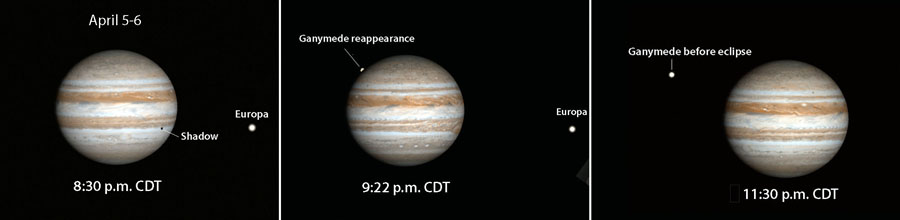
Stellarium
Starting at 9:22 p.m. CDT, Ganymede will emerge from occultation at the planet's northeastern limb, looking like a tiny pearl. A little more than two hours later, at 11:30 p.m., the same moon will slowly fade from sight as it enters Jupiter's shadow in eclipse. It won't poke back into the sunlight again until 2:04 a.m. To find out times of other watch-worthy Jovian moon events, visit Sky & Telescope's Jupiter's Moons site.
Uranus occults 9th-magnitude star
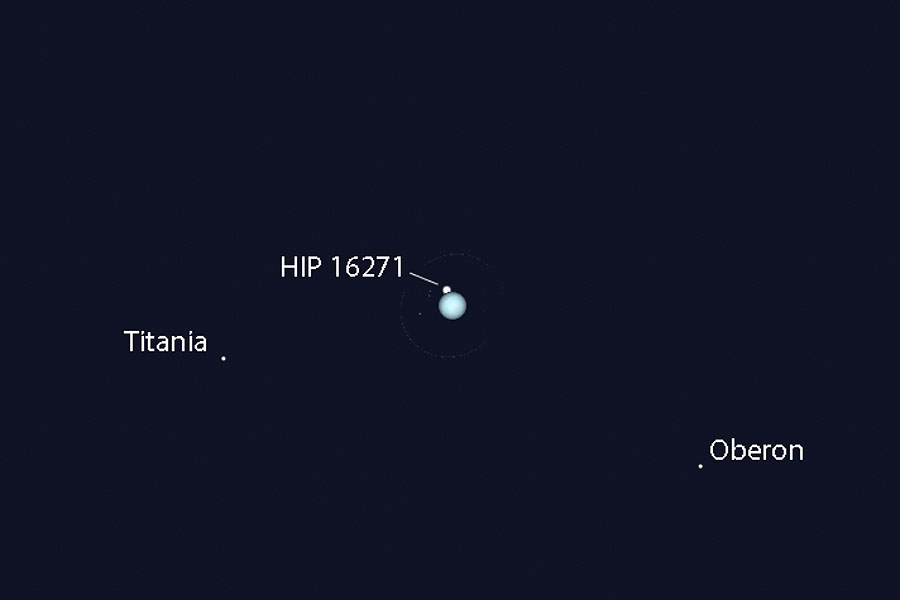
Stellarium
On the evening of April 7th, Uranus will occult the 9.1 magnitude star HIP 16271 around 9:30 p.m. CDT (2:30 UT). Observers in central North America will have the best view. Farther east, the planet will be too close to the horizon or have set, while in the western U.S., the occultation takes place in a bright sky. Even from the best locations, it will still be challenging because the planet will be only about 15° high at the time.
Serious amateurs will attempt to record dips in the star's light as it's occulted by the planet's spindly rings prior to and after its disappearance behind the planet. More casual observers can watch Uranus slowly encroach on the star until the two merge into one. For full details, including a list of cities and times, check out occultation expert David Dunham's Uranus Occultation page.
About Bob King
I love the sky (day and night) and have been a skywatcher and amateur astronomer since childhood. I'm also a long-time member of the American Association of Variable Star Observers (AAVSO) and Astronomical League. I pen the Astro Bob blog and have written four books: Night Sky with the Naked Eye (2016); Wonders of the Night Sky You Must See Before You Die (2018) and Urban Legends from Space (2019) and Magnificent Aurora, published in 2024. The universe invites us on an adventure every single night. To accept the invitation, we only need look up.



Comments
misha17
April 2, 2025 at 5:17 pm
Re: Eclipses of Algol -
"At 10:11 p.m. EDT that evening (April 3rd), the star will dim to minimum light. For one hour on either side of minimum, it remains near that brightness. But if you check 2 hours or more after minimum, you'll see it begin to recover in brightness."
The light graph in the video shows two sharp dips/"valleys" during the eclipses. Given the minimum is 2 hours long for the April 3rd event, the drops in brightness during minima should be flat troughs, not sharp dips.
You must be logged in to post a comment.
Bob KingPost Author
April 2, 2025 at 6:55 pm
Hi Misha,
Thank you for your comment. Look up Algol light curves, and you'll see most show the same sharp profile due to scale. The animation used in the article isn't a precision light curve
but intended for illustration purposes.
You must be logged in to post a comment.
John
April 3, 2025 at 12:43 pm
I think the article would be unharmed if you dropped the final paragraph, with its pointless distinction between "serious" and "casual" amateurs. Gave me flashbacks to my beginnings in the hobby in the early 1980s. There were two very good periodicals, Sky & Telescope and Astronomy. Most enthusiasts at the time would describe Sky & Telescope as the one for "serious amateurs," while the other magazine was for the "more casual observer." Indeed, reading Sky & Telescope in those years was like sitting in a classroom at the Catholic school, where you were always made to feel guilty, and you feared getting backhanded by the nun, for not being a serious enough student. Meanwhile, reading Astronomy magazine was like taking a class field trip to the Smithsonian.
You must be logged in to post a comment.
Bob KingPost Author
April 3, 2025 at 3:26 pm
Hi John,
Great comment and story. And your point is well-taken. I only used "serious" to distinguish those amateurs with a lot of equipment and determination who might try to record occultations by the planet's dim rings. That's definitely an undertaking. "Casual" refers to many others — including myself — who who make lack equipment or the desire to undertake such a project but who would nonetheless enjoy watching the planet approach the star. Perhaps "advanced amateurs" would have been a better fit?
You must be logged in to post a comment.
davidrogersbooks
April 5, 2025 at 1:05 pm
I wonder who else noticed the sentence that says Algol is an amateur astronomer: "As a budding 11-year-old amateur astronomer, Algol in Perseus was . . ."
You must be logged in to post a comment.
Bob KingPost Author
April 6, 2025 at 12:59 pm
David,
Ha! A chuckle-worthy ambiguity. Thank you!
You must be logged in to post a comment.
You must be logged in to post a comment.