 SUNSET:

 4
4
Bob King
On every clear night, I face Arcturus, then slide north and east to Corona Borealis hoping to see another jewel in the Crown. That gem would be the Blaze Star, which also goes by its variable star moniker T Coronae Borealis, or T CrB. It's one of just 10 recurrent novae known in the Milky Way; these are novae that erupt on time scales of less than a century. T CrB is the brightest of the bunch with a peak magnitude of 2.0, on par with its neighbor Alphecca.
The star erupted in 1866 and did so again 80 years later in 1946. While it's only been 78 years since the last blast, T CrB's behavior over the past year has mimicked what was observed just prior to its February 9, 1946, outburst. Should it continue along that path, astronomers think another eruption could be imminent sometime between now and September.
Find details of the star's past behavior and predictions for the future nova in the March 2024 issue of Sky & Telescope.

NASA
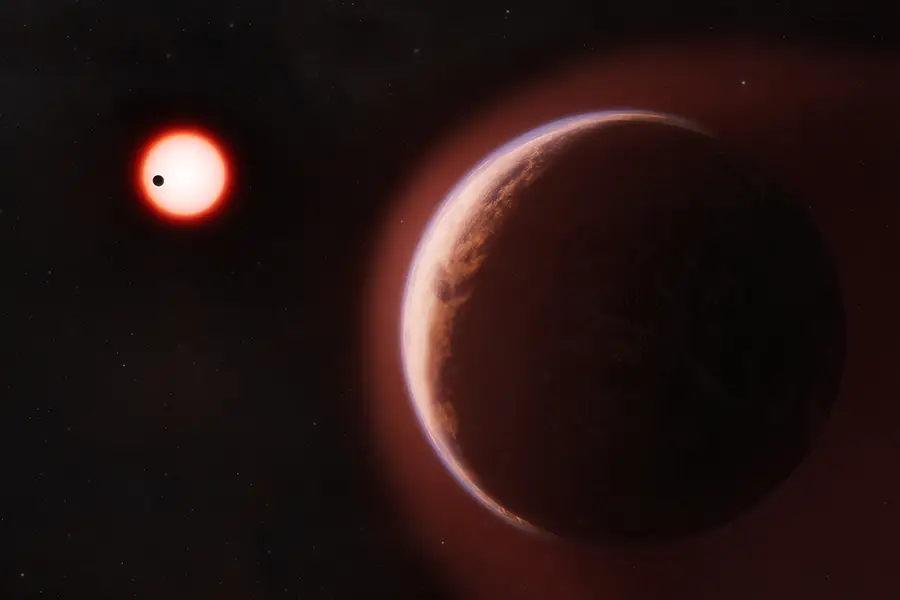
Novae involve interacting, close binary systems. T CrB consists of a red giant in orbit about a white dwarf 1.35 times the mass of the Sun. The compact dwarf siphons gas from the giant into an accretion disk. Instabilities within the disk cause material to spiral down to the surface, where it's heated and compressed until it ignites in a runaway thermonuclear explosion. The blast creates a brilliant flash that quickly fades as the material expands and cools.

Sky & Telescope
All of this happens at a rapid pace, so T CrB is expected to rise from around 10th magnitude to 2nd magnitude in just a few hours. Peak brightness lasts only about half a day. Within a week, the system will fade below the naked-eye limit. So when the moment comes, hope for good weather! If necessary I'll hop in the car and drive to clear skies to witness this once-in-a-lifetime event. I've kept my eye on the star for years and don't want to get skunked, like the famous variable-star observer Leslie Peltier did back in 1946. After diligently observing T CrB for more than 25 years, hoping to catch it during outburst, he chose to go to bed and sleep (for his health's sake) on the very night the star flared.

Courtesy of the AAVSO
Brad Schaefer (Louisiana State University) has been watching T CrB and estimating its brightness since high school. Examining historical records, he identified a likely eyewitness report of an even earlier outburst in 1787. Adding this observation to the others yields an average interval of 79 years between flares. That would imply we'd see the next blast in 2025. However, a careful comparison of the system's 1945–46 pre-outburst light curve with its recent behavior suggests the blast will come earlier, in 2024.

Courtesy of the AAVSO
Just before the 1946 outburst, T CrB underwent a mysterious dimming from its usual magnitude of ~10.1 to around 12.3 — a plunge of more than 2 magnitudes! Soon after this pre-eruption dip, it blew its top. The time from the initial dip to the nova blast was 1.1 years, give or take a third of a year. Prior to the dip, the star was in its "high state" — a few tenths of a magnitude brighter than normal.

Courtesy of the AAVSO
Amateur astronomers around the world routinely monitor T CrB and submit their magnitude estimates to sites such as American Association of Variable Star Observers (AAVSO). Starting in 2015, the star climbed to its high state. Then, in late March, it began to fade. If this is the pre-eruption dip, though, it's not as deep as the one in 1945, especially in the V-magnitude range.
Assuming the nova follows the same pattern as before, we should see it flare in 1.1 ± 0.3 years, or in 2024.4 ± 0.3. After the 1946 outburst, the star quickly plummeted in brightness, then underwent a second, smaller eruption to 8th magnitude, before returning to its high state and ultimately to quiescence. Will it follow the same drum beat in 2024–25?

Sky & Telescope
How to report
It's always possible T CrB could break with tradition and do something else entirely. I encourage you to check on the star every night with binoculars. A pair of 10×50s can reach down to 9th magnitude under a dark sky and enable you to catch a brightening early. If you see T CrB at 9.5 magnitude or brighter, immediately report your observation to the AAVSO site. You can register for a free account by clicking the Log In button at the top of that page. This allows you to access the T CrB Time Sensitive Alerts Forum thread. Post your observation there with the date, time and star's estimated brightness and ask for confirmation. If confirmed, that news will be relayed to The Astronomer's Telegram (known as the ATELs) and distributed around the planet.
How to get alerts when it blows
You can subscribe to the ATELs for free, then restrict them to alerts about novae. Create an account, confirm it as instructed, and log in to it. Then set your email settings. Choose
Email Frequency > Instantly
Wavebands > Optical
Objects > Nova
Or, you may get a quicker alert from the AAVSO. Create an AAVSO website account using the Login button at the top of the home page. Then, from the homepage go to My Account > Profile > MyNewsFlash > Add a New Subscription. Fill out the boxes there including
Frequency > Real Time
Stars to Report > T CrB
Only Show Observations Brighter Than > 8.5 [for example]
Check No Fainter-Than Observations
Observation Type > Visual (and maybe VISDIG).
That way you won't be flooded with email for other stars, outlier observational noise for T CrB, and infrared observations of T which normally run between infrared magnitudes 7 and 8.
But don't wait for an alert; go look at T itself. I hope one of you will be the first to catch it starting up!
About Bob King
I love the sky (day and night) and have been a skywatcher and amateur astronomer since childhood. I'm also a long-time member of the American Association of Variable Star Observers (AAVSO) and Astronomical League. I pen the Astro Bob blog and have written four books: Night Sky with the Naked Eye (2016); Wonders of the Night Sky You Must See Before You Die (2018) and Urban Legends from Space (2019) and Magnificent Aurora, published in 2024. The universe invites us on an adventure every single night. To accept the invitation, we only need look up.


Comments
Genac
July 14, 2024 at 6:51 am
There is no passive alerting system for celestial events? Somebody has to come up with an app for that. Actively monitoring a forum is a weak substitute.
You must be logged in to post a comment.
Bob KingPost Author
July 14, 2024 at 1:21 pm
Hi Genac,
As long as you subscribe to the Astronomer's Telegram that I described at the end of the article you'll be alerted as soon as anyone reports the star in outburst. The observation might show up on the Forum first but I'm sure it would be immediately communicated to ATEL, then you'd see a message pop up in your email.
You must be logged in to post a comment.
phenk
July 16, 2024 at 12:58 pm
I created a free account at the American Association of Variable Star Observers (AAVSO) website. From My Account, Profile, Email Settings, check the box for Alert Notices. I get an email for discovery of novae, unusual activity of variable stars, and requests from astronomers for simultaneous AAVSO observations.
You must be logged in to post a comment.
Bob KingPost Author
July 16, 2024 at 1:30 pm
Dear phenk,
I was unaware that the free registration also included these benefits. This is great to know. I will add this information to the story. Much appreciated!
Bob
You must be logged in to post a comment.
You must be logged in to post a comment.