 SUNSET:

 0
0On Friday night, September 19–20, observers in northeastern North America, eastern Canada, and western Europe have a fine chance to watch the Moon cover up stars in the Pleiades.
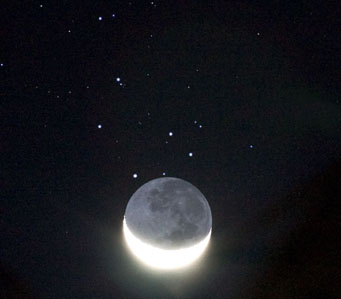
When Stan Richard took this photo in April, 2006, the Moon's bright and dark portions were almost opposite from what they will be on September 19-20, 2008. Click above for a larger image.
Stan Richard
For North Americans, the action comes on the evening of the 19th with the Moon low in the east-northeast. For Europe the occultations take place high in the sky before or during dawn on the 20th. The Moon will be waning gibbous (73% illuminated). This means that stars will disappear behind its bright limb, where you’ll need a telescope to watch them go, and will reappear from behind the Moon’s dark limb, where binoculars might suffice.
For instance: seen from the New York City area, Maia disappears around 9:38 p.m. EDT, Taygeta 9:43, Alcyone 10:16. Electra reappears around 9:59 p.m. EDT, Taygeta 10:00, Celaeno 10:01, Maia 10:23, Alcyone 10:36.
For predictions at many other locations, check lunar-occultations.com/iota/pleiades08/pleiades.htm.
About Alan MacRobert
Alan M. MacRobert became an avid Sky & Telescope subscriber in 1966 at age 14, joined the editorial staff in 1982, and is now a senior contributing editor, semi-retired. He played a role in practically every part of the magazine and the company's other products for more than a generation, both on the amateur-observing side and the science-reporting side. In 1994 a book collection of his observing how-tos and telescopic sky tours was published as Star Hopping for Backyard Astronomers. He has produced This Week's Sky at a Glance online every week since 1989.




Comments
You must be logged in to post a comment.