 SUNSET:

 0
0
Bob King
(Update 11 p.m. CDT — Conditions are trending in the right direction at this time. Aurora may be visible in the lower half of the northern sky from the norther border states within the next half-hour.)
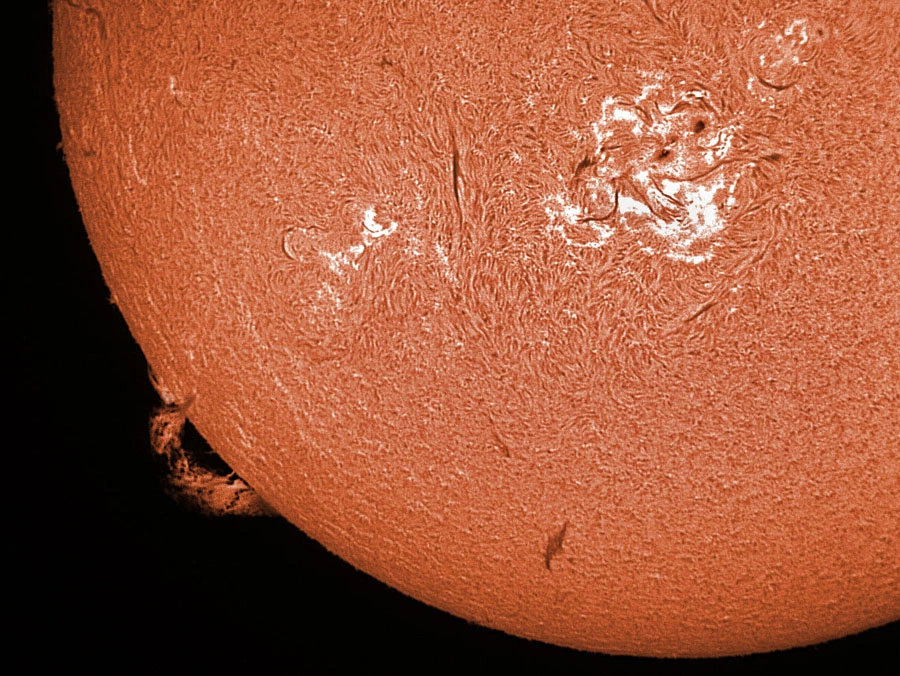
Get ready for a light show! A sunspot group that refused to die lit a fuse that's expected to ignite bright auroras across the U.S. on Sunday night, June 1st. Region 4100 — which first arose in early April and is now making a third go-round of the Sun — produced a strong M8.2-class solar flare that launched a billion-ton cloud of charged particles directly at Earth late on May 30th. Instead of simply blowing by, the coronal mass ejection (CME) coupled with our planet's magnetic field, which released a salvo of electrons and protons into the upper atmosphere Sunday morning, June 1st. From the Upper Midwest the aurora overtopped the zenith! It was even seen in New Mexico.
Bob King
Space weather experts predict a similar display Sunday night, June 1-2 from nightfall till dawn across the U.S. Observers in the northern U.S. could see the sky awash with northern lights. Those living as far south as Georgia and northern California may also get a taste, with colorful rays poking up in the lower half of the northern sky.
Nature's in charge
No matter where you live, start watching in late twilight. Auroral activity is most common in the northern sky at mid-northern latitudes, so that's always a good place to start. Sometimes a display shows up right on time, but it can also be early, late or fail to appear. The fact that the CME arrived very early this morning — ahead of predictions — could mean tonight's storm may fizzle — or not. Forecasting aurora isn't an exact science.
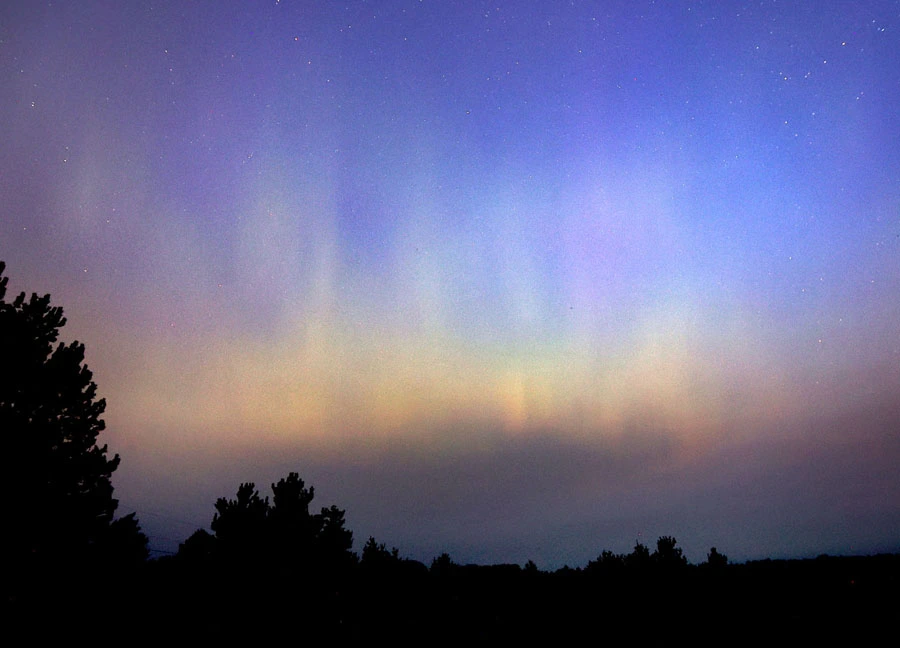
That's why patience and acceptance of nature's vicissitudes are our friends. On May 28th, I watched a dim aurora lollygag from 10:30 p.m. to 11:49 p.m. Then at 11:50 p.m., as I prepared to get in the car and drive home — boom! A portion of the auroral arc suddenly brightened and splintered into parallel green and pink rays that languidly unfolded across the northern sky. Needless to say, I didn't get to bed till after 1 a.m.
Excited oxygen atoms are responsible for the red and green aurora colors. Green emission occur at altitudes around 100-150 kilometers (60-95 miles); red is released much higher up at approximately 300 kilometers (185 miles). During a major display, observers in the southern U.S. often record diffuse red glows and red-topped pillars because high-altitude red aurora can be seen from a great distance. Lower-altitude green aurora is hidden by the horizon. Farther north, closer to the northern auroral oval, both colors are common.
Smoked out?
Geomagnetic storms are rated on a 1 to 5 scale from minor (G1) to extreme (G5). Expectations are for a severe G4 storm from about 10 p.m. to 1 a.m. Central Time, followed by G3 (strong) conditions through dawn. Aurora may also return on Monday night, June 2nd, when a G2 (moderate) storm is forecast.
Bob King
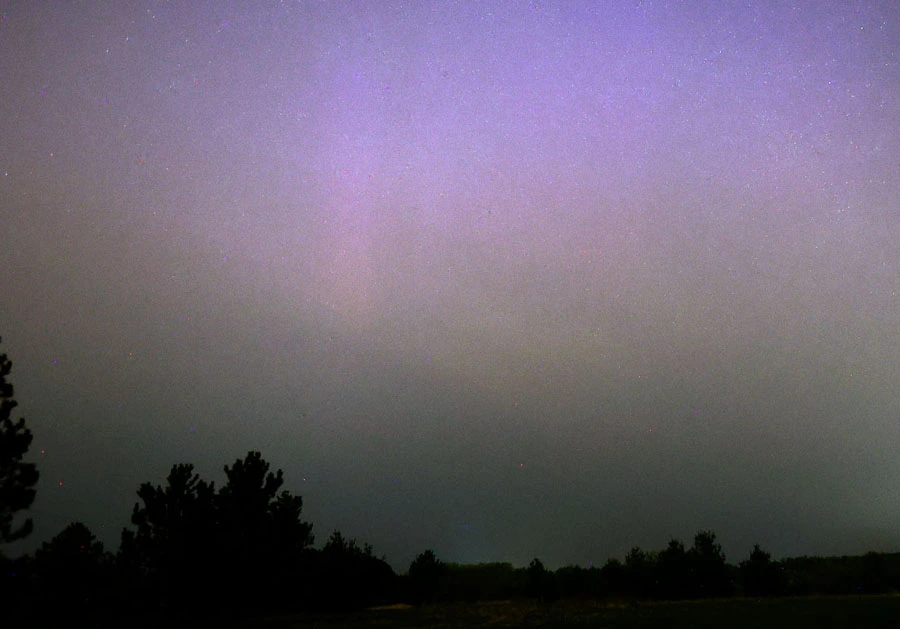
Sometimes a bright Moon will dilute the aurora. Not this time because it's still shy of first quarter phase. We have another problem. Heavy smoke from Canadian forest fires now drapes across much of the central U.S. all the way to the East Coast. Depending on location you may be looking through a "smoke filter" at the aurora. On Sunday morning (June 1) around 3:30 a.m., my sky was pretty horrible. Although perfectly clear (no clouds), smoke blotted out the majority of stars. Although the northern lights filled the northern sky I could hardly tell it was there.
Bob King
If you experience the same on Sunday night, find the darkest location possible. This will lessen the reflective glow of city lights on the smoky dome overhead. And don't forget to bring your secret weapon. Smartphones and digital cameras will record the aurora even if nothing is visible with the unaided eye. Recent phone models will let you take up to 10-second-long handheld time exposures that look great. Yes, it's a miracle. A digital camera on a tripod does even better.
Below are a few resources you'll find handy for anticipating tonight's event. I'll also post news about whether the big storm rises to the occasion or not. Check back around 10 p.m. CDT for an update. Let's hope hope for the best.
Aurora resources
Wildfire smoke map
Latest NOAA space weather forecast
Aurora 30-minute forecast — Short-term forecast of the location and intensity of the aurora.
SpaceweatherLive app — Get aurora alerts and other information for your location.
About Bob King
I love the sky (day and night) and have been a skywatcher and amateur astronomer since childhood. I'm also a long-time member of the American Association of Variable Star Observers (AAVSO) and Astronomical League. I pen the Astro Bob blog and have written four books: Night Sky with the Naked Eye (2016); Wonders of the Night Sky You Must See Before You Die (2018) and Urban Legends from Space (2019) and Magnificent Aurora, published in 2024. The universe invites us on an adventure every single night. To accept the invitation, we only need look up.




Comments
You must be logged in to post a comment.