 SUNSET:

 2
2The annual Lyrid meteor shower should put on a great show this year. Enjoy it with dashes of Venus and the “dark side” of Saturn’s rings.

Sky & Telescope diagram
A good car is a dependable vehicle you can always count on. The Lyrids are like that. Every year, rain or starshine, they're active from April 14–30, with the peak occurring midway through the run. This year, that happens on Monday night-Tuesday morning, April 21–22, when observers under minimally light-polluted skies might see 15 to 20 meteors per hour from roughly midnight until the start of dawn.
Each meteor is a small shard of Comet Thatcher (C/1861 G1). They are heated by air compression as they enter Earth's atmosphere in excess of 175,000 kilometers per hour (110,000 mph). Every April, Earth cuts across the comet's orbital path, where the debris is concentrated, and a meteor shower results. Larger fragments produce the occasional Lyrid fireball.
The Lyrids' origin point, called the radiant, is located about 8.5° west-southwest of Vega in Hercules. They should properly be called the April Herculids, but before the International Astronomical Union (IAU) set constellation boundaries in 1930, no one was quite sure where Lyra ended and Hercules began, the reason for the disparity.
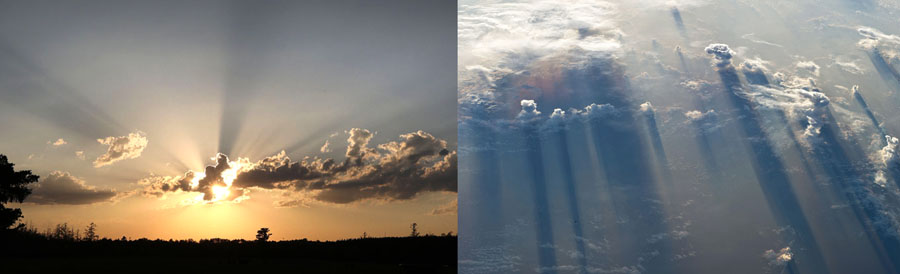
Bob King (left), NASA (right)
A meteor shower's radiant is really a vanishing point, a point in space where parallel lines appear to converge and meet in the distance. Parallel railroad tracks do the same for the same reason. Proportionally, the tracks take up less and less of our field of view the farther we follow them into the distance until they ultimately shrink down to a point. Likewise, sand-size grains shed by Comet Thatcher arrive on parallel paths from a great distance. Drawn backwards, their paths converge at a point in space — the radiant.
The Lyrids' radiant stands almost 20° high by 10:30 p.m. local time. Although the horizon will cut off a fair number of meteors that flash below the radiant, they have free reign above this point, so we'll start to see activity. Dress warmly and get comfortable in a lounge chair while facing southeast or north. Personal experience has shown that the Lyrids require perseverance. There may be gaps of 5 minutes or more between meteor sightings.
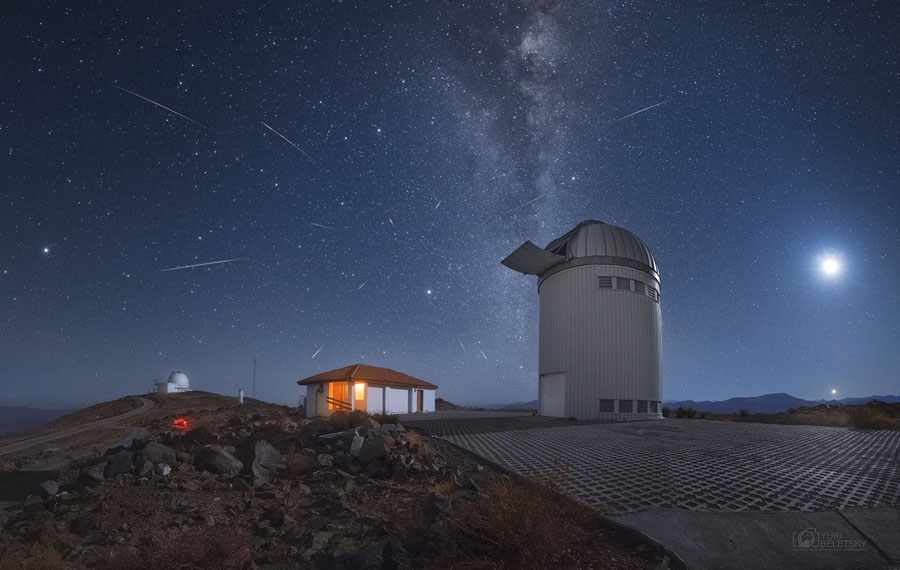
Yuri Beletsky
Meteors streaming directly at the observer from the radiant will look like points or "dashes" of light, while those on paths that peel off in other directions from the radiant will leave longer trails. To see a grab bag of both, place Vega in your peripheral vision so your eyes are directed some distance away from the radiant.
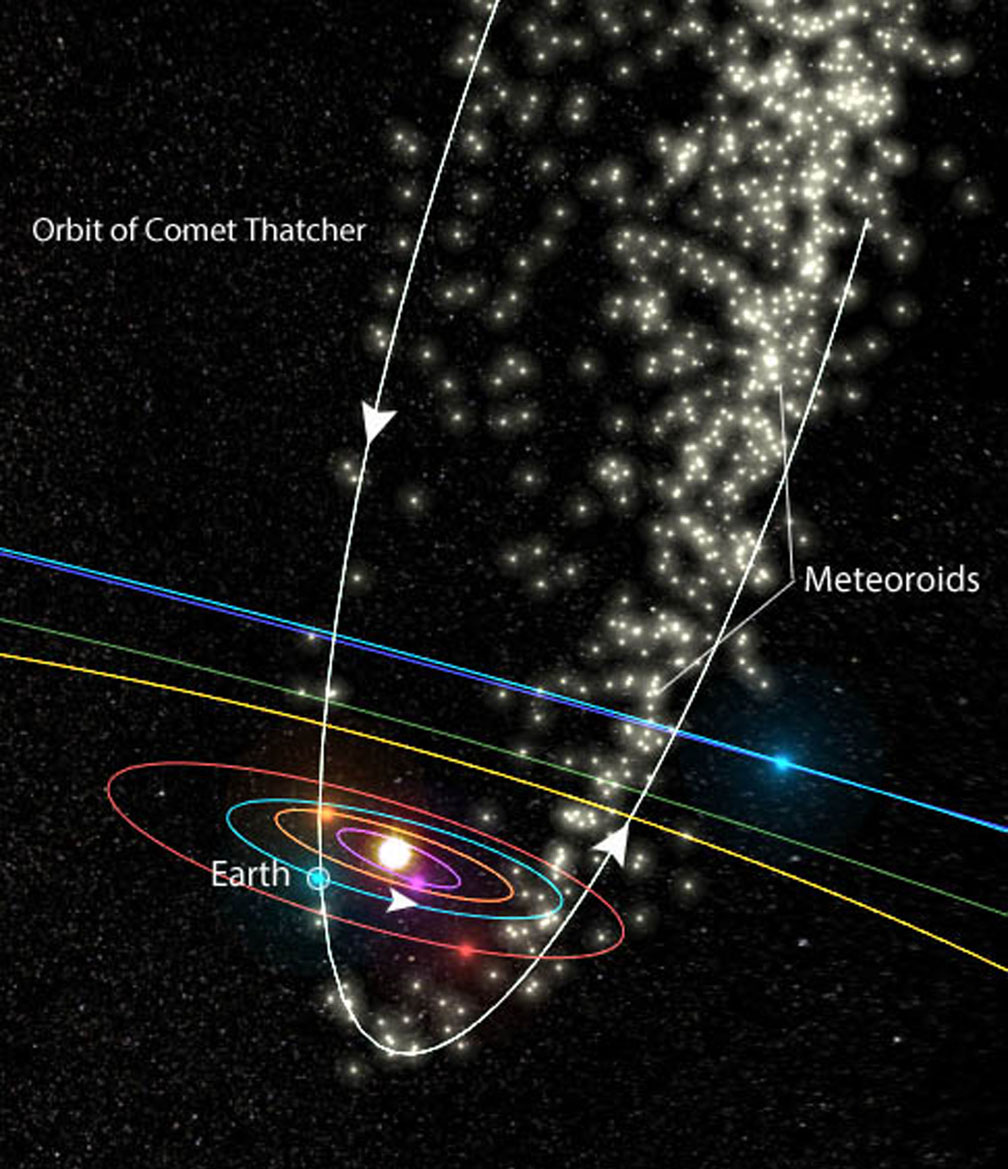
Meteor data from Peter Jenniskens, visualization by Ian Webster
Post-midnight viewing is generally the best, especially from 2 a.m. to 5 a.m. when Lyra stands high above the horizon. The Moon joins the scene around 4 a.m. local time but interferes only a little. The 36% thick crescent rises in Capricornus about an hour before the start of dawn. You might be tempted to return to bed once the sky brightens. But if you do, you'll miss seeing Saturn's return. Look for it about 5° south of the crescent Venus low in the southeastern sky. Twilight may make it necessary to use binoculars to spot the ringed planet, but you'll really want to see it up close in a telescope.
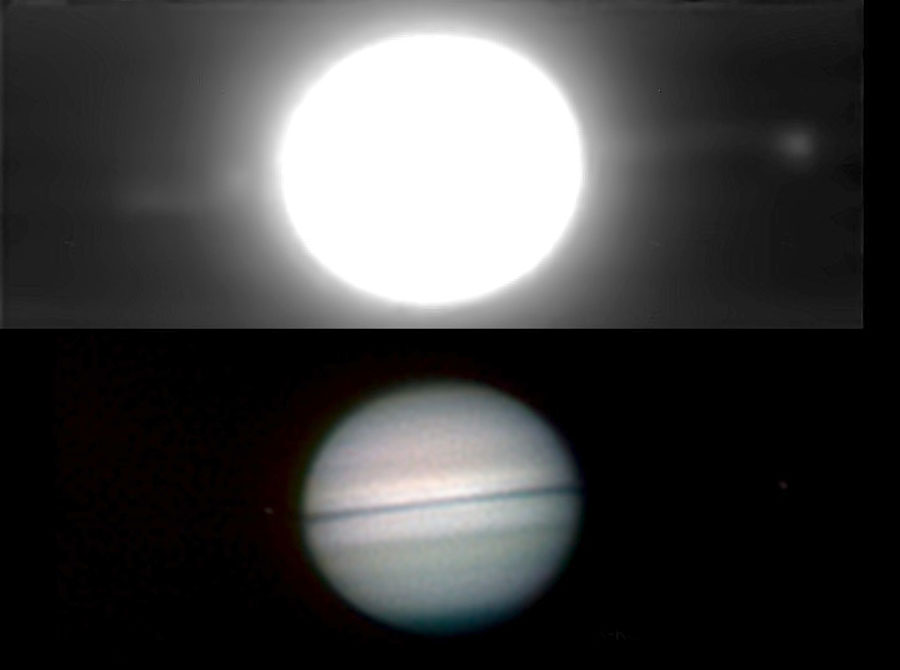
Andy Casely
Earth crossed Saturn's ring plane on March 23rd, when for a brief time the rings would have disappeared in amateur telescopes. Unfortunately, solar glare dashed our chances of seeing this unique presentation. Nonetheless, a potentially amazing sight awaits. We now see the south side of the ring plane — last visible in 2009 — tilted a slivery-thin 1.7° to our line of sight in late April. Will you see them (check photo above), or will the planet appear ringless in a bright sky?
news bite
If you read my recent post about U Geminorum being on the cusp of an outburst, it happened! The star began to brighten on April 8th and has been at maximum light the past few nights. Thanks to a tip from reader John Dolby of Tucson, I spotted it at magnitude 9.6 on April 15th. Catch it if you can.
About Bob King
I love the sky (day and night) and have been a skywatcher and amateur astronomer since childhood. I'm also a long-time member of the American Association of Variable Star Observers (AAVSO) and Astronomical League. I pen the Astro Bob blog and have written four books: Night Sky with the Naked Eye (2016); Wonders of the Night Sky You Must See Before You Die (2018) and Urban Legends from Space (2019) and Magnificent Aurora, published in 2024. The universe invites us on an adventure every single night. To accept the invitation, we only need look up.



Comments
crk112
April 20, 2025 at 11:15 am
Understanding that sun's rays (or particles) converge back on the sun, it stands to reason that (in the ISS photo) the sun's beams are NOT actually parallel but they only appear so at the particular vantage point shown. This is due to the sheer distance from the sun and the minuscule fraction of a percentage of their total length being observed at that moment.
In actuality, even the beams shown in the ISS photo are technically converging back on the sun.
You must be logged in to post a comment.
Bob KingPost Author
April 23, 2025 at 5:15 pm
Hi Crk,
Thanks so much for your comment. You're right, but the point of the photo was to illustrate in a basic way that solar rays are indeed parallel, contrary to what our eyes tell us.
You must be logged in to post a comment.
You must be logged in to post a comment.