 SUNSET:

 10
10As we wait on recurrent nova T CrB, dwarf nova U Geminorum is teeing up for its next 8-magnitude outburst.

NASA
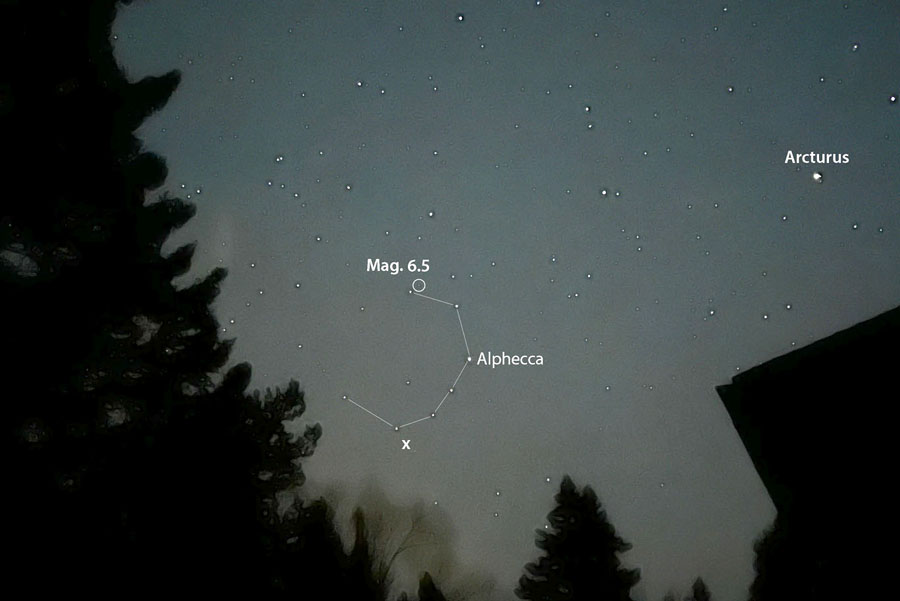
Every clear night before going to bed, I look out my front room window and check on T Cor Bor. T Corona Borealis is a recurrent nova that blows its top about every 80 years. The last eruption occurred in February 1946, when it rose to magnitude 2.0, briefly outshining the constellation's brightest star, Alphecca (mag. 2.2). So far, T CrB has refused to perform, even though a dip in its light in 2023 — a near-match to one that preceded the 1946 eruption — seemed to portend an imminent outburst last year.
We continue to wait, watch and hope. At times, it can feel like the star is yanking our chain, daring astronomers to make one more prediction to prove it has the upper hand. But as Yoda from Star Wars might say, "Predict astronomers will." Jean Schneider of the Paris Observatory picked up the gauntlet in his open access paper When Will the Next T CrB Eruption Occur? published in October 2024. Based on previous eruption dates and the binary star's orbital ephemeris (all novae and recurrent novae are binary systems), Schneider devised a method to tentatively anticipate "with a precision of a week or two" when T CrB will pull the trigger.
Bob King
He expects the next opportunity to occur on March 27th. Should that fail, the next possibility would be one 228-day orbital period later on Nov. 10th. And if those don't pan out, T CrB completes additional orbits on June 25, 2026 and Feb. 8, 2027.
have a blast anyway
Variable star observers are accustomed to waiting. That's why we keep a list of targets to routinely check in hopes of catching at least one in outburst. Recurrent novae like T CrB are rare — there are only 10 known in our galaxy. But there are lots of other close binary stars, dubbed dwarf novae, that produce outbursts under similar circumstances. Their magnitude jumps may not be as extreme, but they're still dramatic, visible in modest instruments, and frequent enough to keep you on your toes.
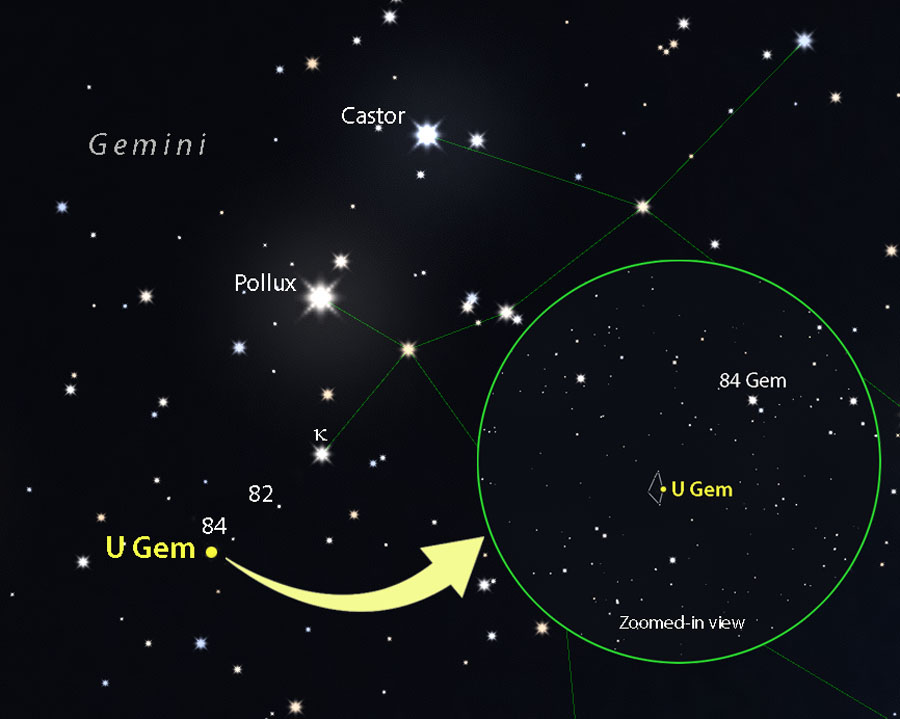
U Geminorum, located near the Gemini-Cancer border, is the archetype of the dwarf nova class. English astronomer John Hind initially thought it was a nova when he discovered the star at 9th magnitude in 1855 while searching for asteroids. But just three months later, it was reobserved in outburst again and has been monitored by amateurs and professionals ever since.

Arne Henden, USRA / USNO
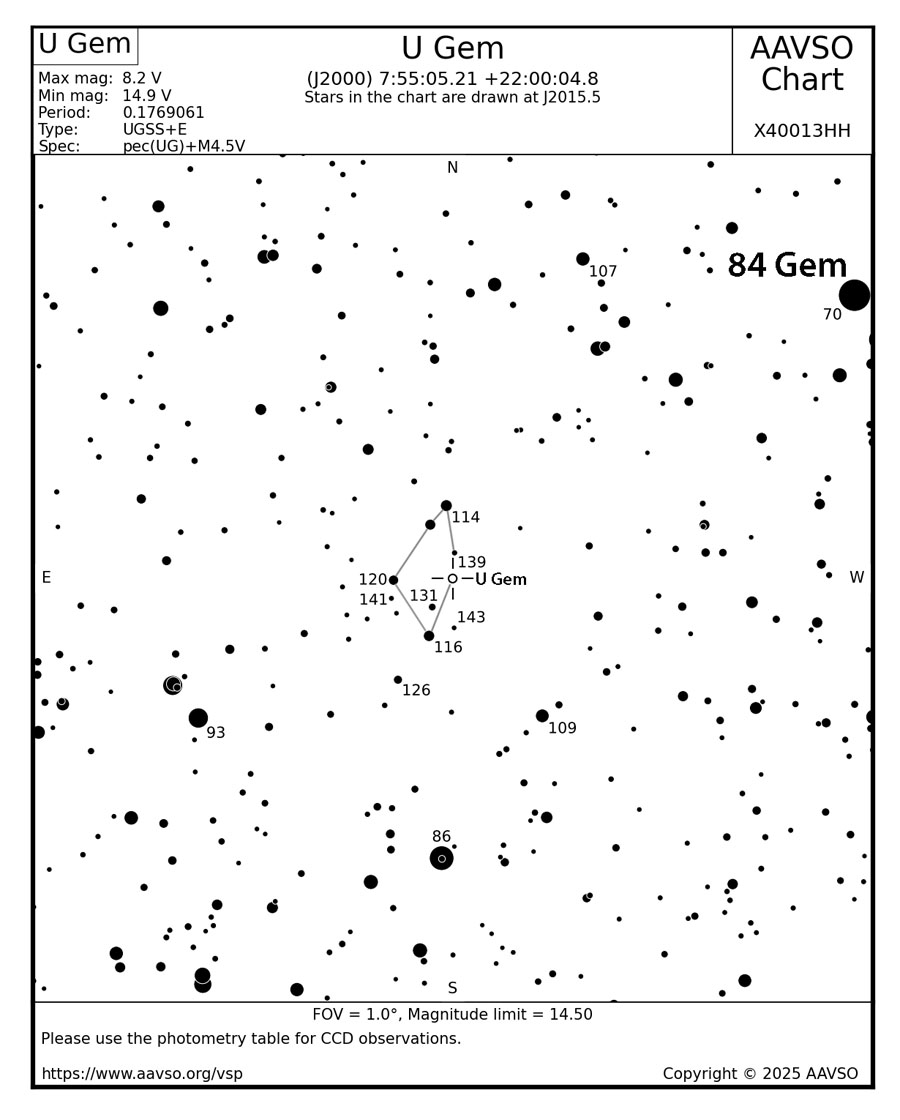
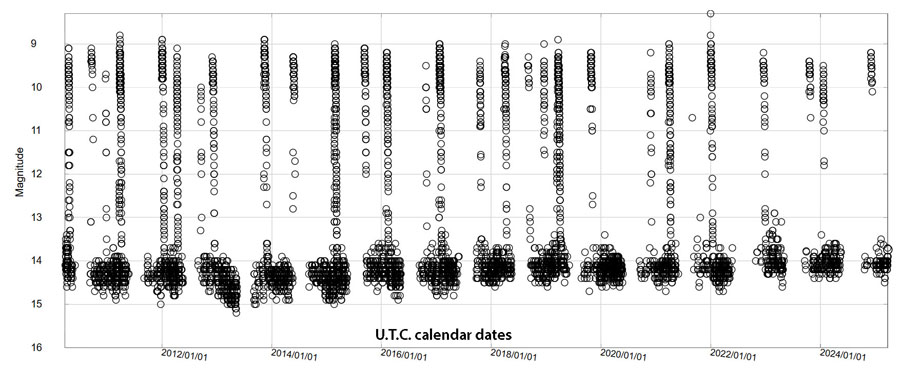
About every 105 days, U Gem brightens a hundredfold from magnitude 14.0 to around 9.0 over the course of a couple nights, followed by a return to its dim state a week or two later. You can follow its entire cycle with an 8-inch telescope from a dark, moonless sky or catch the dwarf nova during its rise and fall in a 3-inch. The star links into an easily recognizable harp-shaped asterism of field stars, which I've outlined on the accompanying AAVSO finder chart.
Stellarium with additions by Bob King
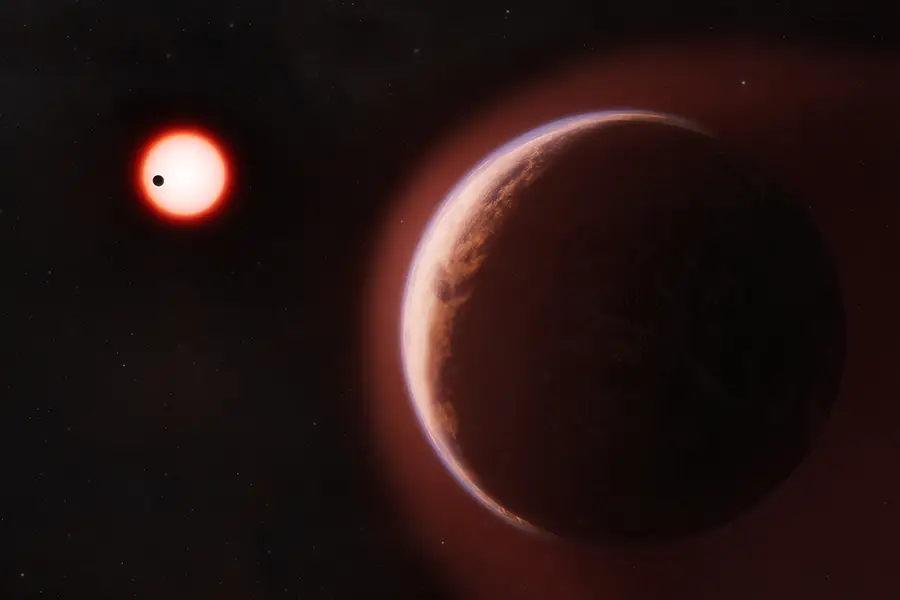
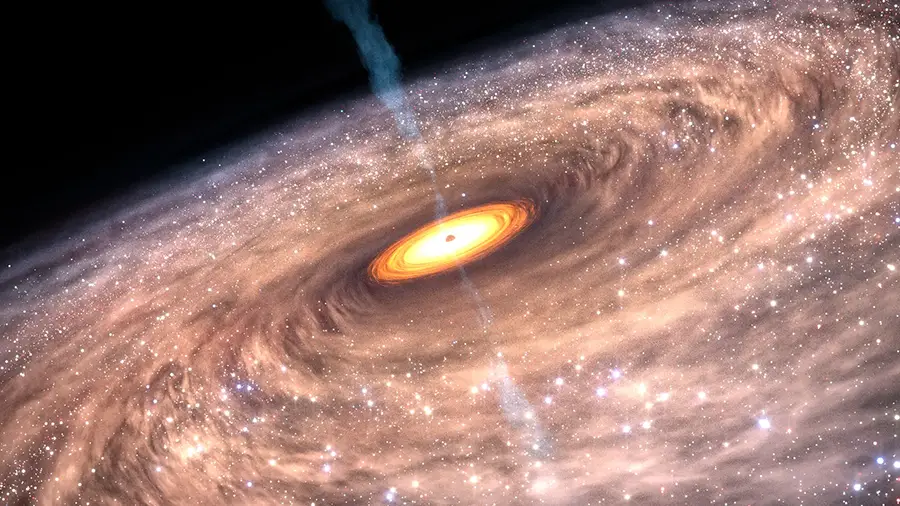
T CrB and U Gem have much in common. Both are binary stars, with a hot, dense white dwarf and cooler companion in orbit about the pair's center of gravity. Also like T CrB, the white dwarf siphons hydrogen gas from its companion into a spinning accretion disk. In the former, the disk material get funneled down to the dwarf's surface, where it gradually accumulates until the heat and pressure become so extreme that the gas ignites in a runaway thermonuclear explosion. During a nova outburst, the white dwarf can brighten up to 100,000 times as the expanding debris cloud balloons into space at over 1,000 kilometers a second.
Courtesy of the AAVSO
Courtesy of the AAVSO
Shoveling coal in the furnace
U Gem's flare-ups originate from both the disk and transfer of material to the white dwarf. Mass transfer from the red dwarf pads the disk until it reaches a critical density, becomes ionized, and radiates light. The increase in density also causes the material to move through the disk more efficiently and spiral down to the dwarf's surface, where it's heated and consumed in a thermonuclear explosion — the light from which can last for days or even weeks. With the excess material transferred and ingested, the companion star proceeds to "restock" the accretion disk, setting the stage for the next outburst.
I've had the pleasure of watching U Gem vault to brilliance a couple times a year for decades. I especially enjoy catching the star rising from its slumbers to maximum. If you become a regular watcher, the rapid and dramatic change in brightness from minimum to maximum will never fail to amaze.
When might we expect U Gem's next flare? The more recent outburst occurred ~115 days ago around Dec. 1, 2024 — some 10 days beyond the usual waiting period. While its period can vary from as little as 62 days to 257 days, the time is definitely getting ripe for another flare-up. Hopefully, we won't have to wait long.
About Bob King
I love the sky (day and night) and have been a skywatcher and amateur astronomer since childhood. I'm also a long-time member of the American Association of Variable Star Observers (AAVSO) and Astronomical League. I pen the Astro Bob blog and have written four books: Night Sky with the Naked Eye (2016); Wonders of the Night Sky You Must See Before You Die (2018) and Urban Legends from Space (2019) and Magnificent Aurora, published in 2024. The universe invites us on an adventure every single night. To accept the invitation, we only need look up.



Comments
Warren-Odom
March 28, 2025 at 7:53 pm
The link to the T CrB paper takes you to a page-not-found. By taking the link to the author's site, I found the correct link which is
https://iopscience.iop.org/article/10.3847/2515-5172/ad8bba
You must be logged in to post a comment.
Bob KingPost Author
March 30, 2025 at 11:47 am
Dear Warren,
Sorry about that! I checked the link on my end before publishing and it worked. I appreciate the link you provided and replaced the previous one with it.
You must be logged in to post a comment.
DesertStargazer
March 29, 2025 at 9:21 pm
The Schneider paper was published in Research Notes of the American Astronomical Society, which is *not* a peer-reviewed journal. In light of that, and considering the media attention that T CrB receives, I think it might have been prudent to ask T CrB experts what they think of his theory, as there are some significant shortcomings in it.
In a nutshell, Schneider's contention is that the intervals between T CrB's nova eruptions (seen in the years 1217, 1787, 1866, and 1946) are integer multiples of the binary orbital period. For example, he contends that the interval between the 1217 and 1787 novae was exactly 915.0 binary orbits. This unconventional hypothesis requires exact knowledge of the dates of the observed novae and of the varying orbital period of the binary in order to be tested meaningfully. However, as the paper notes, the exact date of the 1217 nova is unknown, and the historical records say only that it took place in the fall. That's an uncertainty of perhaps 3 months, but the paper proceeds on the assumption that it happened exactly on 4 Nov. 1217 without examining the consequences of the uncertain date. The uncertainty is a significant fraction of the orbital period, so if the nova had happened, say, at the start of October, the math would no longer work for Schneider's hypothesis.
There's also the separate issue that T CrB's orbital period (the other key ingredient in these calculations) is known to vary significantly and unpredictably on timescales of decades (Schaefer 2023, MNRAS, 524, 3146), which makes it even more difficult to credibly establish the precise number of binary orbits between the 1217 and 1787 novae. Given these issues, I'm afraid I don't have a lot of confidence in these newly predicted eruption dates.
You must be logged in to post a comment.
Bob KingPost Author
March 30, 2025 at 12:01 pm
Thank you very much for your erudite comment, DesertStargazer. I personally had little confidence in the prediction, one of the reasons I described it in a neutral manner without hype. I was only interested in sharing another scientist's attempt to predict its future behavior, however flawed that may or may not turn out to be. That said, I appreciate your critical review of the hypothesis.
You must be logged in to post a comment.
John
April 13, 2025 at 2:45 am
U Gem is in outburst tonight! Looks to be around 10th magnitude!
You must be logged in to post a comment.
Bob KingPost Author
April 13, 2025 at 2:52 pm
Hi John,
WOW! This is great news. Thank you so much for reporting it. I'd been watching and caught it at 13.5 a week or so ago, but it slid back to 14. Can't wait for the next clear sky to see it.
You must be logged in to post a comment.
John
April 14, 2025 at 6:38 am
Bob, Here's an attempt at sending you a link to my animated GIF from the other night. Sorry. It's on a blogger site with a horribly long URL. If it doesn't work, I also made an attempt to upload a GIF to the gallery. Don't know if the gallery will display it as animated. Anyway, tonight's cloudy for me, so I can't give an update on U Gem.
https://blogger.googleusercontent.com/img/b/R29vZ2xl/AVvXsEhDkLlywkua_wUj5FcXTWmhXD7pf-3dAWt7Cj1k5MylqyJdkPe2c7E1ODpezrA77gusqLZTQGNHQku7JRBK_JbScrCp24epzkb796vqVZiO3MeAYhlRKQZ9tt7u7i6EyBVK0vBQHkCSZ2t3c4B2hJ1uthczjH28INOiIEK-VhVsrcWY7iR-xK7Oj3xHZA8P/s1168/U_Gem_2025Apr12_with_AAVSO_chart.gif
You must be logged in to post a comment.
John
April 15, 2025 at 1:13 am
Update: Tonight, U Gem looks to be about the same brightness as the other night. If anything, it may have dimmed slightly. But I may have had a tighter focus tonight or better seeing conditions than the previous night. When I blinked tonight's images with the other night's, all of the star images were slightly smaller in tonight's images. In any case, it would appear to be still around 10th, or maybe 9.8 mag., so hopefully your weather will clear up soon and you'll get a chance to catch it while it's still in outburst. By the way, thanks for bringing U Gem to our attention. It was fun to be able to capture it in min/max modes, but I wouldn't have known about it without seeing your article. I'm not much of a variable star fan. My primary interest is supernova hunting, and I like to record asteroids within the field of view of my target galaxies while I'm searching for supernovae. But long-period variable stars can be unpredictable and it's tough to be vigilant enough. I can be patient. And I can even be diligent. But I'm not good at being vigilant.
You must be logged in to post a comment.
John
April 15, 2025 at 5:23 pm
Here's an updated image from last night, April 15.
https://blogger.googleusercontent.com/img/b/R29vZ2xl/AVvXsEjURObqhDfjNbAyI6xPW03gsnrbTK9rDT86Xsn2BZeSZba3G0vNwkO4IqC49UTRsXiJWKIYS0CN2o1TW4DQaUkpJ6glS0X79iCYDppWfusR4HOds5qpdfssQ6e90c48lPy5NV5qKR4C4OdDAH3IykY_pbUB2074tmuNQdlS2Zwiw63-P31Ra3xNvmz94-Ug/s681/U_Gem_2025Mar30_vs_2025Apr15.gif
You must be logged in to post a comment.
Bob KingPost Author
April 16, 2025 at 11:30 am
Hi John,
Well-done! This is the best U Gem animation I've seen. Thank you for sharing it.
You must be logged in to post a comment.
You must be logged in to post a comment.