 SUNSET:

 1
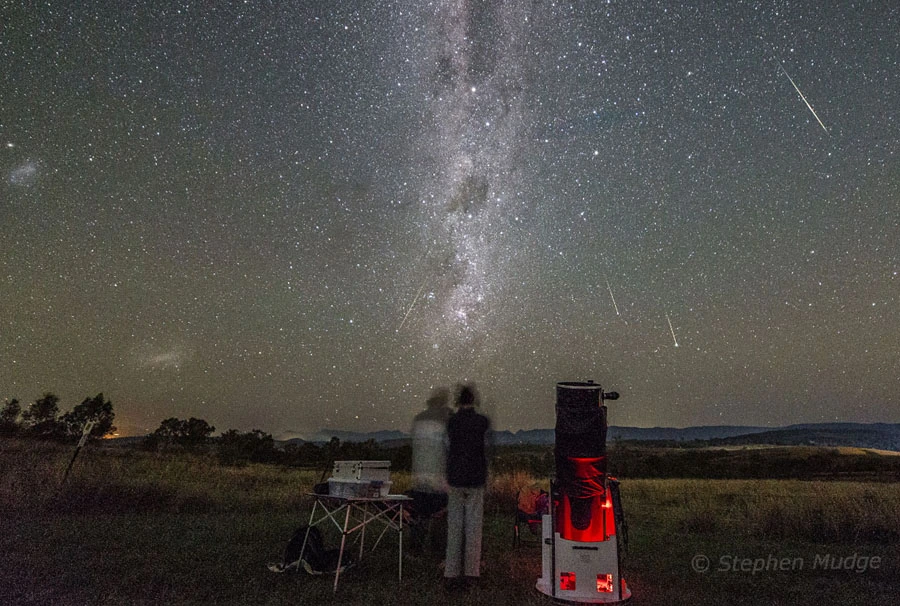
1Meteor-watchers will be busy this month and next. Not only are the Southern Delta Aquariids peaking soon, but they get a boost from additional minor showers.
Stephen Mudge
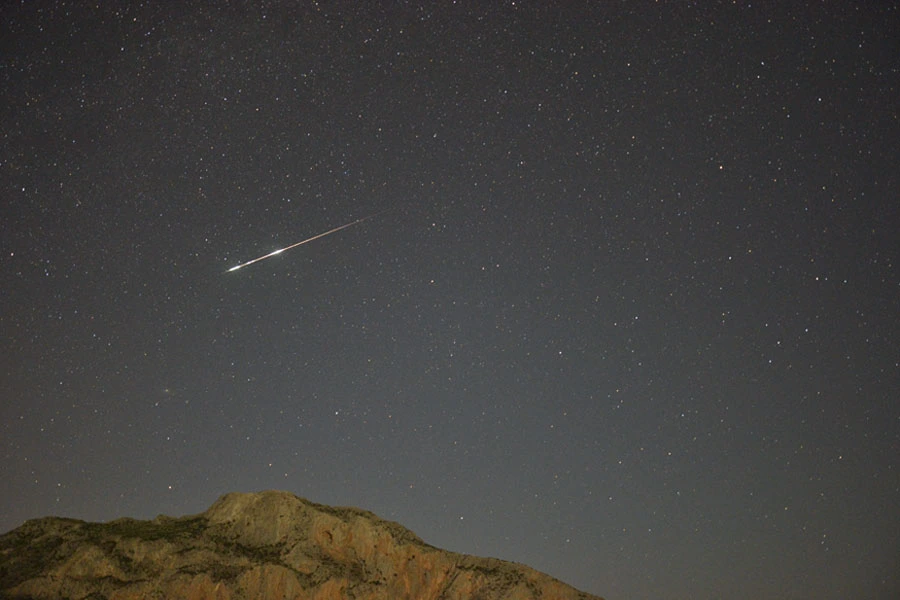
You may have heard that the bright waning gibbous Moon will put a damper on next month's Perseids. While true, there will still be enough meteors to go around. But if you're looking for a Moon-free meteor show, why not spend an hour with the Southern Delta Aquariids? The annual shower will peak after moonset from midnight to dawn local time Wednesday morning, July 30th. Viewed from a dark sky, up to 25 meteors per hour will shoot hither and yon from southern Aquarius.
Stellarium with annotations by Bob King
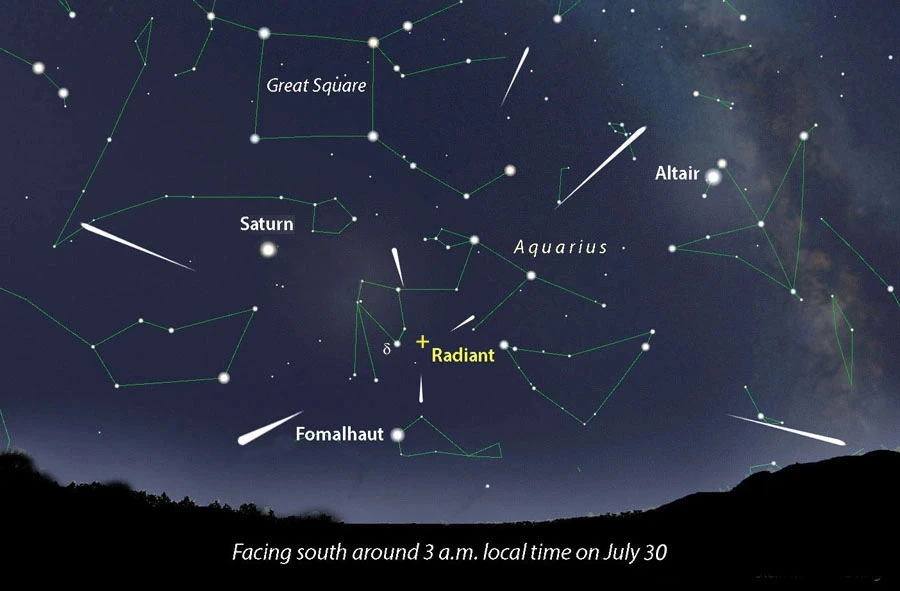
Because the radiant sits relatively low in the sky as seen from the northern U.S., the shower is best viewed from the southern states and the tropics. But why sacrifice an opportunity? From 40° north latitude, the streaming point stands a third of the way up the southern sky when it culminates around 3 a.m. local time. If we deduct 50% from the hourly rate to account for meteors cut off by the horizon due to its low-slung radiant, that's still a dozen streaks of delight per hour!
Kai Frode Gaarder
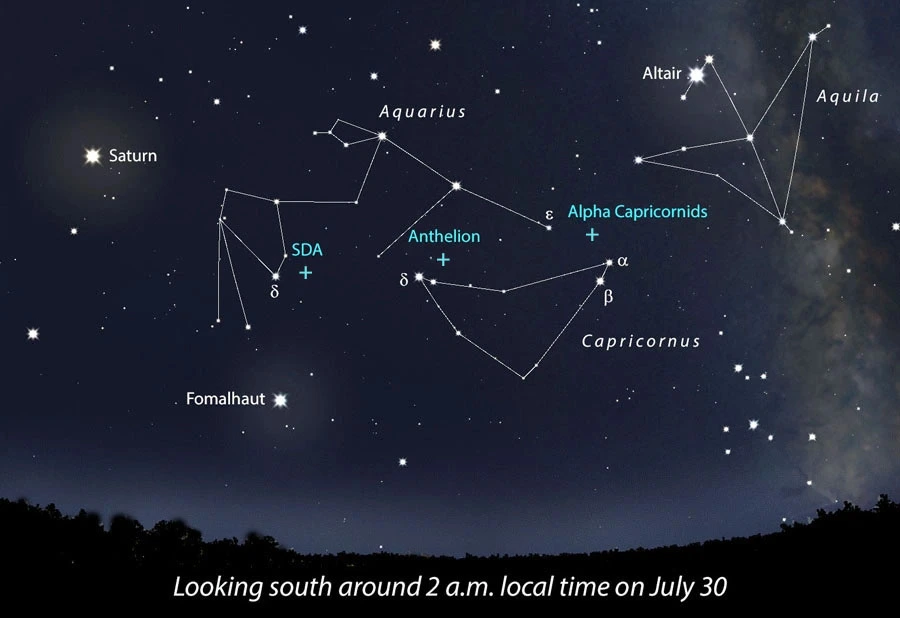
It's possible you've already seen a few Deltas. The shower's been active since July 3rd and will stick around through August 15th. Nor is it the only one that contributes to a general uptick in meteor numbers this time of year. The Alpha (α) Capricornids overlap the SDAs and reach maximum on July 31st. Although they dribble a scant 5 meteors per hour, slow-moving fireballs are common and stand in stark contrast to the fainter, faster and more numerous SDAs. The radiant lies in northwestern Capricornus about 32° west-northwest of the Aquariids' streaming point.
Many raindrops make a flood
Roughly midway between the Alpha Capricornid and SDA radiants lies a third active stream called the anthelion source. As the name implies, these meteors stream from a point in the sky directly opposite the Sun (anti-helios). None are tied to a known body, but they contribute an additional 4 to 5 random meteors called sporadics to our nightly tallies. Anthelion meteors originate from debris shed by comets under the gravitational influence of Jupiter, called Jupiter-family comets, and possibly also from Earth-crossing asteroids.
Stellarium
Anthelion meteors are present year-round and stream from a radiant that extends about "30° in right ascension and at least 20° in declination," writes Robert Lunsford, secretary-general of the International Meteor Organization. The broad stream follows the ecliptic, reaching a high point of +23 ° declination in late November and early December, and bottoming out at –23° in May and June. Similar to a planet at opposition, the anthelion source rises toward the end of evening twilight, crosses the meridian soon after midnight, and sets in the west around sunrise.
Although the Perseids peak the night of August 12–13, like the SDAs and Alpha Caps, they're around from mid-July to late August. Let's add them to the mix, too. We may even get a visit from the Kappa Cygnids, a minor shower also active in mid- to late summer. With five showers afoot at month's end, it will undoubtably prove a fun challenge to sort one meteor from the other! No equipment is needed unless you choose to record your observations or take photos with a tripod-mounted camera. Otherwise, find a dark place to watch from and grab a lounge chair.
Face the chair to the east or west and ease back for an hour or two. If you can't escape light pollution, find a spot on your property or apartment grounds shaded by trees or buildings. A lot of us have to deal with neighbors who leave their outdoor lights on. If you're on friendly terms, explain what you're doing and ask them to shut them off for a night. You could even go the extra mile and invite them to join you. While they're likely to turn you down because of the hour, the gesture will be appreciated. Wherever you end up, dress warmly and bring a blanket to ward off the late-night chill. The best viewing hours are when the radiant (or radiants) are highest, from about 1 to 4 a.m. local time.
Meteor showers occur when the orbiting Earth intersects a ribbon of debris shed by a passing comet or asteroid. In the case of the Southern Delta Aquariids (depicted by Ian Webster in the interactive visualization above), the parent comet is thought to be 96P/Machholz. The shower may also be linked to the asteroid 2003 EH1 as well as the Kracht and Marsden sungrazing comet families. The whole lot is often grouped together and referred to as the 96P/Machholz Complex.
How the cookie crumbles
In a 2024 study that examined how SDA meteoroids crumble as they enter the atmosphere, a team of Canadian and American astronomers determined that the particles resembled carbonaceous chondrite meteorites. Upon contact with the atmosphere, they underwent a two-stage erosion process: First, the lighter, more porous material was ablated (vaporized), followed by fragments of higher density.
It's unclear how long the Southern Delta Aquariids have been around. They were first recorded by Lt. Col. George L. Tupman in 1870 during his time spent cruising the Mediterranean Sea. Tupman had a keen eye for meteors and their streaming points, for he also discovered the Eta Aquariid shower, the spawn of Halley's Comet.
Every meteor shower is a puzzle with a million pieces. Astronomers assemble their stories fragment by fragment, flash by flash.
About Bob King
I love the sky (day and night) and have been a skywatcher and amateur astronomer since childhood. I'm also a long-time member of the American Association of Variable Star Observers (AAVSO) and Astronomical League. I pen the Astro Bob blog and have written four books: Night Sky with the Naked Eye (2016); Wonders of the Night Sky You Must See Before You Die (2018) and Urban Legends from Space (2019) and Magnificent Aurora, published in 2024. The universe invites us on an adventure every single night. To accept the invitation, we only need look up.



Comments
Glenn
July 26, 2025 at 6:29 am
In 2014 I was at Crater Lake Oregon. Observing at 2 am looking south with an SDA every minute or so. Mostly faint mag 3 to 4. But every few minutes a bright silvery mag 1 PER would streak over my shoulder from the NE. A memorable morning.
You must be logged in to post a comment.
You must be logged in to post a comment.